<?xml version="1.0" encoding="utf-8"?><feed xmlns="http://www.w3.org/2005/Atom" ><generator uri="https://jekyllrb.com/" version="3.10.0">Jekyll</generator><link href="https://nadia.xyz/feed.xml" rel="self" type="application/atom+xml" /><link href="https://nadia.xyz/" rel="alternate" type="text/html" /><updated>2026-02-24T22:43:47+00:00</updated><id>https://nadia.xyz/feed.xml</id><title type="html">Nadia Asparouhova</title><subtitle>Personal writing, links, and other things by Nadia Asparouhova.</subtitle><author><name>Nadia Asparouhova</name></author><entry><title type="html">Does meditation experience improve success with the jhanas?</title><link href="https://nadia.xyz/meditation-experience" rel="alternate" type="text/html" title="Does meditation experience improve success with the jhanas?" /><published>2024-06-27T00:00:00+00:00</published><updated>2024-06-27T00:00:00+00:00</updated><id>https://nadia.xyz/meditation-experience</id><content type="html" xml:base="https://nadia.xyz/meditation-experience"><![CDATA[<p>Jhanas – a series of altered mental states that are accessed via concentration – are often described as an “advanced meditation practice,” a phrase that suggests that one must be a skilled meditator to access them: just as only a skilled outdoorsman would embark upon an expedition to the Arctic Circle. It implies that meditation exists on a spectrum of difficulty, with perhaps mindfulness apps like Calm and Headspace on one end, and jhanas on the other.</p>

<p>Anecdotally, however, many modern teachers notice that even experienced meditators can struggle with the jhanas, while inexperienced meditators find success. A light, playful approach seems important: it’s often said that the most effective way to access the jhanas is to not try too hard at all. While a novice backpacker should not attempt to trek to the Arctic Circle, some novice meditators appear to be quite capable of accessing the jhanas. I recently experienced this myself as a novice meditator, where <a href="ttps://nadia.xyz/jhanas">the jhanas came more quickly </a>than I had been led to believe was possible.</p>

<p><em>Is there any relationship between meditation experience and jhana success?</em> I decided to team up with <a href="https://jhourney.io/">Jhourney</a> – the company that taught me the jhanas – to answer this question. (Please note that views here are my own, and any mistakes in this piece are mine alone.)</p>

<h1 id="methodology">Methodology</h1>
<p>We looked at an anonymized sample of 81 unique participants who attended a Jhourney retreat between September 2023 and April 2024, all of whom were new to the jhanas.</p>

<p>Figuring out how to measure “meditation experience” was its own challenge. If we were examining differences between experienced and beginner swimmers, for example, we could approximate experience based on their lap times and effort expended. But meditation, for the most part, is a hard-to-verify skill.</p>

<p>Because no one metric seems to give us a complete picture of meditation experience, we decided to look at these three variables, all of which were self-reported:</p>

<ul>
  <li><em>Estimated lifetime hours meditated:</em> This is a commonly used, but not especially reliable estimate, as many people can’t precisely recall this number.</li>
  <li><em>How often (hours/week) they meditated in the 6 months leading up to the retreat:</em> This is more helpful, but still doesn’t tell the whole story, as meditation hours can vary widely in quality, especially on- versus off-retreat. (Meditating for one hour per week for a year, for example, is different from meditating 50 hours in one week at a retreat.)</li>
  <li><em>Whether they had attended a meditation retreat before:</em> Though not granular enough on its own, this could be a valuable data point to capture, as people who are familiar with practicing in a dedicated, structured format might progress through the jhanas more quickly.</li>
</ul>

<p>Then we chose a few key milestones to capture how participants progressed through the jhanas during the retreat:</p>

<ul>
  <li><em>Whether they experienced a jhana.</em> Because jhanas are a highly subjective experience, we only looked at people where their descriptions matched key markers that are commonly seen across jhana self-reports.</li>
  <li><em>How far they progressed through the jhanic states,</em> bucketed into two categories: jhanas 1-3 (which are more embodied and blissful), or jhana 4 and above (which are more mental and peaceful).</li>
  <li><em>Whether they have deterministic access to the jhanas;</em> that is: by the end of the retreat, were they able to access the jhanas at will?</li>
</ul>

<p>There are a few caveats to our sample. We looked at attendees across several different retreats, which employed a variety of formats, including online and in-person, as well as different teachers and programming. They also represented a mix of demographics. We were not able to control for these variables, and the margin of error is large (±8.09%, 95% CI), so we will be cautious about the conclusions we can draw from our analysis.</p>

<h1 id="the-difference-in-jhana-success-rates-between-beginner-and-experienced-meditators-is-small">The difference in jhana success rates between beginner and experienced meditators is small</h1>
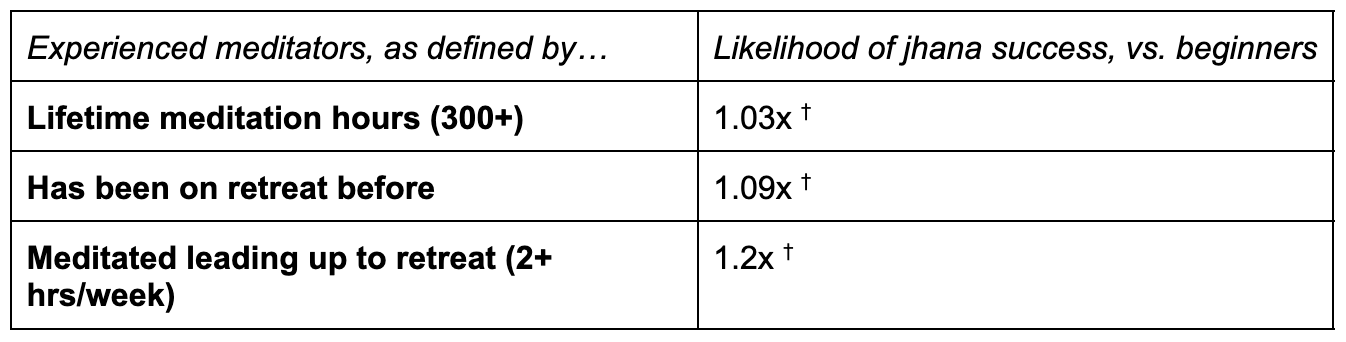
<p>We started by looking at absolute differences in jhana success rates between experienced and beginner meditators, using our three markers of meditation experience: [<sup id="fnref:1" role="doc-noteref"><a href="#fn:1" class="footnote" rel="footnote">1</a></sup>]</p>

<ul>
  <li>For lifetime meditation hours, <em>experienced</em> = at or above the median in our sample (300 hours); <em>beginner</em> = below the median</li>
  <li>For “has been on retreat before,” <em>experienced</em> = yes; <em>beginner</em> = no</li>
  <li>For hours meditated per week, <em>experienced</em> = at or above the median in our sample (2 hours/week); <em>beginner</em> = below the median</li>
</ul>

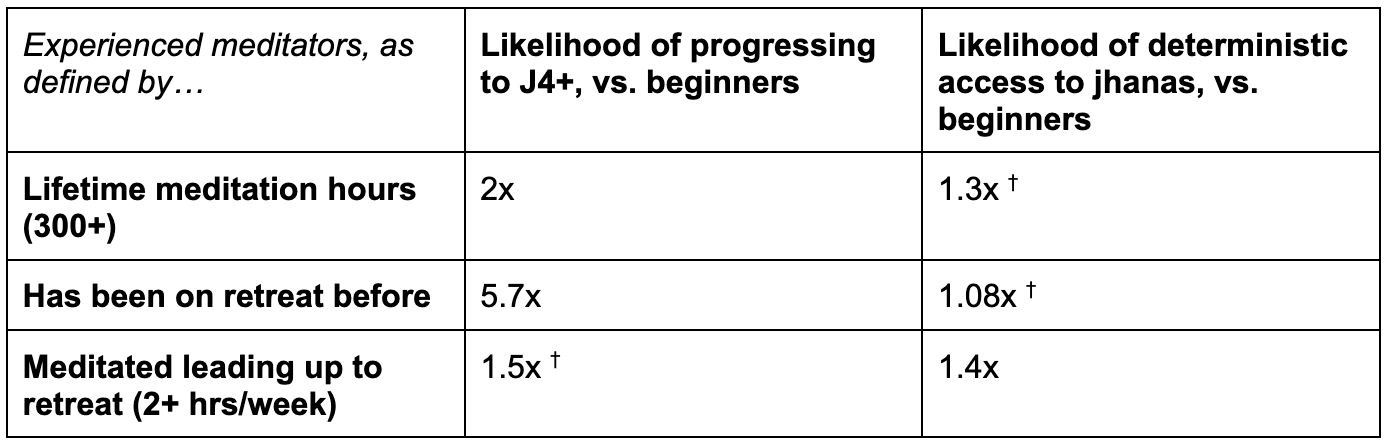
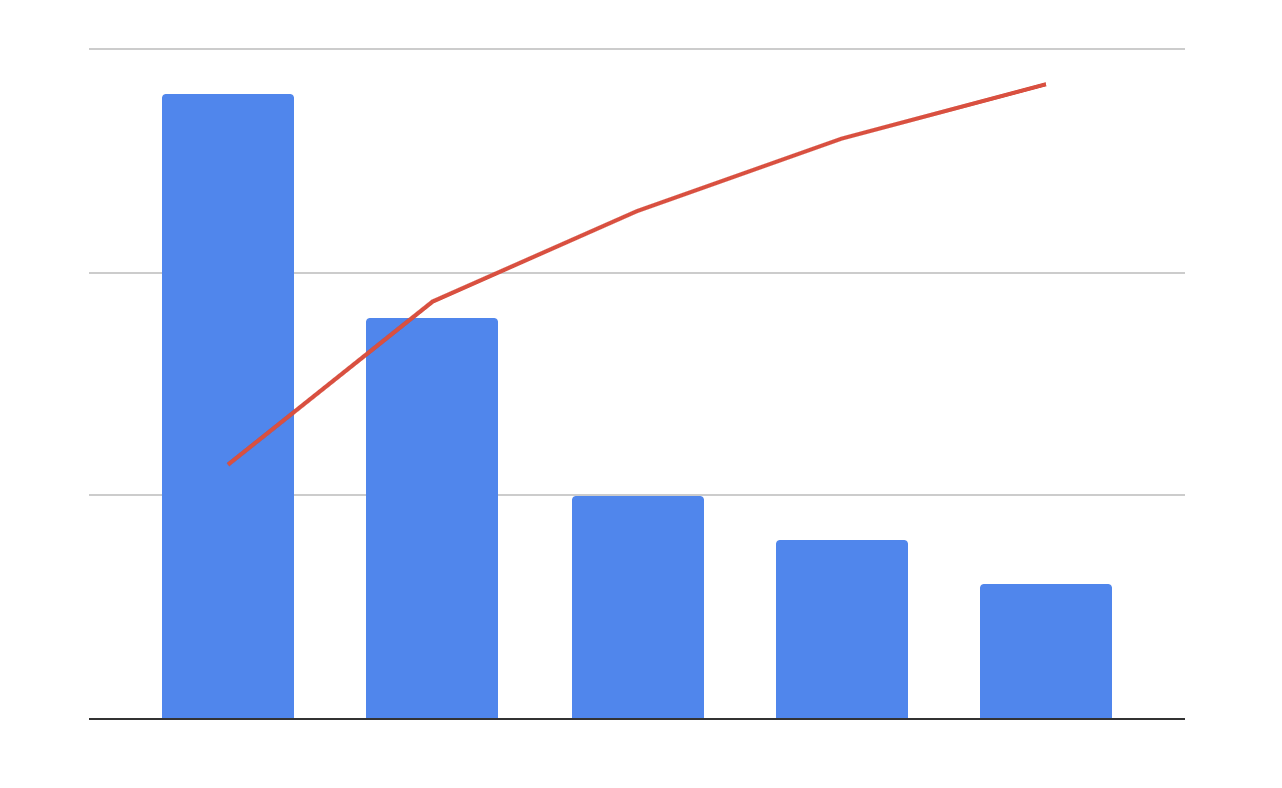
<p>Across all three dimensions of meditation experience, <strong>we see virtually no difference in success rates between experienced vs. beginner meditators.</strong> While the group that meditated 2+ hours/week was slightly more likely to experience a jhana, it’s worth noting that <em>all observed differences between groups were within our margin of error.</em></p>

<h3 id="jhana-success-rates-among-experienced-meditators-compared-to-beginners">Jhana success rates among experienced meditators, compared to beginners</h3>

<p><img src="../assets/img/meditation-experience/jhana-success-rates.png" alt="" />
<em>† = within margin of error</em></p>

<h1 id="experienced-meditators-are-more-likely-to-progress-further-with-the-jhanas-when-they-succeed">Experienced meditators are more likely to progress further with the jhanas when they succeed…</h1>
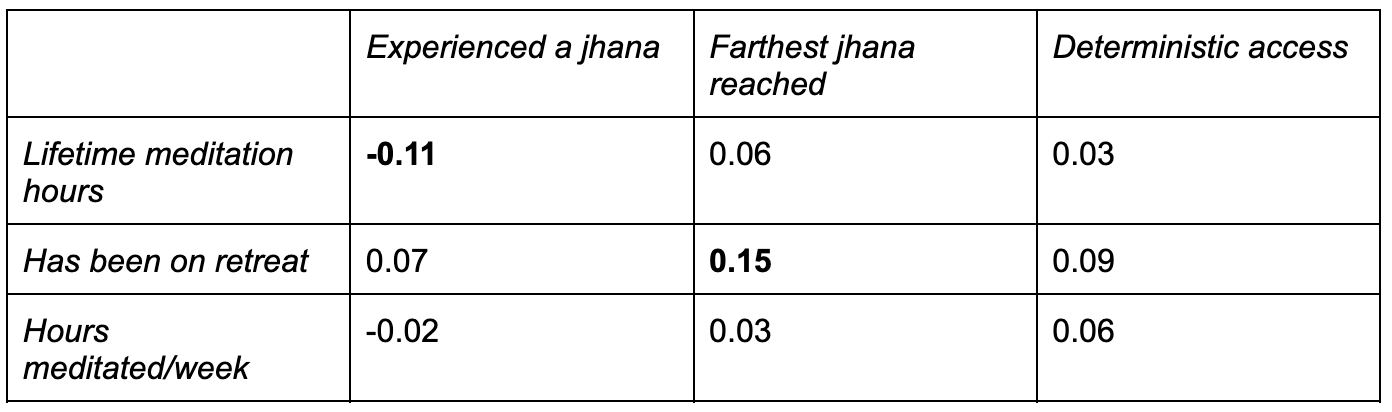
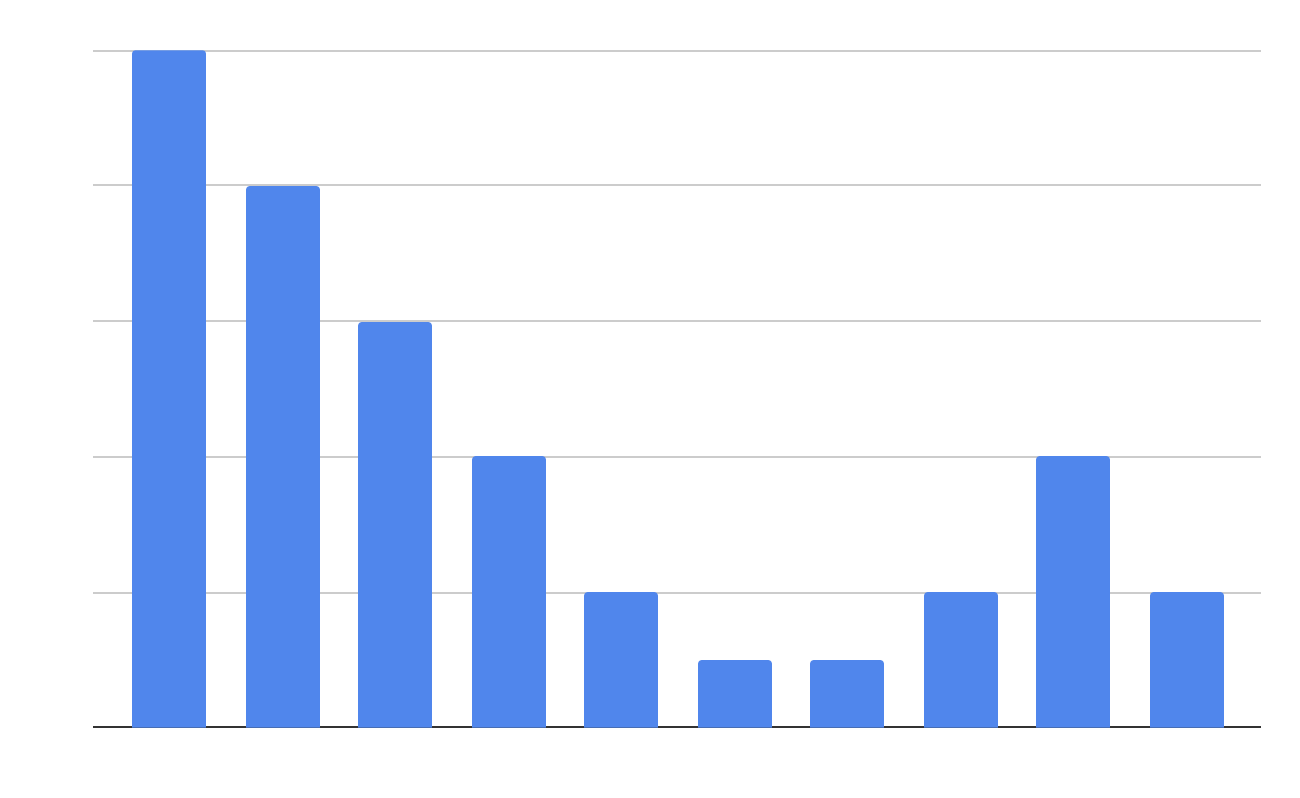
<p>Separately, we looked at skill differences between experienced and beginner meditators who accessed the jhanas: <em>how far they progressed,</em> and <em>whether they could access the jhanas deterministically</em> by the end of the retreat. Here, the differences between groups are more pronounced.</p>

<h3 id="likelihood-of-jhana-skill-progression-in-experienced-meditators-compared-to-beginners">Likelihood of jhana skill progression in experienced meditators, compared to beginners</h3>

<p><img src="../assets/img/meditation-experience/jhana-skill-progress.png" alt="" />
<em>† = within margin of error</em></p>

<p>Experienced meditators in our sample were more likely to have progressed to higher jhanic states, with the biggest difference seen among those who had attended a retreat before. They were also somewhat more likely to have gained deterministic access to the jhanas – although in this case, we saw the smallest differences between those who had attended a retreat before, versus those who had not.</p>

<p>It’s tempting to conclude, based on the above, that beginner meditators are just as likely to access the jhanas, but experienced meditators are more likely to progress further in their jhana skills. But the story isn’t quite that simple!</p>

<h1 id="but-these-differences-are-not-attributable-to-meditation-experience">…but these differences are not attributable to meditation experience</h1>
<p>Having identified some differences between groups, we took a closer look at the data to determine whether we could establish a correlation between meditation experience and jhana skill.</p>

<p>Here is where we found a surprise: in our sample, <strong>we saw no significant correlations between meditation experience – no matter how it’s measured – and any jhana skill.</strong> How is this possible, given the group differences we just observed?</p>

<p>While beginners and experienced meditators do show differences on <em>average,</em> there’s a wide range of outcomes <em>within</em> each group. This matches the meditation teachers’ anecdotal reports, where some people – beginner or experienced – find it easy to access the jhanas, while others struggle. The variability within each group cancels out any clear pattern in the data.</p>

<h3 id="correlation-coefficients-prior-meditation-experiences-vs-jhana-milestones">Correlation coefficients: prior meditation experiences vs. jhana milestones</h3>

<p><img src="../assets/img/meditation-experience/jhana-correlation.png" alt="" /></p>

<p>Our findings suggest that observed differences between groups aren’t explained by meditation experience, but by other factors that haven’t yet been identified. This presents an exciting opportunity for further research!</p>

<h1 id="if-not-meditation-experience-what-predicts-jhana-success">If not meditation experience, what predicts jhana success?</h1>

<p>To summarize – in our sample:</p>

<ul>
  <li><strong>We found no significant difference in jhana success rates between experienced and beginner meditators.</strong> If this is the case, we ought to exercise caution in describing jhanas as an “advanced meditation practice,” because it could deter those who might otherwise succeed – and personally benefit – from the jhanas. “Advanced” might refer more to the consciousness-altering effects of the jhanas than the experience required to access them.</li>
  <li><strong>We found no correlation between meditation experience and any jhana skill.</strong> This suggests that we either need to find more accurate ways of measuring meditation experience, or consider whether meditation experience is a (poor) proxy for some other skill that’s critical for getting into jhanas, such as an ability to sustain attention, or what’s sometimes called mental <a href="https://en.wikipedia.org/wiki/Absorption_(psychology)">absorption</a>. [<sup id="fnref:2" role="doc-noteref"><a href="#fn:2" class="footnote" rel="footnote">2</a></sup>]</li>
</ul>

<p>Here are a few theories we can think of as to why meditation experience doesn’t seem to impact one’s experience with the jhanas:</p>

<ul>
  <li><strong>We don’t have great ways of measuring (or defining!) meditation experience.</strong> What does it mean to be an “experienced” meditator, in the way that someone is an “experienced” swimmer? Number of hours meditated tells us how long someone has been practicing, but not how adept they are at cultivating and sustaining a quiet mind.</li>
  <li><strong>Experienced meditators may have more confidence that they know what meditation is,</strong> so while they have assets (ex. experience sitting for long hours on retreat, or familiarity with deep levels of mental absorption), they are also at times mistaken about which skills to use and when. This misplaced confidence could lead to mixed results.</li>
  <li><strong>Other types of meditation do not develop the skills needed to get into jhana.</strong> It’s possible that many popular forms of meditation (such as mindfulness, “dry insight” Vipassana, or nondual exercises) teach skills that are mechanistically different from what’s needed to get into the jhanas.</li>
</ul>

<p>If not meditation experience, what <em>does</em> predict jhana success? As I’ve talked to more people about their experiences, my current hypothesis is that there are two main skills involved:</p>

<ul>
  <li><em>Ability to invoke a positive feeling in the body</em> (the initial “spark” of joy)</li>
  <li><em>Ability to sustain attention</em> (letting the spark grow into a flame)</li>
</ul>

<p>It seems that many of the common challenges I’ve heard about can be diagnosed as one of these two issues. For example, some people seem to fear (or “brace”) against pleasure; think they don’t deserve it; can’t come up with a source of pure, uncomplicated joy; or struggle to tap into any strong emotion at all: <em>these are issues with invoking a positive feeling.</em> It also explains why people sometimes report that therapy or prior psychedelic use seems to help with jhana practice.</p>

<p>Other practitioners struggle with anxiety; lack confidence in their abilities; get distracted or bored with practice; or strive and grasp too much. Though it may not seem obvious at first, <em>these are issues with attention.</em> It’s an inability to focus on the task at hand without one’s inner narrative getting in the way. The relationship between attention and emotion has been well-noted in <a href="https://psycnet.apa.org/record/1995-97095-000">clinical psychology</a>, and there’s <a href="https://www.ncbi.nlm.nih.gov/pmc/articles/PMC2970710/">evidence to suggest</a> that training one’s attention can improve emotional regulation.</p>

<p>Meditation is one method to develop better control over one’s attention, but certainly not the only one, which might be why we see mixed results among meditators – because we’re only measuring how long someone has meditated, rather than the underlying skill. Someone who practices violin for an hour a day is not necessarily proficient at the violin.</p>

<p>We assess a violinist’s skill by how they play music, not by how often they practice. Similarly, if we can identify and measure the skills that meditation is supposed to cultivate, it could help us more clearly diagnose and address common challenges with accessing the jhanas.</p>

<h1 id="a-bitter-lesson-for-the-jhanas">A bitter lesson for the jhanas?</h1>
<p>In a <a href="http://www.incompleteideas.net/IncIdeas/BitterLesson.html">2019 essay</a>, computer scientist Rich Sutton identifies a “bitter lesson” for artificial intelligence research: in the last 70 years, major progress in AI was made not by <em>leveraging human knowledge</em> (better models for how our brains work), but by <em>leveraging computation</em> (i.e. Moore’s Law, which observes that computation power doubles roughly every two years). Sutton believes that some AI researchers are misguided in their focus on developing new, complex ways of modeling the human mind, because they don’t want to admit that crude, simplistic “brute force” is actually what worked.</p>

<p>I wonder if there is a bitter lesson to be found for the jhanas, as well. Maybe it’s less important to unpack why you are anxious, or why you can’t seem to let yourself feel joy, or why you think you’re not good enough. Instead of introspecting heavily – trying to model where these feelings came from, and how they impact one’s behavior – it could be more effective to simply “brute force” one’s way into, for example, sparking joy and cultivating attention. With success, all the other limiting beliefs might fall away – or, perhaps, resolve themselves – in the process. [<sup id="fnref:3" role="doc-noteref"><a href="#fn:3" class="footnote" rel="footnote">3</a></sup>]</p>

<p>As my <em>Asterisk</em> editor Jake Eaton wrote, while <a href="https://jakeeaton.substack.com/p/my-week-of-magical-thinking">reflecting on his experience</a> with the jhanas:</p>

<blockquote>
  <p>I’ve spent so much time — through therapy and self-enquiry and whatever form of analytical thought — looking for answers to questions that plague me, but when I look back at my own growth, it was never inspired by finding an answer or identifying some Freudian root. I just learned, through whatever grace, to drop the question.</p>
</blockquote>

<p>Additional research, such as practitioner interviews and self-assessments, could help us better understand and validate these hypotheses, as well as surface clues on how to reliably measure and improve the skills required to successfully access, and progress through, the jhanas.</p>

<p><em>Thanks to Stephen Zerfas, Alex Gruver, and Matt Lanter.</em></p>

<h3 id="notes">Notes</h3>
<div class="footnotes" role="doc-endnotes">
  <ol>
    <li id="fn:1" role="doc-endnote">
      <p>We use the term “beginner” meditator in this post only as a shorthand to differentiate this group from “experienced” meditators. Experience is all relative! <a href="#fnref:1" class="reversefootnote" role="doc-backlink">&#8617;</a></p>
    </li>
    <li id="fn:2" role="doc-endnote">
      <p>We also noticed that measuring meditation experience in different ways – lifetime hours, having attended a retreat, hours meditated per week – seemed to yield different conclusions. Strangely, however, <strong>we don’t see that one method of measurement clearly maps to consistent differences across every outcome.</strong> This could be due to the large margin of error with our sample; because different types of meditation activities influence certain outcomes more than others; or – as our findings suggest – because the causal mechanism isn’t meditation experience at all, but factors that are only partly represented by these variables. Given these inconsistencies, however, we suggest that researchers carefully consider how they measure prior meditation experience when studying the jhanas, as well as the conclusions they can draw. <a href="#fnref:2" class="reversefootnote" role="doc-backlink">&#8617;</a></p>
    </li>
    <li id="fn:3" role="doc-endnote">
      <p>I’m reminded of the observation that if you force yourself to smile, even if you don’t feel like it, eventually, the act of smiling will boost your mood anyway. <a href="#fnref:3" class="reversefootnote" role="doc-backlink">&#8617;</a></p>
    </li>
  </ol>
</div>]]></content><author><name>Nadia Asparouhova</name></author><summary type="html"><![CDATA[Jhanas – a series of altered mental states that are accessed via concentration – are often described as an “advanced meditation practice,” a phrase that suggests that one must be a skilled meditator to access them: just as only a skilled outdoorsman would embark upon an expedition to the Arctic Circle. It implies that meditation exists on a spectrum of difficulty, with perhaps mindfulness apps like Calm and Headspace on one end, and jhanas on the other.]]></summary></entry><entry><title type="html">How to do the jhanas</title><link href="https://nadia.xyz/jhanas" rel="alternate" type="text/html" title="How to do the jhanas" /><published>2024-06-13T00:00:00+00:00</published><updated>2024-06-13T00:00:00+00:00</updated><id>https://nadia.xyz/jhanas</id><content type="html" xml:base="https://nadia.xyz/jhanas"><![CDATA[<p>The jhanas are a series of eight (or nine) altered mental states, which progress from euphoria, to calm, to dissolution of reality – culminating in <em>cessation</em>, or loss of consciousness. They are induced via sustained concentration, without any external stimuli or substances. This is a practical guide on how to do them yourself.</p>

<p><em>Table of Contents</em></p>
<ul id="markdown-toc">
  <li><a href="#jhanas-are-learned-by-doing-not-reading" id="markdown-toc-jhanas-are-learned-by-doing-not-reading">Jhanas are learned by doing, not reading</a></li>
  <li><a href="#what-the-jhanas-feel-like" id="markdown-toc-what-the-jhanas-feel-like">What the jhanas feel like</a></li>
  <li><a href="#why-learn-the-jhanas" id="markdown-toc-why-learn-the-jhanas">Why learn the jhanas?</a></li>
  <li><a href="#hours-practiced" id="markdown-toc-hours-practiced">Hours practiced</a>    <ul>
      <li><a href="#retreat-i-march-2024" id="markdown-toc-retreat-i-march-2024">Retreat I (March 2024)</a></li>
      <li><a href="#retreat-ii-june-2024" id="markdown-toc-retreat-ii-june-2024">Retreat II (June 2024)</a></li>
      <li><a href="#practice-between-retreats" id="markdown-toc-practice-between-retreats">Practice between retreats</a></li>
    </ul>
  </li>
  <li><a href="#general-tips-for-practice" id="markdown-toc-general-tips-for-practice">General tips for practice</a>    <ul>
      <li><a href="#experiment-with-different-techniques" id="markdown-toc-experiment-with-different-techniques">Experiment with different techniques</a></li>
      <li><a href="#flow-state-relaxation" id="markdown-toc-flow-state-relaxation">Flow state » relaxation</a></li>
      <li><a href="#a-jhana-is-like-a-sneeze" id="markdown-toc-a-jhana-is-like-a-sneeze">A jhana is like a sneeze</a></li>
      <li><a href="#pace-yourself-and-listen-to-your-body" id="markdown-toc-pace-yourself-and-listen-to-your-body">Pace yourself and listen to your body</a></li>
    </ul>
  </li>
  <li><a href="#instructions-for-accessing-the-jhanas" id="markdown-toc-instructions-for-accessing-the-jhanas">Instructions for accessing the jhanas</a>    <ul>
      <li><a href="#how-i-entered-j1j4" id="markdown-toc-how-i-entered-j1j4">How I entered J1&lt;&gt;J4</a></li>
      <li><a href="#how-i-entered-j5j7" id="markdown-toc-how-i-entered-j5j7">How I entered J5&lt;&gt;J7</a></li>
      <li><a href="#how-i-entered-j7j9" id="markdown-toc-how-i-entered-j7j9">How I entered J7&lt;&gt;J9</a></li>
    </ul>
  </li>
  <li><a href="#whats-going-on-under-the-hood" id="markdown-toc-whats-going-on-under-the-hood">What’s going on under the hood?</a></li>
  <li><a href="#impact-of-the-jhanas" id="markdown-toc-impact-of-the-jhanas">Impact of the jhanas</a></li>
  <li><a href="#in-conclusion-try-it" id="markdown-toc-in-conclusion-try-it">In conclusion: try it!</a>    <ul>
      <li><a href="#notes" id="markdown-toc-notes">Notes</a></li>
    </ul>
  </li>
</ul>

<h1 id="jhanas-are-learned-by-doing-not-reading">Jhanas are learned by doing, not reading</h1>

<p>The word <em>jhana</em> comes from Buddhist scriptures, where they were first described. However, as many meditators like to point out, jhanas predate Buddhism. The Buddha experienced jhanas spontaneously as a child, and likely is not the first or only person to have experienced them.</p>

<p>I am not a Buddhist, nor would I describe myself as a meditator. I’m just a curious person who wanted to try a new thing, and was gobsmacked by what I experienced. Prior to attempting the jhanas, I’d guess that I had maybe 30 hours of lifetime meditation experience, scattered over a decade or more: in other words, not much. But with just over 20 hours of practice, I progressed through all nine jhanic states.</p>

<p>I would still say that I do not like “meditation” for its own sake, though I enjoy meditative activities (such as exercise, a deep 1:1 conversation, writing, or other creative work). But I don’t think jhanas are a form of meditation. Rather, they are a rare technology <em>whose instructions are encoded in our bodies.</em> Jhanas are an algorithm in the oldest sense of the word: a set of instructions that, if executed correctly, solve for a problem that you may not have even realized you’ve been trying to unravel. They are an Easter egg hiding in the game of life. [<sup id="fnref:1" role="doc-noteref"><a href="#fn:1" class="footnote" rel="footnote">1</a></sup>]</p>

<p>If jhanas are a technology that exists <em>a priori</em> to Buddhism, then I find it strange how they are discussed and taught by most practitioners today, which is pretty much <em>only</em> through a Buddhist lens. The actual, mechanical instructions are buried in what I’d say is akin to computer science: a lot of complex language and spiritual theory, which - it is often implied - are inseparable from practice.</p>

<p>I understand the purpose of the ornate cultural context that is chained – albeit beautifully – around the jhanas. Powerful technology <em>should</em> be embedded in a community of norms and protocols that help people make sense of them and integrate them safely into their lives. And jhana practitioners have done this part a bit too well. It is no wonder that jhanas have quietly passed through civilization for centuries, protected like a rare jewel inside a cave of wonders, with little attention from the outside world.</p>

<p>It’s just that, well. If you had recently figured out how to code, and realized it was really quite simple and teachable to others – then looked around, and all you saw were computer scientists warning off would-be developers from making software, claiming that they needed to understand all the underlying theory before attempting to write a line of code – wouldn’t that make you want to open up a text editor and type out your own version of things?</p>

<p><strong>This post is not intended as a reckless act.</strong> Rather, it reflects my personal belief that some types of knowledge are best acquired implicitly, not explicitly. You probably have little interest in reading about grief, or parenting, for example, unless you’re imminently facing these experiences.</p>

<p>To return to the software analogy: these days, most developers don’t learn how to write software by studying computer science first. They learn by tinkering around. They print “hello world.” Maybe they have a problem they want to solve for, so they make a simple app. As they become more experienced and run into more sophisticated problems, they might then revisit the theory to understand why things work the way they do.</p>

<p>This has been my experience with the jhanas. I read little about them beforehand, instead receiving minimal instruction and letting my intuition guide the experience. When I experienced things that were confusing or beyond what I could explain, I went back and read about the underlying philosophy to understand what was going on. (As a concrete example: I tried listening to <a href="https://www.youtube.com/playlist?list=PLO6hhaAzLmiqUzBYuLLJQ8FexOTRxz8xF">Rob Burbea’s talks</a> on the jhanas before I’d ever tried them myself, and found myself rather lost and bored. Later, however, I went back and consumed his talks voraciously; they had taken on new meaning. I now find them very valuable.)</p>

<p>So that’s what I’m going to attempt here. Instead of bogging you down with theory, I’ll share the basic instructions that helped me access the jhanas, going from first jhana to cessation in just over 20 cumulative hours. More than anything, <strong>I want to instill confidence in anyone reading this post that you can absolutely do this, regardless of how much you meditate.</strong> The most important advice I can give is to relax, have fun, maintain a playful and curious mindset, and <em>don’t overthink it.</em> Just follow the instructions as best you can.</p>

<p>But first, just a bit more information and background, so that you know what to aim for.</p>

<h1 id="what-the-jhanas-feel-like">What the jhanas feel like</h1>
<p>Jhanas are like swirling the paintbrush of your consciousness across a palette of altered sensations. These states vary in intensity; some are comparable to psychedelics, MDMA, or dissociatives.</p>

<p>Here’s how each state feels to me. I’ve kept my descriptions vague, because I think it’s more fun to discover them yourself. I’ve included their short descriptions in parentheses from <a href="https://www.dhammawiki.com/index.php/9_Jhanas">this wiki</a>.</p>

<ul>
  <li><strong>J1 (Pleasant Sensations):</strong> euphoric, bright, sunny, yellow</li>
  <li><strong>J2 (Joy):</strong> gratitude, beaming, radiating, hot pink</li>
  <li><strong>J3 (Contentment):</strong> content, reasoned, soft, wide, robin’s egg blue</li>
  <li><strong>J4 (Utter Peacefulness):</strong> dissociative, stillness, bathtub, cashmere, felt, muted lavender</li>
  <li><strong>J5 (Infinity of Space):</strong> disembodied, infinite, outer space, grayscale</li>
  <li><strong>J6 (Infinity of Consciousness):</strong> beauty, benevolence, grace, psychedelic, rose petal pink</li>
  <li><strong>J7 (No-thingness):</strong> —— (nothing in nothingness)</li>
  <li><strong>J8 (Neither Perception Nor Non-Perception):</strong> surreal, dissolution, black velvet studded with colorful ’80s rhinestones and gold that wink in and out of existence</li>
  <li><strong>J9 (Cessation):</strong> [cannot be described; no direct experience; consciousness is switched off]</li>
</ul>

<p>(Edit: I also adore this <a href="https://x.com/RogerThisdell/status/1882779644635513072">video visualization</a> of the jhanas from Roger Thisdell, which maps closely to my experiences.)</p>

<h1 id="why-learn-the-jhanas">Why learn the jhanas?</h1>
<p>Why bother trying the jhanas? Are they just a weird party trick?</p>

<p>I’ll talk about this more later, but in short: jhanas are a good way to cultivate your attention. When you can skillfully control, deepen, and direct your attention, you may discover that life is easier and more malleable than it seemed.</p>

<p>It may sound hyperbolic, but jhanas are the closest thing to magic that I’ve experienced in my adult life. J1-J4 are especially useful for altering your moods and states of reality. I especially find jhanas to be an important skill in a modern context, where everyone is perpetually distracted. Mastering proactive control over one’s attention is an increasingly rare superpower.</p>

<p>(Spoiler alert: this isn’t the whole story of the jhanas. In fact, practicing the jhanas isn’t really the point of the jhanas at all. But I’ll cover that towards the end of this post. Let’s try to get to “hello world,” first.)</p>

<h1 id="hours-practiced">Hours practiced</h1>
<p>I primarily learned the jhanas on two <a href="https://jhourney.io/">Jhourney</a> retreats in 2024. Jhourney is a company that takes a pragmatic, fun, and accessible approach to teaching the jhanas to beginners. They are markedly different from a typical meditation retreat, and I’m grateful they exist, because I don’t think I would’ve learned the jhanas otherwise.</p>

<h2 id="retreat-i-march-2024">Retreat I (March 2024)</h2>
<p>On the first retreat, I experienced jhanas 1 through 7 over the span of four days, at which point I left the retreat early to process what I’d learned. (You can read an account of my experience in <a href="https://asteriskmag.com/issues/06/manufacturing-bliss"><em>Asterisk</em> magazine</a>.)</p>

<p>Here’s an approximation of how many hours I practiced per day; cumulative hours practiced on a given retreat, (<em>t</em>); and when I experienced each jhana for the first time. Each session lasted from 30-60 minutes, and I never meditated <em>solo</em> (not counting group sits) more than three times per day. Aim for quality, not quantity.</p>

<p><strong><em>Note:</em></strong> (t) <em>includes walking meditation time + group sits (where the goal wasn’t always to practice the jhanas). Dedicated jhana practice time is probably ~80% of this number.</em></p>

<p><strong>Day 1: 3 hours total</strong></p>
<ul>
  <li>J1, possibly J2, <em>t</em> &lt;1 hour</li>
  <li>J2 for sure, <em>t</em> = 2.25 hrs</li>
</ul>

<p><strong>Day 2: 4.75 hours total</strong></p>
<ul>
  <li>J3, <em>t</em> = 4.5 hrs</li>
  <li>J4, <em>t</em> = 5.5 hrs</li>
</ul>

<p><strong>Day 3: 5 hours total</strong></p>
<ul>
  <li>J5, <em>t</em> = 10.75 hrs</li>
</ul>

<p><strong>Day 4: 2 hours total</strong></p>
<ul>
  <li>J6 and J7, <em>t</em> = 14.25 hrs</li>
</ul>

<p><strong>Total hours meditated on Retreat I:</strong> 14.75</p>

<h2 id="retreat-ii-june-2024">Retreat II (June 2024)</h2>
<p>On the second retreat, I additionally experienced jhanas 8 and 9 (meaning, cessation) over the span of two and a half days, at which point I left the retreat early to process what I’d learned.</p>

<p><strong>Day 1: 1.5 hours total</strong></p>
<ul>
  <li>Possibly J8 and J9, <em>t</em> &lt;1.25 hrs</li>
</ul>

<p><strong>Day 2: 3 hours total</strong></p>
<ul>
  <li>J8 and J9 for sure, <em>t</em> = 3 hrs</li>
</ul>

<p><strong>Day 3: 2.25 hours total</strong></p>

<p><strong>Total hours meditated on Retreat II:</strong> 6.75</p>

<h2 id="practice-between-retreats">Practice between retreats</h2>
<p>In the three months between retreats, I only did 2-3 dedicated practice sessions, and not very seriously (maybe 15-30 min apiece?). But I did “practice” the jhanas all the time, in the sense of being aware of my body and mind, how I was reacting to things, and guiding myself towards different mental states. I popped into J1 all the time throughout the day, almost reflexively, and I’d sometimes tap into J2-J4 when I wanted to deepen certain sensations. This felt more like wielding a skill, though, versus dedicated practice.</p>

<h1 id="general-tips-for-practice">General tips for practice</h1>
<p>To access the jhanas, you basically induce the “opposite of a panic attack,” as I’ve heard others describe it. Before getting into my specific method (see next section), here are a few general recommendations. Remember, again, that <strong>the number one most important thing is to relax, have fun, and don’t overthink it.</strong></p>

<h3 id="experiment-with-different-techniques">Experiment with different techniques</h3>
<p>It really does seem that everyone is different, so my method may not work for you. It’s your brain; go with what feels right. For example, to invoke a positive sensation, some people tap into feelings of gratitude, forgiveness, or altruism. I preferred a fairly mechanical, detached approach where I just thought of my brain as a machine, and which levers I needed to pull to induce various sensations.</p>

<h3 id="flow-state-relaxation">Flow state » relaxation</h3>
<p>For me, at least, the trick to jhanas was not “relaxation,” but something closer to “flow state.” Relaxing, to me, is like being at ease, where no new thoughts come to mind. Flow state, on the other hand, means I’m <em>highly</em> engaged with a task for a sustained period of time, and that one task is all that matters. IME this is at odds with how I’ve been told to practice mindfulness meditation. So if you’re struggling to “relax,” maybe try tapping into flow state instead.</p>

<h3 id="a-jhana-is-like-a-sneeze">A jhana is like a sneeze</h3>
<p>You’ll hear meditators talk about not “grasping” onto sensations or trying too hard with the jhanas. This can be frustrating: what does it mean to both try, and not try too hard? I think of it like sneezing. Sneezing requires some degree of intentionality, but it’s a physical reflex that only happens if you don’t think too hard about it. Like sneezing, jhanas are more like a release than a force of will.</p>

<h3 id="pace-yourself-and-listen-to-your-body">Pace yourself and listen to your body</h3>
<p>For me, the jhanas came hard and fast. I struggled at one point between wanting to slow down, versus feeling like I was “supposed” to practice more. And I didn’t trust what I was experiencing at first, which led me to push myself more than I ideally would’ve.</p>

<p>Jhanas are weird because they’re considered a form of meditation, so there are a lot of meditation-like protocols around them (put in lots of hours! no phones or devices! avoid talking to people!). But I think these recommendations are just meant to help you cultivate the attention required to <em>invoke</em> jhanic states: they don’t help you process the experience <em>itself.</em> If you’re going through a transformative experience, locking yourself in a room without friends, family, or outside support might not be such a good idea.</p>

<p>So, make sure you listen to your needs. If things get overwhelming, it’s okay to stop, process, and ground yourself. Spend time with your friends. Go outside. Hug your pets. Write about it. You can always come back when you’re ready.</p>

<p>The biggest milestones for me, which prompted seeking outside input to make sense of my experience, were: J5, J6 and J7 (experienced together), and J9 (cessation). At these points, I made sure to slooowww down and process what was going on. If you get to any point in your practice where you’re feeling WTF about it, I’d highly recommend <a href="https://www.youtube.com/playlist?list=PLO6hhaAzLmiqUzBYuLLJQ8FexOTRxz8xF">Rob Burbea’s talks</a>, which are thoughtful, philosophical lectures on each jhana.</p>

<h1 id="instructions-for-accessing-the-jhanas">Instructions for accessing the jhanas</h1>
<p>Here’s the method I used. If it doesn’t feel right to you, I suggest experimenting with different techniques. In particular, try switching what you use as your “object of joy,” and see if that helps.</p>

<p>(Note, of course, that you will likely progress through these stages over multiple sessions, spread out over days or weeks or months. Feel free to just read the first set of instructions, then continue only once you’ve mastered each stage. Pace yourself!)</p>

<h2 id="how-i-entered-j1j4">How I entered J1&lt;&gt;J4</h2>

<ul>
  <li>Relax your body deeply, clearing your mind of any distractions. (My personal hack: try falling asleep, but stop before you actually do.)</li>
  <li>Think about someone, something, or a memory that sparks a pure, uncomplicated feeling of joy. I thought about my child. Don’t focus on the thing itself, but on the joy that arises as a <em>result</em> of thinking about it.</li>
  <li>Allow that joy to grow, then loop upon itself, as you feel more and more joyful. If the joy begins to dissipate, “pulse” more joy by thinking about the person/thing/memory. Don’t think too much about what you’re doing. Your hands and chest might tingle; that’s a good sign. Eventually, the euphoria will hit. Now you’re in J1.</li>
  <li>To progress to J2, don’t do anything. Just stay in the moment and enjoy the sensation. If it doesn’t dissipate, it will begin to evolve on its own. Notice how it’s changing, until you find yourself in a qualitatively different state.</li>
  <li>Repeat the previous step to get to the next jhana. Stay with that state, be in the moment, don’t try to change or interact with it. It will evolve into the next state, and so on.</li>
  <li>As you get familiar with each state and what they feel like, you’ll be able to locate them in your body and move between states using muscle memory. So to get from J1 → J4, I just move the focus of my energy from my head (J1), to heart (J2), to stomach/groin (J3), to flowing out through my legs and all around me (I call this one, J4, “bathtub”). To move from J4 → J1, reverse the order.</li>
</ul>

<p>As I became more comfortable with the jhanas, I dropped the first relaxation step. Then I dropped my meditation object, or “trigger.” With a bit more practice, I found that I could pop into J1 instantly and progress through my “jhana flow” from there.</p>

<h2 id="how-i-entered-j5j7">How I entered J5&lt;&gt;J7</h2>

<p>J5-J7 work a little differently. Because they are dissociative, you no longer have your body for reference. The technique that worked for me was thinking about <em>expansion</em> (or “softening”) and <em>contraction</em>.</p>

<ul>
  <li><strong>J4 → J5:</strong> Expand and soften my awareness, as if the walls of the “bathtub” were falling away. Imagine you’re sitting in the pitch dark and trying to sense what’s around you, or you’re in a room and you sense someone behind you. You’re not focusing on anything specific, just trying to be more aware.</li>
  <li><strong>J5 → J6:</strong> You’re staring at an infinite space; now <em>become</em> the infinite space. For me, this feels like floating “forward,” as if my consciousness is merging with the space before me.</li>
  <li><strong>J6 → J7:</strong> I just stay in J6, keeping the sensations soft, until it fades into J7. Sometimes I can accelerate this process by reminding myself that the J6 experience is finite, and it has to end sometime. But I find that J6 tends to dissolve on its own.</li>
</ul>

<p>To get back down from J7 → J4, I contract my awareness. I remember that I have a consciousness (J6). I remember that there is space (J5). I remember that I have a body (J4). Then it collapses down, like closing a book.</p>

<p>As you get more comfortable with J5-J7, you can move between states deterministically by directing your “gaze” (I think this is actually my attention, but I think of it as my gaze):</p>
<ul>
  <li>To get from J4 -&gt; J5: I gaze sort of out and slightly down</li>
  <li>J6: I glide forward into the space</li>
  <li>J7: I sort of gaze inwards, into my center. This feels like a “flattening” of self, collapsing into a line or a horizon.</li>
</ul>

<h2 id="how-i-entered-j7j9">How I entered J7&lt;&gt;J9</h2>

<p>Jhanas are typically separated into two buckets of “light” (J1-J4) and “deep” (J5-J8), but in my view, J7-J8-J9 form their own special trio, because J8 is a tricky state to navigate.</p>

<p>J9 can’t be directly experienced, because you’re unconscious – just as how you can’t experience being under general anesthesia. And J8 is a fleeting, unstable state, because noticing you’re in it, beyond the <em>faintest</em> bit of awareness, will send you back to J7. But J7 is stable! So we can use that as our anchor. Think of it as your base camp before attempting to summit Everest.</p>

<p>The helpful advice I received was to focus on getting <em>very</em> comfortable with J7, deepening and maintaining that state, and then - when you’re ready - “shooting the gap,” or catapulting yourself across J8 to land in J9. I think of it like skipping rocks. A light touch will get you to the other side (J9), but if you’re too heavy-handed, you’ll sink into the pond (end up back in J7) and start over. (I’m sure there is a way to train yourself to linger in J8, and I’d be curious to cultivate this skill, but so far, this method works for me.)</p>

<p>The best way I can describe J7-J9 is to compare it to lucid dreaming, where you’re dreaming, but strangely alert. J7-J9 is like that, but for the act of falling asleep. First, the heaviness of your body sets in (J7). Then, nonsensical sounds and thoughts begin to arise, also known as <a href="https://en.wikipedia.org/wiki/Hypnagogia">hypnagogic hallucinations</a> (J8). And then you’re asleep (J9).</p>

<p>If you want to cultivate your J7-J9 skills, I’d suggest paying attention to what it feels like to fall asleep at night, noticing the progression from wake to sleep. The difference is you’ll be highly aware – not drowsy – while in the jhanas.</p>

<p>So, to get from J7 to J8: relax more deeply into J7, be patient, and notice where reality is breaking down. There are likely fleeting, nonsensical thoughts floating through your mind; try to ever-so gently notice them. Notice that they’re nonsensical. But don’t react to them.</p>

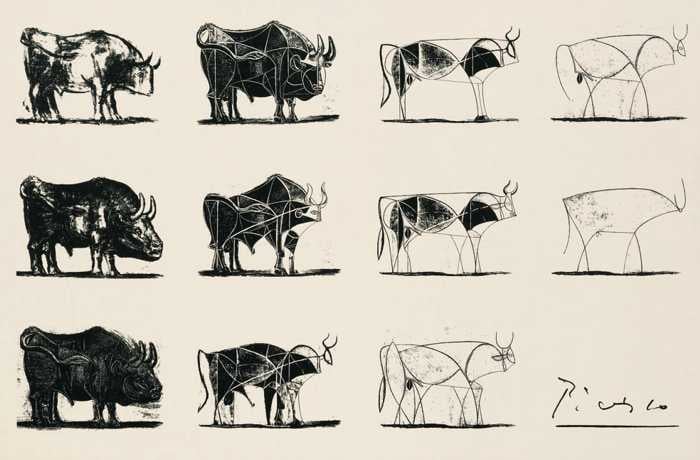
<p>It’s hard to describe how this works. In J8, you have to get comfortable with the fact that <em>they may be thoughts or non-thoughts, you might be noticing or not-noticing, things could be happening or not-happening</em>…and just let it be. The image that comes to mind for me is some cartoon I watched once (maybe Adventuretime, or Rick and Morty?), where the characters end up in a bizarro world where their lines and shapes and colors are drawn in strange ways, and the background is now white and empty, but they’re still talking to each other. Kinda like Picasso’s bulls:</p>

<p><img src="../assets/img/jhanas/picasso-bull.jpg" alt="" />
<em>[<a href="https://drawpaintacademy.com/the-bull/">Source</a>]</em></p>

<p>Everything is surreal and breaking apart, but you have to be cool with it. You might flit between J7&lt;&gt;J8 a few times before landing in J9.</p>

<p>J9 is equally bizarre, because you’ll only know you experienced it <em>after</em> you come back. You know how if you’re given general anesthesia, and the doctor tells you to count down from 10 to 1, and you’re counting, totally awake, feeling so confident that you’ll make it to 1…and next thing you know, you’ve woken up again, and the whole thing is over? That’s what J9 feels like. You’re alert, you’re alert, you’re alert…annnnd, you’re back. Hey, where were you? It feels like you winked out of existence for a bit. I found that I almost always regained consciousness in J7 – usually in a very deep and delicious state of absorption. You can also play with inducing multiple cessations within one session – going from J7-J8-J9-J7, and looping that a few times – before voluntarily ending the session.</p>

<h1 id="whats-going-on-under-the-hood">What’s going on under the hood?</h1>

<p>I said I wouldn’t spend too much time on theory, but if at this point you’re still wondering how it’s possible that we can <em>think</em> our way into psychedelic experiences and loss of consciousness, congratulations: I know about as much as you do. Jhanas are still understudied in academia, though interest is growing, and there are <a href="https://academic.oup.com/cercor/article-abstract/34/1/bhad408/7369445?login=false">a few</a> <a href="https://www.sciencedirect.com/science/article/abs/pii/S0079612322001984?via%3Dihub">papers</a> that use EEG and fMRI data to demonstrate that something is actually happening inside people’s brains when they are in jhana that’s comparable to other altered states, like psychedelics or being in a coma. [<sup id="fnref:2" role="doc-noteref"><a href="#fn:2" class="footnote" rel="footnote">2</a></sup>]</p>

<p>The explanation that follows has nothing to do with such literature. It’s just me theorizing, based on my own experience and what I’ve read from others so far, on what I <em>think</em> is happening. But I really have no clue! So, don’t read this as an authoritative take; just a peer-to-peer musing out loud as how I would explain these phenomena. (Please note that these aren’t solely my original thoughts, but a composite of things I’ve read and mashed together from all over the place. I’m not sure what I’ve learned where anymore, so proper attribution feels impossible, but I am not claiming these as my views and shouldn’t be credited as such.)</p>

<p>The key ingredient of the jhanas seems to be <em>attention.</em> If you’ve ever tried to make the best of a bad situation, you’re already familiar with this concept. How, and where, you direct your attention, can heighten and intensify an experience. If you get stuck in an anxiety loop, you can make the experience worse. Everything that happens, no matter how objectively “good” it is, will be re-coded as “bad.” But if you try to relax and look on the bright side, you’ll find that your experience actually improves: things that seem “bad” will be re-coded as “good.” To some degree, then, our perception of reality is influenced by where we direct our attention.</p>

<p>Now imagine that we’ve plotted all emotions along an x-y axis, where <em>x = valence (positive/negative) of emotion,</em> and <em>y = intensity of emotion</em>. Negative emotions (<em>x&lt;0</em>) might include things like anger, anxiety, and fear. Positive emotions (<em>x&gt;0</em>) are things like euphoria, gratitude, and pride. Attention is the <em>thrust</em>, or force, that you can exert to move your state along the y-axis (i.e. intensify any emotion), regardless of its x-position. [<sup id="fnref:3" role="doc-noteref"><a href="#fn:3" class="footnote" rel="footnote">3</a></sup>] This is why the metaphor of jhanas as “inducing the opposite of a panic attack” is so helpful. It’s the same y-value, just with a positive rather than negative x-value.</p>

<p>But how do we know the x-positions of our positive emotions? Why are J1-J4 organized the way they are?</p>

<p>It’s often said that the jhanas aren’t any different from the positive emotions that we feel in the “real world.” For example, if you start dating someone new, you might progress from the giddy honeymoon phase (J1); to being so joyful and grateful to know this person (J2); to feeling content with, and proud of, the relationship you’ve built (J3); to viewing the relationship as your anchor in the storm of life (J4).</p>

<p>I don’t know why positive emotions follow this progression (though I’m sure someone else does), but the point is that jhanas aren’t doing something weird and unusual here. They’re exactly how good feelings evolve in any other circumstance, just with the extra “amplifier” of attention (higher y-value). If our emotions are typically capable of lifting us into the sky and back down to Earth, highly concentrated attention enables us to shoot them into outer space (more thrust!). But if your attention is scattered, you won’t go very far. So, learning how to cultivate and sustain attention is critical to practicing the jhanas. [<sup id="fnref:4" role="doc-noteref"><a href="#fn:4" class="footnote" rel="footnote">4</a></sup>]</p>

<p>What about J5-J9, which aren’t associated with magnifying any specific emotion, but rather the deconstruction of reality itself? Well…you got me there. I’ve been told (though haven’t read about this myself, so I may be spouting ideas incorrectly here) that J5-J9 are all actually part of J4: so, once you’re anchored in this state of deep calm and equanimity, your brain starts dismantling your consciousness, piece by piece, until there is nothing left. Perhaps it’s akin to how, when you’re very relaxed and calm, it’s easy to fall asleep? But I’m especially baffled by J6, which is an intensely beautiful and psychedelic experience that’s oddly sandwiched between two very dissociative ones (J5 and J7). I wish I had answers here, but I’m still not sure how to explain J5-J9.</p>

<h1 id="impact-of-the-jhanas">Impact of the jhanas</h1>

<p>Now that I’ve taken you all the way through this post, I’ll give you the plot twist: jhanas are cool, but they’re not actually the point. The valuable part is the insight gained along the way.</p>

<p>Jhanas, breathwork, psychedelics, MDMA, etc are all tools for inducing altered states, from which new insights can arise. None of the actual methods matter, so much as putting your brain into what I think of as “developer mode,” from which you can write new rules that govern your thoughts and behavior, then close things up and operate anew. (Some people call this <a href="https://opentheory.net/2019/11/neural-annealing-toward-a-neural-theory-of-everything/">“neural annealing.”</a>)</p>

<p>After I published my account of the first retreat, many people have asked me how the jhanas improved my life. My answers were fairly straightforward. Having better control of my attention helped me navigate challenging moments more easily than before. Things just didn’t bother me as much, even if a moment was genuinely sad or disappointing or hard. I could experience difficult emotions, and sit with them, without letting it all fall apart. I was also prompted to reexamine aspects of my personality, such as a tendency towards grumpiness, and whether I wanted them to be part of my identity. I don’t think the jhanas <em>made</em> me happy, but <strong>their biggest impact was enabling me to realize how happy I already was:</strong> I just had to direct my attention towards this fact, then update how I thought of myself. Now I embrace and see the joy in life’s moments, big and small, much more easily than before.</p>

<p>I think we could be on the precipice of a modern wave of “natural psychedelics” – like jhanas and breathwork – that are accessible without the red tape (see also: <a href="https://www.nature.com/articles/d41586-024-01622-3">the FDA’s recent rejection</a> of MDMA therapy) and have great potential for therapeutic use. [<sup id="fnref:5" role="doc-noteref"><a href="#fn:5" class="footnote" rel="footnote">5</a></sup>] If more people gain access to “developer mode,” they can debug their minds without the use of chemical interventions. One day, we might look back on psychedelics as an early, coarse attempt to do this sort of thing that came with all sorts of weird side effects, like dentists using cocaine in the late 1800s, versus the comparatively “smoother” methods that something like the jhanas might offer. This sort of future is where the bulk of conversation is centered regarding the jhanas’ benefits, and they are very good benefits indeed.</p>

<p>…But. Even <em>that</em> isn’t the point of the jhanas!</p>

<p>Cessation, or J9, was a completely different experience from the other jhanas. Whereas J1-J7 (I’m not sure where to put J8 because it’s so fleeting and instrumental) were more about being able to improve myself, my mind, and my reality, J9 prompted more philosophical and spiritual reflections on the nature of consciousness itself.</p>

<p>Now I see the jhanas like this: they are an algorithm for understanding some fundamental truths about the world. These truths are <em>not</em> specific to the jhanas – they are visible across many different spiritual traditions and lived experiences – but the jhanas are an extremely straightforward way of getting to them. And once I had those insights, I didn’t feel the need to practice the jhanas anymore.</p>

<p><strong>After cessation, my practice of the jhanas felt complete.</strong> Not only do I not have a desire for dedicated jhana practice anymore, but so far (admittedly, it’s still fresh) I haven’t even felt the need to invoke them in my day-to-day life anymore, like I did after the first retreat.</p>

<p>I find this sense of closure to be a really beautiful thing. How often does mastery of an activity end with true fulfillment, rather than boredom, distraction, or disinterest? There’s something about the innate <em>completeness</em> of the jhanas that speaks to their elegant design, like finding a perfectly round sphere in nature.</p>

<p>I would love to describe the truths I discovered, but something tells me this isn’t the right format. I think some insights – really, most forms of wisdom – can only be learned by experiencing them yourself. It would be hubris to think that I could convey this sort of knowledge using words, in the same way that no one can teach you about love, or loss, or the feeling of pride that comes from accomplishment, besides yourself. You just need to go do the thing. That’s why I’ve explicitly taken the approach of trying to share instructions that are as clear and straightforward as possible, and emphatically encouraging you to give the jhanas a try.</p>

<p>I guess I’ll wrap here by saying that <strong>the jhanas are useful for tinkering with the mind, but after cessation, I realized that neither body <em>nor</em> mind is really all that important.</strong> I imagine if my brain gets re-muddled somehow, I could use the jhanas to light up the path again. But right now, I see no additional purpose to practicing them.</p>

<p>To try on one last metaphor before we part ways: it feels like finishing a video game. I might play through the game again if I’m feeling nostalgic, or to uncover new ways of “beating” it, or find any hidden quests or parts of the map I might’ve missed along the way. But that would just be for fun. I know that all those paths will lead to the same ending, and I already know what the ending is. My intrinsic desire to finish the game has been satisfied. [<sup id="fnref:6" role="doc-noteref"><a href="#fn:6" class="footnote" rel="footnote">6</a></sup>]</p>

<h1 id="in-conclusion-try-it">In conclusion: try it!</h1>

<p>I hope this post has inspired you to want to try the jhanas for yourself. I came into them rather skeptical, thinking they must be overhyped, and came out of it permanently changed. I <em>do</em> think some aspects of the jhanas are overhyped (not in terms of sensory experience, but in terms of their significance), but it’s still an entertaining – and at times, enlightening – experience along the way, with at least 20+ hours of gameplay. And I encourage you to try to “finish the game,” because the ending is a real humdinger. Good luck!</p>

<h3 id="notes">Notes</h3>
<div class="footnotes" role="doc-endnotes">
  <ol>
    <li id="fn:1" role="doc-endnote">
      <p>I’m not thinking about the <em>Three Body Problem</em> game, you are. <a href="#fnref:1" class="reversefootnote" role="doc-backlink">&#8617;</a></p>
    </li>
    <li id="fn:2" role="doc-endnote">
      <p>Oshan Jarow’s <a href="https://www.vox.com/future-perfect/354069/what-if-you-could-have-a-panic-attack-but-for-joy"><em>Vox</em> piece</a> is a helpful introduction to the jhanas that references the research we have so far. <a href="#fnref:2" class="reversefootnote" role="doc-backlink">&#8617;</a></p>
    </li>
    <li id="fn:3" role="doc-endnote">
      <p>I’ve been tempted, for research’s sake, to try inducing and intensifying an actual panic attack to see if a distinct set of states emerge, similarly to the jhanas. But I’ve had panic attacks before, and I don’t wish them on anyone. I do also wonder: is valence purely bidirectional? That is, can you only induce and heighten a “positive” or “negative” emotion, or are there any other directions we could send our consciousness down? The jhanas encompass what I believe to be every type of positive emotion, including joy, contentment, and peacefulness (and their associated variations). Can we line up all the negative emotions – such as anxiety, fear, and doubt – along the valence axis in the opposite direction? And together, does that neatly organize every possible human emotion along a single -1/1 axis, or are we still missing others? If so, what happens if we try to intensify and loop on <em>those</em> emotions? <a href="#fnref:3" class="reversefootnote" role="doc-backlink">&#8617;</a></p>
    </li>
    <li id="fn:4" role="doc-endnote">
      <p>I suspect this is partly why I was able to learn the jhanas quickly. Even though I don’t meditate, I’m lucky to spend most of my days deeply immersed in focused, creative work. If you want to get good at the jhanas: stop scrolling on your phone, pick up a book or a hobby or some activity, and just do that one thing for hours. Learn to be alone with your thoughts. Go on a long walk. Eat dinner alone, without watching TV or being on your phone. You get the idea. <a href="#fnref:4" class="reversefootnote" role="doc-backlink">&#8617;</a></p>
    </li>
    <li id="fn:5" role="doc-endnote">
      <p>After having tried breathwork a couple of times, I personally prefer the jhanas, because they enable you to have a much more precise and controlled experience, without the distraction of external stimuli. (I also couldn’t get comfortable with the idea that I was essentially hyperventilating my way into these states.) On the flip side, breathwork might be a more deterministic way to induce an altered state. <a href="#fnref:5" class="reversefootnote" role="doc-backlink">&#8617;</a></p>
    </li>
    <li id="fn:6" role="doc-endnote">
      <p>Of course: never say never. There’s always the possibility that this sequel turns into a trilogy! <a href="#fnref:6" class="reversefootnote" role="doc-backlink">&#8617;</a></p>
    </li>
  </ol>
</div>]]></content><author><name>Nadia Asparouhova</name></author><summary type="html"><![CDATA[The jhanas are a series of eight (or nine) altered mental states, which progress from euphoria, to calm, to dissolution of reality – culminating in cessation, or loss of consciousness. They are induced via sustained concentration, without any external stimuli or substances. This is a practical guide on how to do them yourself.]]></summary></entry><entry><title type="html">Working notes for Summer of Protocols</title><link href="https://nadia.xyz/summer-of-protocols-working-notes" rel="alternate" type="text/html" title="Working notes for Summer of Protocols" /><published>2023-05-27T00:00:00+00:00</published><updated>2023-05-27T00:00:00+00:00</updated><id>https://nadia.xyz/summer-of-protocols-working-notes</id><content type="html" xml:base="https://nadia.xyz/summer-of-protocols-working-notes"><![CDATA[<p><em>I participated in the <a href="https://summerofprotocols.com/">Summer of Protocols</a> research program this summer as a Core Researcher. It was an 18-week program, funded by the Ethereum Foundation, that aimed to catalyze a wider exploration of protocols and their social implications.</em></p>

<p><em>I <a href="https://efdn.notion.site/Protocols-as-Systems-of-Control-Nadia-Asparouhova-1226e5ce1b604f33a9ddea4cb1b153aa">decided to focus on</a> protocols as systems of social control, and whether they help or hinder human agency. Protocols have a very technical meaning for the internet (HTTP, TCP/IP, IP, etc), but are also used in a variety of other sectors in nontechnical ways (diplomacy, healthcare, emergency response, etc). I want to develop a unified history of protocols, through this lens of control, that shows how these different types are interrelated – then use that to better predict the role that protocols will play in our near future.</em></p>

<p><em>I thought it might be useful to share my working notes from this process, especially since Summer of Protocols is an interesting meta-experiment in funding a cohort of independent researchers. I tried to keep these summaries fairly condensed, with major themes and challenges that I worked through.</em></p>

<p><em><strong>Read the final essay here:</strong> <a href="https://summerofprotocols.com/research/dangerous-protocols">“Dangerous Protocols”</a></em></p>

<hr />

<h1 id="weeks-17-18-aug-21---sep-1">Weeks 17-18 (Aug 21 - Sep 1)</h1>

<h3 id="what-did-it-all-mean">What did it all mean?</h3>
<ul>
  <li>Finished revisions and turned in final draft. It sounds a bit silly to say, but only once I finished the draft was I able to zoom out and think about “What did this all mean?,” why this piece evolved in the direction it did, and how it ties to other ideas that have been rattling around in my head</li>
  <li>I’ve noticed that “agency” has been a recurring theme for me. It’s been implicit in my work for a very long time from the perspective of funding, creators, and the tension between open source maintainers &lt;&gt; community expectations. In recent years, I’ve thought about agency as an essential part of tech culture and what makes it special; as a distinctly American value (America as an idea, not the literal nation state); and as an underlying conflict between worldviews today (I wrote about this a bit wrt a <a href="/agency">widespread fear of the future and having kids</a>). I’ve also thought about when technology enables greater levels of agency (as I think a lot of tools do), and when it hinders or engenders a lack of agency (the worst effects of social media and smartphones, which are very good at hijacking the mind)</li>
  <li>Although I didn’t go into this research program with an explicit focus on agency, I can see it clearly in my final output (funny how that works), and this project has definitely helped me clarify my own feelings on the topic</li>
  <li>I think my hesitation around embracing protocols as a unilaterally positive future development comes from this ambiguity about whether “protocolized mindsets” increase or decrease human agency, which I find particularly concerning because it seems like there’s a lack of consistency in how we describe the benefits of protocols. In a modern, technological context, they’re seen as a way to enable more customization and interoperability. But in a historical and theoretical context, they’ve always been a way of standardizing and reducing decision making. That makes me feel more hesitant about accepting the utopian view of protocols. Do we <em>really</em> understand what protocols are for, or is this just hopeful rhetoric that distracts us from engaging with more serious problems around the decline of agency today, and its root causes?</li>
</ul>

<h1 id="weeks-15-16-aug-7-18">Weeks 15-16 (Aug 7-18)</h1>

<ul>
  <li>We’re in the final stretch! My updates are fairly boring from this period; I’ve been heads down revising a semi-final draft of my SoP essay, which I shared with a few other researchers for feedback</li>
  <li>Hardest thing to pin down has been how to describe the evolution, and increased entrenchment, of protocols over time. The first iteration was “material layers” (how protocols exist on everything from e.g. physical infrastructure -&gt; social -&gt; identity layers), second iteration gave it more directionality to suggest that protocols don’t just exist on these layers, but move from <em>explicit</em> to <em>implicit</em> over time</li>
  <li>But Eric gave the feedback - and I agree - that I’m being too prescriptive with that directionality; that protocols don’t always perfectly move in one direction from e.g. hard infrastructure to social institutions, but that they might iterate and loop recursively. So I revised it for a third time to reflect that multi-directionality, while also remaining somewhat opinionated that protocols, as they become more deeply entrenched, ultimately become indistinguishable from our identities. I think I’m happy with this final version now</li>
</ul>

<h1 id="weeks-13-14-july-24---aug-4">Weeks 13-14 (July 24 - Aug 4)</h1>

<h3 id="in-person-time-is-good">In-person time is good</h3>
<ul>
  <li>We had our SoP retreat in Seattle. Face-to-face time was so important and long overdue. I wish we’d done this at the beginning of the program!</li>
  <li>Getting together in person helped me see what the common themes / agenda were among our work. I think this is <em>especially</em> important when a field is very nascent or undefined. You need some common language and experience to ground everyone’s work, otherwise people are working in silos</li>
  <li>Talking about bad protocols (see below) also evolved into the “Kafka Index” (Rafa’s term), a list of evaluative criteria, which I’m going to try to refine as a companion artifact for my essay. Definitely the kind of thing that would’ve only come out of having in-person collaboration time for a few days</li>
</ul>

<h3 id="tricks-for-defining-hard-to-define-concepts">Tricks for defining hard-to-define concepts</h3>
<ul>
  <li>Turns out, talking about protocol dystopia (i.e. bad protocols) is way more generative than trying to describe “what is a protocol” from scratch. It’s a lot easier to identify the bad vs. the good (because when something is good, you don’t notice it as much), which you can then invert to get an idea of what a good protocol looks like</li>
  <li>We also did a session on “protocol humor,” which helped us define protocols in a more roundabout way, because humor is easy and intuitive to identify (something makes you laugh, or it doesn’t), and thinking about <em>why</em> it is/isn’t humorous exposes all the fault lines of a concept</li>
</ul>

<h3 id="do-protocols-control-or-liberate-us">Do protocols control or liberate us?</h3>
<ul>
  <li>In our “imagined protocol futures” session, I noticed that many people seemed to imagine protocolized futures as having a lot of customization and interoperability. This seems in line with how protocols are typically discussed in a software / social benefit context, but doesn’t match the definition of protocols in the abstract. Protocols historically seem to exist to <em>simplify</em> decisionmaking</li>
  <li>To me, a protocolized future is almost certainly highly controlling and constraining - not one where we have a ton of choice. I don’t think it necessarily <em>has</em> to be dystopian, but at the very least, it seems like the opposite of a highly customizable future. (This is the rhetorical disconnect I keep noticing about protocols, which is what I’ve been trying to explore this summer!)</li>
</ul>

<h1 id="weeks-11-12-july-10---21">Weeks 11-12 (July 10 - 21)</h1>

<h3 id="revising-my-draft-based-on-feedback-and-making-difficult-cuts">Revising my draft based on feedback, and making difficult cuts</h3>
<ul>
  <li>Threw out my “material layers” diagram, which I realize doesn’t really make sense anymore, given what I’ve learned. It’s now turning into evolutionary “stages of protocolization,” but I’m still testing the connection between theory and application (i.e. does this model work for all the examples I’ve been working with?)</li>
  <li>The major examples I was previously hoping to center this piece around now feel like they don’t fit my definition of protocols anymore, as I’ve gained a better understanding. Think I’m gonna have to cut most of them, which is painful (especially given how much time I spent trying to understand them!) but necessary</li>
  <li>Cut out a lot of my 3rd-party references, which felt good. Need a word for the research equivalent of “legalese,” where it’s tempting to add lots of citations to “show your work,” but ends up making the paper too convoluted and inaccessible and uninteresting. I feel especially vulnerable to it in a cohort setting where I’m getting a lot more feedback/suggestions from others than usual</li>
  <li>A lot of people seemed to resonate with my concept of “weakly vs. strongly expressed” protocols, so I’m going to lean into that more, though Eric pointed out that these terms don’t seem to quite convey my intent, given that “weakly” expressed protocols are more powerful. I’m going to call them “implicit vs. explicit” protocols instead</li>
</ul>

<h1 id="weeks-9-10-june-26---july-7">Weeks 9-10 (June 26 - July 7)</h1>

<h3 id="the-not-fun-parts-of-the-writing-process">The not-fun parts of the writing process</h3>
<ul>
  <li>Slogging through first draft of essay. I’m writing it piece-by-piece before synthesizing it into a whole, which isn’t my usual style. Usually, after the research phase, I can sense what “the whole thing” should look like before I start editing, but this time I feel like I can’t see the whole thing yet, which is frustrating</li>
  <li>Finding myself in a familiar place where I kinda hate my current draft because it’s too reliant on others’ authority vs. on my own. I notice this is a tempting crutch when writing about a topic I’m new to or unsure about. I think it’s a subconscious attempt to establish credibility (by “showing one’s work”)</li>
  <li>I need to fight that temptation, so…that means throwing out a lot of my original essay! Which is painful, but I think it’s a good practice. I still think all that background work was useful in a lit review-sort of way, I just don’t need to include it all in the final piece</li>
  <li>The Affiliate Researchers joined the SoP cohort, which served as a sort of midway checkpoint. We were asked to share rough first drafts to get feedback from others, as well as “pitching” our topics to affiliates in speed dating format. This was a difficult exercise for me to do midway through my synthesis process. I did get some helpful feedback, but it was overwhelming to parse through others’ thoughts, and defend or explain certain ideas, while also trying to grapple with them myself. Kinda felt like being woken up while in the middle of a deep dream</li>
  <li>SoP has been a very different process from how I typically work. I don’t think I prefer it, but from a personal development standpoint, it’s probably good mental cross-training to try working in a different style from how I’m used to, if only to help me figure out what I do/don’t like</li>
</ul>

<h3 id="exploring-my-aversions-to-postmodern-thinking">Exploring my aversions to postmodern thinking</h3>
<ul>
  <li>Revisited some postmodern work because I’m writing about control, but found myself regretting it as usual. I don’t know why postmodernism gets under my skin so much, it’s like a very reflexive allergy</li>
  <li>Mused about this with Venkat in our Discord a bit, his reaction was that they <em>“squat on all topics regardless of how well or poorly they grok it;”</em> <em>“good to have in a big discourse, but bad as stewards of the discourse for everybody.”</em> This feels right to me</li>
  <li>Relatedly, I do worry about my output from this summer being too theoretical; I really don’t like to live at this level of abstraction. But because protocols <em>are</em> such a poorly-defined topic, it felt necessary to zoom out a bit and try to understand them from a more fundamental place. If I’d had a narrower focus, I think I’d feel stuck on what conclusions to draw, because there are no “schools of thought” or shared prior thinking about protocols in the world already. So, I think I know how I got here…but I still feel a bit out of my element</li>
  <li>A shared theme among Core Researchers seems to be that the notion of protocols is just…so broad (or as Dorian put it, “shotgun-blasted across the internet”) that it’s been hard to build a coherent discourse around it. I’m glad I’m not the only one who’s been feeling this way!</li>
</ul>

<h3 id="the-role-of-humor-in-research">The role of humor in research</h3>
<ul>
  <li>Venkat and I also talked about the importance of humor in research. I think this is especially true when dabbling in abstract thinkwork (and again, part of my aversion to postmodern thinking, which I find too serious and humorless)</li>
  <li>But even for research more generally, I think humor is helpful as a way of keeping one’s mind open, which helps form unexpected connections between ideas. I find The Discourse to be far too literal and lacking playfulness today; ex. “cringe” is IMO a dangerous concept that stifles creativity</li>
</ul>

<h1 id="weeks-7-8-june-12-23">Weeks 7-8 (June 12-23)</h1>

<h3 id="did-philosophy-die-with-the-early-internet">Did philosophy die with the early internet?</h3>
<ul>
  <li>It’s weird that there’s this whole string of philosophers that wrote about control and protocols and technology up til, like, the 1990s or early 2000s, and then…what? I had this same feeling while researching open source, too (which is why I wrote Working in Public!)</li>
  <li>It’s like, people had so much to say about the internet in its early days, and then (IMO) the internet got REALLY weird in the 2010s, and suddenly no one has anything to say about it? The 1990s/2000s era looks <em>nothing</em> like the 2010s/2020s era, but I feel like our current era is woefully undertheorized. The only people who write about it now are much more grounded and political, like those who study misinformation or mental health effects from a social science perspective, or chronicle weird internet subcultures from a more journalistic perspective. Those people existed in the early internet days too, but that’s not what I’m looking for. (There’s also plenty of theorizing on random blogs and corners of the internet, of course, but why don’t those conversations live on a bigger stage? Are those conversations enduring? Will anyone remember them, 50 years from now?)</li>
  <li>My secret, cynical theory is that we are so completely numbed and overwhelmed by information these days that we simply don’t <em>think</em> in these more abstract terms anymore (and I think it’s that numbness that I want to capture in this piece somehow). Or maybe we still do, but it all gets lost in idle musings on Twitter or in group chats or messages to each other. I’m not trying to be regressive in wishing for a rosier time where cyberpunk philosophy was a thing, because that’s not even what I want today, I just find myself wanting…something, some deeper level of dialogue, that seemed to exist throughout the entire 20th century and then mysteriously disappeared in the 21st</li>
</ul>

<h3 id="the-inevitable-panic-stage-of-research">The inevitable panic stage of research</h3>
<ul>
  <li>Starting to panic a bit about needing to have something to show Affiliate Researchers by the July 5th kickoff. I don’t like sharing half-finished drafts until it’s really polished and done, but this program is structured to have a “checkpoint” of sorts, so I need to figure out how to create something that’s shareable, while also not disturbing my own messy process. It feels like having to clean up my metaphorical desk in the middle of a creative project to show visitors around. I like having my papers all strewn about!</li>
  <li>Decided to take a step back and reassess my research direction. My current strategy was going through each material layer and doing a deep dive on “case studies” for each one, in hopes that a common understanding of protocols would emerge. But it’s honestly turned into a bit of a slog, and I’m not sure I’ll get much more benefit from continuing down this path, vs. zooming out and starting to try to pull all this into a draft</li>
  <li>In the end, I think the material layers are gonna be just one snippet of this essay, and I’ve learned enough so far. More important to try to synthesize what I’m saying overall. So that’s what I’m gonna do instead</li>
  <li>I like this line from Galloway about how protocols aren’t good or bad, they’re just “dangerous,” so I’m gonna try to use that as my framing (and title!)</li>
  <li>I have this notion of “strongly” vs “weakly” expressed protocols that still feels important to include, too. Protocols that we know are governing us, vs. being unaware of their control</li>
</ul>

<h1 id="weeks-5-6-may-29-june-9">Weeks 5-6 (May 29-June 9)</h1>

<h3 id="protocols-as-an-industrial-phenomenon-and-beyond">Protocols as an industrial phenomenon and beyond</h3>
<ul>
  <li>Read <a href="https://www.amazon.com/Control-Revolution-Technological-Economic-Information/dp/0674169867/">The Control Revolution</a>, which a few people recommended to me (thank you!). Beniger’s thesis is that the “control revolution” (information processing society) was a direct outcome of the Industrial Revolution, and the loss of control that resulted from the rapid increase in production/distribution/consumption</li>
  <li>I imagine we could say a similar thing about “cultural protocols” today emerging as a direct result of the Social Age in the 2010s (which feels distinct to me from the onset of digitization / i.e. birth of the internet…we need a better name for this that’s not Web 2.0) and the loss of social control that came from context collapse? Which I think sparked a new era of protocols (“weakly expressed” / harder to pin down)</li>
  <li>Not sure exactly how to describe this newer set of protocols yet, or why those differences exist. I think it has something to do with exerting control in digital / nontangible spaces vs. physical ones, but I’m not sure yet</li>
  <li>I feel like I’ve been dancing around this topic for awhile now though, from multiple angles! Antimimetics, proprioception as the primary sense for moving through nonphysical spaces today, etc. It’s all related…somehow…</li>
  <li>Also, this seems obvious now in retrospect, but I’m realizing that protocols kinda just…weren’t a thing, pre-industrialization? Surely there were still some informal social protocols, and the <em>word</em> existed (in a different context), but I can’t imagine that protocols, as we understand them today, were really relevant or even identifiable as a social construct?</li>
</ul>

<h3 id="researching-material-layers-may-15-26">Researching material layers (May 15-26)</h3>
<ul>
  <li>I expected to be more interested in the Freud/Jung era of psychoanalysis in the late 19th century and early 20th century, but I ended up getting sucked more into the personality test frameworks that were first developed after WWI and rose to prominence in the mid-20th century, and how they are used to sort people, especially in hiring contexts</li>
  <li>I’ve been rabbitholing on corporate towns as heavily “protocolized” physical environments. Drew made a great point in distinguishing company towns as more like platforms, vs. e.g. bottoms-up Jacobs-esque urban neighborhoods as more like protocols, which could probably be a whole research topic in itself!</li>
  <li>I think the notion of company towns as platforms (vs. bottoms-up planning as protocols) is correct, based on the common definitions of protocols vs. platforms. But now, from the perspective of my more generalized definition of protocols as systems of social control, I think platforms are really not that different from protocols? Or maybe they’re a sub-category of protocols? And maybe we’ve been making this false distinction between them for political reasons. Platforms are certainly a more “all-in-one” solution, but they still serve the same fundamental purpose as a protocol</li>
  <li>I think the notion that protocols are customizable or extensible at all is itself an illusion of control. We like protocols (in the political, anti-platform sense) because we think they give us more control, but protocols are actually always in control. (“Greatest trick the devil ever played,” etc)</li>
  <li>Looking at how protocols are intertwined with promises for social reform. “Give up a bit of control / enter into this social contract, and you will experience XYZ social benefits”</li>
</ul>

<h3 id="running-our-research-meeting">Running our research meeting</h3>
<ul>
  <li>Angela and I ran our research meeting for the group on our shared theme, “unconscious protocols”</li>
  <li>One takeaway from our exercise + discussion was that even when we <em>think</em> we’re subverting a protocol, we’re often just redirecting the energy (but still complying with the rules). If you break out of the protocol entirely, you’d also need to exit the ecosystem that supports it. TLDR protocols are very difficult to actually escape, if at all!</li>
  <li>Angela’s musings of “are we just talking about culture, not protocols?” and what the difference is between them, were also useful</li>
</ul>

<h3 id="synchronicity-is-hard-to-manage-against-deep-work">Synchronicity is hard to manage against deep work</h3>
<ul>
  <li>A month+ into this program, I’m definitely struggling with the synchronicity of the SoP schedule. Because so many of the meetings are in the middle of my morning work block (time zones are hard to synchronize when everyone lives across the US and Europe), it makes it harder to for me get into a deep workflow. It’s been fun discussing with people and finding new ideas to tug on, but I feel like I haven’t made progress nearly as quickly on the <em>actual</em> research part as I would have liked. I need my quiet time in order to synthesize and make connections</li>
  <li>I don’t know what it is about morning work blocks, but I’ve noticed nearly every person I know who does creative work (especially research / writing) is very protective of their morning time, and I’m no different. I can’t have scheduled meetings before noon; it just blows up my whole day. So that’s been a challenge to manage this summer</li>
</ul>

<h1 id="weeks-3-4-may-1-12">Weeks 3-4 (May 1-12)</h1>

<h3 id="looking-for-protocol-literature">Looking for protocol literature</h3>
<ul>
  <li>Having a hard time finding any literature about protocols that isn’t purely technical, which I guess is unsurprising. I think I need to use my own definition of protocols to figure out what isn’t necessarily coded as protocols right now, then weave that story together myself</li>
  <li>I did re-read a old book I remembered I had about protocols and control, <em><a href="https://www.amazon.com/Protocol-Control-Exists-Decentralization-Leonardo/dp/0262572338">Protocol: How Control Exists After Decentralization</a></em>. I remember thinking it was way too postmodern for my taste when I first read it, but it’s actually been quite useful to return to (though I still skimmed through a lot of the Foucault talk). It’s funny to consider where our common understanding of protocol governance was when I first read it in 2018, right after the first big crypto boom but well before the web3 era, and how much more relevant this book feels now. I think I wasn’t really able to place this book into modern context when I first read it, but I got a lot more out of it now.</li>
</ul>

<h3 id="starting-to-flesh-out-my-material-layers-of-protocols">Starting to flesh out my “material layers” of protocols</h3>
<ul>
  <li>Aka <em>psychological, physical, social, technological, cultural</em> layers. After reading Galloway’s book (see above), I’m sort of thinking about these as the various “corporeal” forms that protocols take</li>
  <li>Starting to work through each of these sub-themes as practical applications of my thesis, and hopefully come out with a more refined intuition for what “protocols” are vs. everything else (culture, norms, rituals, etc)</li>
  <li>I realized that each of these layers had a “golden era” of development in post-industrial history (I think?), which I’ve started to outline. I’m gonna try to do a deeper dive into each of those periods on their own, and also see if they string together into any sort of interesting chronology</li>
  <li>Had a useful convo with Angela about our shared interest in protocols that exist on the psychological layer (psychoanalysis, internal narratives, etc). We all have unconscious protocols (i.e. patterns of behavior) that dictate our reactions in any given situation, and these protocols are often hidden even to ourselves. We also often don’t know how we acquired these protocols, but can still be “trapped” (aka controlled) by them nonetheless.</li>
</ul>

<h1 id="weeks-1-2">Weeks 1-2</h1>

<h3 id="struggling-to-define-what-protocols-are">Struggling to define what protocols are</h3>
<ul>
  <li>I’m surprised how much of a blocker this has been for me. It feels difficult to proceed with my current project scope until I understand where the boundaries are.</li>
  <li>I don’t normally like to get this meta, but I think it’s important, given that this is a nascent field of study without existing precedents. Not addressing this question up front will make everything feel loose and disconnected later on</li>
</ul>

<h3 id="challenges-to-field-building-when-a-research-topic-is-too-broadly-defined">Challenges to field building when a research topic is too broadly defined</h3>
<ul>
  <li>We don’t want to broaden the definition of protocols so much that it becomes meaningless, which is a real danger when evaluating protocols in a non-purely-technical sense</li>
  <li>Bernadette shared <a href="http://faculty.haas.berkeley.edu/chatman/papers/ParadigmLost2016.pdf">this paper</a> with me about how the lack of definition around “culture” has caused challenges in academia for those studying organizational culture. I like this excerpt about how to build a field that doesn’t just attract grifters:</li>
</ul>

<blockquote>
  <p>“In 1996, Ed Schein, perhaps the seminal figure in the field, called for researchers to meet four conditions to make progress in understanding organizational culture.</p>

  <ul>
    <li>First, the culture research needed to be anchored in concrete observations of real behavior in organizations.</li>
    <li>Second, these observations needed to be consistent or “hang together.”</li>
    <li>Third, there needed to be a consistent definition of culture that permitted researchers to study the phenomenon.</li>
    <li>And, fourth, this approach needed to make sense to the concerns of practitioners confronted with real problems, an edict that likely contributed to the consulting emphasis that we discussed above.</li>
  </ul>

  <p>Without consistency in definition and measurement, he argued, studies of culture will simply fail to aggregate, with different researchers studying different constructs even as they label them “culture.” Unfortunately, we believe that this lack of unity describes the current state of the field.
While there have been voluminous studies on the subject, it is difficult to see with any clarity what we really understand about culture.”</p>
</blockquote>

<ul>
  <li>Dorian also drew parallels to the UX field, which apparently has become similarly populated with grifters due to lack of clear definitions + industry’s interests overshadowing academia</li>
  <li>Venkat <a href="https://www.jstor.org/stable/40195145">shared a paper</a> about low-paradigm vs. high-paradigm fields, which helped me think about where the study of protocols should fall. He also clarified that we don’t <em>need</em> a proper research field (i.e. “protocol studies”) to emerge from SoP, and maybe that’s part of the experiment in itself. I still think it’s important to feel like this body of work is cohesive and practically useful to “protocol practitioners,” even if it doesn’t turn into a field, and I want that to guide my work</li>
</ul>

<h3 id="core-researchers-come-up-with-their-own-definitions-of-protocols">Core researchers come up with their own definitions of protocols</h3>
<ul>
  <li>The aforementioned paper on organizational culture defines culture as <em>“the norms and values that guide behavior within organizations and act as a social control system.”</em> I like this term “social control system,” and think this is more precisely relevant to protocols vs. culture as a whole</li>
  <li><a href="https://www.notion.so/Toward-a-Parsimonious-Definition-of-Protocols-a7da7857d42d4e27b7ebc3d9ef2cb116">Toby’s definition</a></li>
  <li><a href="https://docs.google.com/document/d/1RXNymciVEaAL5X8IWJpHqTyHuIdrdtW2rJK4bdXNTBc/edit#">Rafa’s definition</a></li>
  <li><a href="https://doriantaylor.com/summer-of-protocols/#what-we-mean-when-we-say-words">Dorian’s definition</a></li>
  <li>Venkat reminds us that we are unlikely to all settle on a single, shared definition of protocols, and that’s perfectly fine - but that if we end up with several competing schools of thought, that would be a good thing!</li>
  <li>I settled on a working definition of protocols for myself: <em>“Systems of social control that dictate the procedural steps to resolve a coordination problem”</em></li>
  <li>I don’t want to spend more brain cycles on definitions than I have to. I want to keep things intentionally simple; I just need a heuristic that helps me guide my work, and I trust that I’ll improve on it as I get deeper into research. But I know I’m not going to get to the right answer just by thinking about it in a vacuum</li>
  <li>I’m also realizing that core researchers are approaching protocols from many different angles, beyond what I had even considered on my own. I think I can understand “protocols as systems of social control” by looking at how they exist across many different layers: <em>psychological / self, physical / built environment, social, technological, cultural</em>. I’m gonna try to workshop this into a more coherent framework, but will use this initial hypothesis to guide my plan of attack (i.e. try to dive deep into each layer and see if this is true)</li>
</ul>

<h3 id="guiding-questions-ive-collected-to-scope-my-project--focus">Guiding questions I’ve collected to scope my project + focus</h3>
<ul>
  <li>What is <em>not</em> considered a protocol? (via Rafa)</li>
  <li>What problem/s do we see among current practitioners / users of protocols in the wild that we would like to address? (via Kei)</li>
  <li>What do we currently all believe about protocols? What may or may not be true about that?</li>
  <li>30 years from now, if someone were to write a history of protocols, what would they say about this era, and how it evolved into the next era?</li>
  <li>How would someone describe our collective history of prior thinking about protocols, even up til this day?</li>
</ul>

<p>In light of all this definitional work, I’ve decided to adjust my project scope. Originally, I wanted to look at how protocols spread and are transmitted (especially since I’ve had a tangled body of thought around antimimetics that I think would complement this work nicely). But writing about antimimetic protocols feels like Protocols 201. As fun as it would be, given the nascency of the field, I think I need to stick to a Protocols 101 project first. Otherwise it will just be confusing and not stick in the heads of anyone reading it. Updated my project description <a href="https://efdn.notion.site/Protocols-as-Systems-of-Control-Nadia-Asparouhova-1226e5ce1b604f33a9ddea4cb1b153aa">here</a>.</p>]]></content><author><name>Nadia Asparouhova</name></author><summary type="html"><![CDATA[I participated in the Summer of Protocols research program this summer as a Core Researcher. It was an 18-week program, funded by the Ethereum Foundation, that aimed to catalyze a wider exploration of protocols and their social implications.]]></summary></entry><entry><title type="html">Explaining tech’s notion of talent scarcity</title><link href="https://nadia.xyz/top-talent" rel="alternate" type="text/html" title="Explaining tech’s notion of talent scarcity" /><published>2023-04-25T00:00:00+00:00</published><updated>2023-04-25T00:00:00+00:00</updated><id>https://nadia.xyz/top-talent</id><content type="html" xml:base="https://nadia.xyz/top-talent"><![CDATA[<p><em><strong>TLDR:</strong> Most conversations about “top talent” assume Pareto distribution; however, a closer examination suggests that different corporate cultures benefit from different types of talent distribution (normal, Pareto, and a third option – bimodal) according to the problem they’re trying to solve. Bimodal talent distribution is rare but more frequently observed in creative industries, including some types of software companies.</em></p>

<p><em>While Pareto companies compete for A-players (“high-IQ generalists”), bimodal companies compete for linchpins (those who are uniquely gifted at a task that few others can do). These differences account for variations in management style and corporate cultures.</em></p>

<hr />

<p>It was a group of consultants at McKinsey &amp; Company who coined the “war for talent” in their <a href="https://www.researchgate.net/publication/284689712_The_War_for_Talent">1998 report</a> and <a href="https://www.amazon.com/War-Talent-Ed-Michaels/dp/1578514592/">subsequent book</a> of the same name, propelling the term “top talent” into the corporate executive hive-mind for the next two decades. While McKinsey refrained from offering a precise definition of talent, they thought that a shortage of  “smart, energetic, ambitious individuals” was coming, and that it would lead companies to fight to attract and retain the very best.</p>

<p>In software, there is a related but distinct notion of the “10x developer,” which dates at least as far back as <a href="https://dl.acm.org/doi/10.1145/362851.362858">a 1968 study</a> that accidentally uncovered individual differences in programmer performance, and was further popularized by Fred Brooks’ 1975 book, <a href="https://www.amazon.com/Mythical-Man-Month-Software-Engineering-Anniversary/dp/0201835959/"><em>The Mythical Man-Month</em></a>. The definition of a 10x developer is similarly vague, and its existence is frequently contested. Depending on who you ask, a 10x developer might be someone who can write code 10x faster; is 10x better at understanding product needs; makes their team 10x more effective; or is 10x as good at finding and resolving issues in their code.</p>

<p>Despite the similarity between these two concepts, McKinsey’s notion of <em>top talent</em> and software’s <em>10x developer</em> reveal subtle cultural differences. Both are concerned with identifying the best people to work with, but the McKinsey version defines the best as the top percentile in their field, whereas the 10x developer is often a singular, talented individual whose magic is difficult to explain or replicate.</p>

<p>For example, in conversations about hiring AI researchers, many people have said something to the effect of <em>“There are only [10-200] people in the world who can do what [highly-paid AI researcher] does.”</em> This is a very different statement from, say, <em>“We are trying to hire top AI researchers.”</em> In the latter case, “top” means the highest-performing slice of all AI researchers, but in the former, the assumption is that there are only a handful of people who can perform the job at all. While this idea is intuitive among software engineers, it is rarely seen in other industries.</p>

<p>Why can’t more people be trained to do certain tasks in software? Why aren’t there more Linus Torvaldses or John Carmacks? Will there only be 100 people, ever, who can do what some AI researchers do?</p>

<p>After exploring these questions, I identified three distinct models of talent distribution, which correlate strongly to industry, but vary even within industries, depending on what the company does and how mature it is:</p>

<ul>
  <li><strong>Normal distribution:</strong> Talent follows a normal distribution. Companies succeed not by attracting and retaining “top talent,” but by the strength of their processes, to which all employees are expected to conform. Frequently seen among manufacturing, construction, and logistics companies.</li>
  <li><strong>Pareto distribution:</strong> Talent follows a Pareto distribution, skewed towards the top <em>nth</em> percentile. Companies benefit from attracting, retaining, and cultivating “A-players,” who are expected to demonstrate exceptional individual performance. Frequently seen among knowledge work and sales-centric companies.</li>
  <li><strong>Bimodal distribution:</strong> Talent follows a bimodal distribution, where companies benefit from identifying, hiring, and retaining “linchpins,” who make up a fraction of headcount, but drive most of the company’s success. Frequently seen in creative industries (ex. entertainment, fashion, design), as well as software companies solving difficult technical problems (ex. infrastructure).</li>
</ul>

<p>A company’s distribution type also shapes their organizational culture, which lives downstream of the types of talent they are most incentivized to seek out and hire. Most notably, we can understand the difference between what I’ll call McKinsey and Silicon Valley mindsets by understanding differences in their respective definitions of “top talent.” [<sup id="fnref:1" role="doc-noteref"><a href="#fn:1" class="footnote" rel="footnote">1</a></sup>]</p>

<h1 id="normal-distribution">Normal distribution</h1>

<p><img src="../assets/img/top-talent/normal-distribution.jpg" alt="" /></p>

<p><strong>Examples:</strong> <em>manufacturing; freight and shipping logistics; construction</em></p>

<p>Companies with a normal talent distribution are influenced by scientific management theory, or the “assembly line” approach, which emerged in the early 1900s in response to industrialization. This approach maximizes worker productivity while ensuring that the production process is highly predictable. Production is standardized and hierarchical, work is broken down into smaller tasks, and employees operate in lockstep as a machine.</p>

<p>The competitive advantage of these companies lies not in a select number of top performers, but in the strength of its processes, built on specialized knowledge that is refined through years of practice. Workers’ roles are clearly defined and rarely change. They need to be competent and reliable, but individualism is gently discouraged, as it threatens the resilience of the process. Employees take pride in maintaining performance and being part of something bigger than themselves, rather than in standing apart from their peers.</p>

<p>Toyota is a classic example of a company that differentiates itself through operational excellence, pioneering a more efficient approach to manufacturing throughout the second half of the 20th century. Their organizational culture is defined by “The Toyota Way” (its corporate philosophy, which emphasizes respect and a team-centric approach to continuous improvement) and the “Toyota Production System” (its manufacturing process, which emphasizes reducing waste). These philosophies tend to be emergent artifacts of tacit knowledge and practice, rather than articulated up front; The Toyota Way took decades to develop.</p>

<p>Companies that benefit from normal talent distribution can still experience talent scarcity: for example, a shortage of construction or warehouse workers. But scarcity usually comes from a lack of demand among workers for these jobs (due to, ex. low pay or high barriers to certification), rather than because the talent pipeline doesn’t exist at all.</p>

<h1 id="pareto-distribution">Pareto distribution</h1>

<p><img src="../assets/img/top-talent/pareto-distribution.jpg" alt="" /></p>

<p><strong>Examples:</strong> <em>management consulting, investment banking, strong sales cultures</em></p>

<p>Companies with a Pareto talent distribution are influenced by modern management theories that emerged in the 1940s and 1950s. Peter Drucker, for example, envisioned decentralized, participatory management among employees, as well as the rise of “knowledge workers” who would play a more active role in guiding organizational strategy.</p>

<p>In this model, the central importance of knowledge workers and diffusion of managerial power among employees means that companies must preoccupy themselves with attracting, retaining, and cultivating “A-players,” or talent that performs at the top <em>nth</em> percentile of their field.</p>

<p>A-players are “high-IQ generalists’’ who can excel at many different types of tasks and are capable of handling complexity at work. As described in McKinsey’s 1998 report, executives at “high-performing” companies (defined by the top percentile of shareholder returns) were more likely to have attended a Tier 1 undergraduate school, graduated in the top 10% of one’s class, had a higher undergraduate GPA, and had a master’s degree. An A-player might also have at least one or two hobbies they’re exceptional at, whether competitive rowing, language learning, or classical piano. They tend to perform at the top of their field, regardless of what they do.</p>

<blockquote>
  <p>“Companies [should not] hesitate to go outside their own industry. Sears hired Gulf War general Gus Pagonis to run its logistics; Banc One hired Taco Bell head Ken Stevens to lead retail banking.” – McKinsey’s <a href="https://www.researchgate.net/publication/284689712_The_War_for_Talent">The War For Talent report</a></p>
</blockquote>

<p>A-players can be quantitatively defined and ranked against B- and C-players, which is why management consulting firms use IQ tests, math tests, and personality tests to hire A-players. Because this type of talent is easier to identify, Pareto-distribution companies often have robust recruiting programs to hire graduates straight out of college: specialized skills matter less than general competence.</p>

<p>Management consulting (ex. McKinsey, BCG, Bain), investment banking (ex. Goldman Sachs, JP Morgan), and Big Tech associate product manager programs (ex. Facebook, Google) all recruit heavily out of college, with plenty of interview tips and preparation materials proactively offered. Applying to one of these jobs is not so different from studying for college entrance exams or applying to a top-tier university.</p>

<p>If a normal-distribution company is more like socialism – where employees see themselves as part of a bigger machine, and benefits are evenly distributed – the Pareto-distribution company is more like capitalism, where rewards are unevenly distributed, accruing to the best performers. Employees are expected to be exceptional; consistently average performers who merely “meet expectations” will languish or be fired. Because not every employee can be exceptional (or else it would just be the new average), this leads to zero-sum internal competitions for power.</p>

<p>In terms of talent scarcity, A-players represent a comparatively small percentage of the population. But, with the benefit of twenty years’ hindsight, McKinsey probably overstated the idea that there would be a “war” for A-player talent. Senior A-players are widely known and competed for, so employers pay well to keep them from being poached. But among junior A-players, even though the pool is somewhat fixed, it’s still a big pool, relative to the number of jobs that require A-players. And they are relatively easy to identify and cultivate.</p>

<p>While junior A-players may be more interchangeable with one another, companies do fight for a monopoly over the talent pipeline. McKinsey, Goldman, and Google, for example, all want to be the de facto place for top college graduates looking for their first job. Although these companies are not actually competitors in terms of products, they are competitive when it comes to owning the A-player talent pool.</p>

<p>There is also a sort of “brain drain” paradox that occurs <em>within</em> an organization, rather than between organizations, where A-players tend to gravitate towards (or are recruited into) high-visibility management roles. This makes it harder to hire and retain A-players for lower-paying or less visible types of roles. Jan Fields, former CEO of McDonald’s, started out as a fry chef; Stuart Rose, former CEO of Marks &amp; Spencer, started out on the sales floor. In other words, although there are other roles that could benefit from A-player skills, A-players are groomed to only do certain types of roles, so that there is no shortage of A-players competing for a small number of high-profile roles. [<sup id="fnref:2" role="doc-noteref"><a href="#fn:2" class="footnote" rel="footnote">2</a></sup>]</p>

<h1 id="bimodal-distribution">Bimodal distribution</h1>

<p><img src="../assets/img/top-talent/bimodal-distribution.jpg" alt="" /></p>

<p><strong>Examples:</strong> <em>software infrastructure (ex. data management, cloud computing, security); hedge funds; creative industries (ex. entertainment, fashion, design)</em></p>

<p>Companies that benefit from bimodal talent distribution succeed by attracting and retaining “linchpins,” whose unique skills provide a competitive advantage to the company. In contrast to A-players – generalists that like to solve any problem thrown at them – linchpins are specialists who are very, very good at one particular type of task, which most other people in the world cannot do.</p>

<p>This type of company is rare, but more frequently observed among software companies tackling difficult technical problems, as well as creative industries. Disney’s Bob Iger blocked Marvel’s CEO Ike Perlmutter from firing its president, Kevin Feige, after they acquired the company, whom Iger saw as its visionary. Apple’s history is frequently told through the dynasties of its most iconic designers: Steve Jobs, Jony Ive.</p>

<p>Linchpins are qualitatively defined, and are thus especially difficult to hire for, or even identify. While A-players willingly cram for their exams at Tier 1 management consulting firms, software engineers frequently criticize code interviews and hiring practices because they think they don’t accurately test for ability. The lack of consensus around what even constitutes a 10x engineer, again, points to the difficulty in quantifying linchpin talent, even if everyone ‘knows it when they see it.’</p>

<blockquote>
  <p>“I came to see that the types of people who are good at pleasing admissions committees are not the types of people who are good at founding companies.” – Michael Gibson, <a href="https://www.amazon.com/Paper-Belt-Fire-Investors-University/dp/B0B8LT7SPQ/"><em>Paper Belt on Fire</em></a>, reflecting on the Thiel Fellowship program, which he helped launch and run</p>
</blockquote>

<p>Linchpins are more frequently observed in software because, unlike physical engineering, software has sprawling complexity. A civil engineer who builds a bridge must conform to industry standards that limit their creativity, and they are beholden to the laws of physics regardless.</p>

<p>But writing software has no such constraints. Solving problems with code has an infinite possibility space; what you can build, and how you build it, is only bound by imagination. New programming languages, tools, and frameworks can be invented entirely and used as needed. Unless the task is well-understood and frequently repeated, one cannot simply teach an engineer what to do in every circumstance, because there are endless “unknown unknowns” that could lead to better solutions.</p>

<p>Similarly, fixing bugs has an equally infinite (and frustrating) possibility space; unlike a civil engineer, who can see and inspect a malfunctioning bridge, code that doesn’t act as expected can be blamed on any number of invisible dependencies. The gap between an average and exceptional software engineer, then, is much bigger than that between an average and exceptional physical engineer, as an exceptional developer can “see” possibilities that an average one cannot, due to some amorphous combination of intelligence, creativity, and intuition. [<sup id="fnref:3" role="doc-noteref"><a href="#fn:3" class="footnote" rel="footnote">3</a></sup>]</p>

<p>Most software companies these days don’t require linchpins, however, because they sell commoditized products without a competitive technical advantage. While these products may not have to conform to industry standards, as with physical engineering disciplines, the right tools for the task are strongly influenced by social norms. This seems to be where much of the confusion lies regarding “10x developers:” while historically, virtually all software companies were tackling difficult technical challenges, today, most probably look more like Pareto-distribution companies, and should follow a different management approach.</p>

<p>But companies that are building foundational technology still benefit from linchpins. For example, Snowflake was co-founded by Benoît Dageville and Thierry Cruanes, two highly respected software architects at Oracle; Databricks was co-founded by the creators of Apache Spark.</p>

<p>Bimodal-distribution companies benefit from what Sebastian Bensusan calls <a href="https://blog.sbensu.com/posts/high-variance-management/">“high variance management,”</a> which he compares to producing a Hollywood movie instead of a Broadway play. With a live performance, an actress must be able to deliver her lines correctly at every single performance, so it’s important to select for consistency. But when filming a movie, the actress can fail six times if that means she produces one really amazing performance. Thus, a movie director can be more adventurous in deciding who to cast, as well as encourage her to take risks with her performance.</p>

<blockquote>
  <p>“Talent with a creative spark…is where the bureaucratic approach is most deadly.” – Tyler Cowen, <a href="https://www.amazon.com/Talent-Identify-Energizers-Creatives-Winners-ebook/dp/B08R2KNYVX/">Talent: How to Identify Energizers, Creatives, and Winners Around the World</a></p>
</blockquote>

<p>At bimodal-distribution companies, only a handful of linchpins are needed; everyone else at the company plays a supporting role. At first glance, these companies might look like they are normal distribution, because they have tightly-organized production processes, but the difference is that everyone is working in support of a single individual’s vision. Fred Brooks compared this to surgical teams in <em>The Mythical Man-Month</em>, where “few minds are involved in design and construction, yet many hands are brought to bear.”</p>

<p>Linchpins are usually siloed from one another: a team comprised of linchpins doesn’t necessarily produce great outcomes, versus having teams that are each centered around a linchpin, who’s paired with a supporting team.</p>

<p>Linchpins are more likely than A-players to produce work of public benefit, such as inventing a new technology or design, which can muddle their market value to employers. By contrast, an A-player’s value is usually confined to their employer – for example, managing teams or projects, or generating sales – which makes the return on investment clear.</p>

<p>Only when linchpins offer private value (ex. infrastructure providers competing to hire a software architect) will they command large sums in the market. The heated competition for AI researchers between Google and Microsoft/OpenAI, for example, is partly driven by these dynamics. Because these companies are building foundational technology, whoever aggregates the most AI researchers from a select pool of hires will have a major competitive advantage.</p>

<p>On the other hand, companies don’t fight to hire prolific open source developers – unless having their expertise in-house gives the company a competitive advantage – because an open source developer’s output is primarily a public good: they will produce that same value regardless of whom they work for.</p>

<h2 id="right-hands">Right hands</h2>
<p>There is also a variant of linchpins that I’ll call “right hands” (a term borrowed from <a href="https://lethain.com/staff-engineer-archetypes/">ex-Stripe Will Larson</a>). Right hands are people who enjoy a uniquely high-trust, close relationship to at least one executive, and operate as a proxy for that executive’s interests.</p>

<p>Although right hands are often generalists, they are more similar to linchpins than A-players, because they are qualitatively defined, have a unique role that no one else can perform, and work best in silos. Like linchpins, right hands are a rare form of talent, and companies need them to achieve their most ambitious, innovative goals. They are – ideally – exceptionally competent, loyal to the company, and capable of seeing the “big picture.”</p>

<p>A right hand’s value is primarily derived from being an executive’s “chosen one,” which gives them unusual levels of creative working freedom. Because this freedom is so contextual, their success is typically confined to one company, and/or working with that particular executive. Right hands don’t necessarily have senior titles, nor is their true impact and favored position always visible to outsiders. Unlike A-players, they don’t tend to follow a typical corporate leadership path – they’re more likely to start their own companies afterwards, versus becoming an executive at another company. (This phenomenon can be observed among highly successful startups, which create “mafias” of early employees.)</p>

<blockquote>
  <p>“I care a LOT about Stripe: when I see something out of place I feel antsy and want to fix it.” – Michelle Bu, <a href="https://staffeng.com/stories/michelle-bu/">Payments Products Tech Lead at Stripe</a></p>
</blockquote>

<blockquote>
  <p>“[W]hen Jack Welch met with The Home Depot to share what is distinctive about GE’s approach to managing growth, he took two human resources executives with him…building their bench is a crucial part of their job.” – McKinsey’s <a href="https://www.researchgate.net/publication/284689712_The_War_for_Talent">“The War for Talent” report</a></p>
</blockquote>

<h1 id="putting-these-models-into-practice">Putting these models into practice</h1>
<p>A company’s talent needs might change over time. For example, while Google likely started as a bimodal-distribution company to build its advantage in search, it appears to have become more of a Pareto-distribution company as the organization matured (though I’m not sure this was advantageous for its reputation as an innovator!).</p>

<p>Corporate culture norms can be explained by the types of talent that a company is trying to acquire or cultivate. For example:</p>

<ul>
  <li><strong>OpenAI’s heavy mission focus and its unusual governance and funding structure</strong> can be partly explained by its need to attract “linchpin” AI researchers, who are often very principled</li>
  <li><strong>OKRs, KPIs, and similar performance frameworks</strong> are designed for Pareto-distribution companies, where performance is quantifiable and measurable against other employees</li>
  <li><strong>Zero incident culture (“X days without an accident”)</strong> emphasizes consistency and collective responsibility, and discourages risky behavior among normal-distribution companies</li>
  <li><strong>The prototypical software company culture</strong> (flexible hours, games and snacks in the office, “quiet areas”) was designed to attract and retain linchpin developers</li>
</ul>

<p>Finally, different models of talent partly explain the differences between McKinsey and Silicon Valley cultures. The former is highly quantified, favors tightly-coordinated teams of overachievers, and encourages a competitive zero-sum talent environment (A-players are a fixed percentile of the overall pool, and if you’re not in, you’re out). The latter skews more qualitative, favors lone “creative genius” archetypes, and has a positive-sum approach to talent (linchpins could be lurking anywhere, and we surely haven’t uncovered them all). It could also help explain why historically, many software companies struggle to mature or produce shareholder returns in public markets, as succeeding at this scale requires transitioning organizational culture from bimodal- to Pareto-distribution. [<sup id="fnref:4" role="doc-noteref"><a href="#fn:4" class="footnote" rel="footnote">4</a></sup>]</p>

<p><em>Thanks to Sebastian Bensusan, Bernadette Doerr, and Daniel Lee for conversations that influenced the direction of this piece.</em></p>

<h3 id="notes">Notes</h3>
<div class="footnotes" role="doc-endnotes">
  <ol>
    <li id="fn:1" role="doc-endnote">
      <p>As discussed later, many if not most software companies are probably Pareto-distribution now, because they don’t compete on technical advantage. But – unlike management consulting – the software industry was historically built upon the notion of bimodal talent distribution, and is still culturally influenced by this way of seeing the world. <a href="#fnref:1" class="reversefootnote" role="doc-backlink">&#8617;</a></p>
    </li>
    <li id="fn:2" role="doc-endnote">
      <p>See also: Peter Turchin’s notion of <em>elite overproduction,</em> or the idea that society produces too many elites for a limited number of powerful positions. <a href="#fnref:2" class="reversefootnote" role="doc-backlink">&#8617;</a></p>
    </li>
    <li id="fn:3" role="doc-endnote">
      <p>I was struck by how every engineer I spoke to struggled to articulate this concept more precisely. The words “voodoo,” “magic,” and “alchemy” were all used. The competitive advantage of linchpins reminds me, surprisingly, of normal-distribution companies at the organizational level, where process power can’t be described or replicated because it is acquired through tacit knowledge. But in the case of software engineers, this indescribable advantage occurs at the individual level. <a href="#fnref:3" class="reversefootnote" role="doc-backlink">&#8617;</a></p>
    </li>
    <li id="fn:4" role="doc-endnote">
      <p>I don’t know if this is true or not. It’s a hypothesis! <a href="#fnref:4" class="reversefootnote" role="doc-backlink">&#8617;</a></p>
    </li>
  </ol>
</div>]]></content><author><name>Nadia Asparouhova</name></author><summary type="html"><![CDATA[TLDR: Most conversations about “top talent” assume Pareto distribution; however, a closer examination suggests that different corporate cultures benefit from different types of talent distribution (normal, Pareto, and a third option – bimodal) according to the problem they’re trying to solve. Bimodal talent distribution is rare but more frequently observed in creative industries, including some types of software companies.]]></summary></entry><entry><title type="html">Mapping digital worlds</title><link href="https://nadia.xyz/mapping-digital-worlds" rel="alternate" type="text/html" title="Mapping digital worlds" /><published>2023-04-17T00:00:00+00:00</published><updated>2023-04-17T00:00:00+00:00</updated><id>https://nadia.xyz/mapping-digital-worlds</id><content type="html" xml:base="https://nadia.xyz/mapping-digital-worlds"><![CDATA[<p><em>I gave a talk at <a href="https://www.thestoa.ca/">The Stoa</a> in February about “Mapping digital worlds to understand our present and future.” You can watch the video <a href="https://www.youtube.com/watch?v=jvAyJImbEeA">here</a>; the following is a transcript of that talk.</em></p>

<hr />

<p>Peter Limberg asked me to talk about <a href="https://nadia.xyz/climate-tribes">an analysis I did</a> late last year, where I mapped out all the different tribes that are influencing the climate conversation today. But since Peter also did a great <a href="https://medium.com/s/world-wide-wtf/memetic-tribes-and-culture-war-2-0-14705c43f6bb">analysis of mimetic tribes</a> back in 2018 that I enjoyed, I thought it’d be fun to zoom out and talk about this meta-practice of mapping digital worlds more broadly: both why it matters, and how I and others go about doing it.</p>

<p><em>Table of Contents</em></p>
<ul id="markdown-toc">
  <li><a href="#maps-legitimized-our-physical-world" id="markdown-toc-maps-legitimized-our-physical-world">Maps legitimized our physical world</a></li>
  <li><a href="#the-digital-world-is-still-largely-unmapped" id="markdown-toc-the-digital-world-is-still-largely-unmapped">The digital world is still largely unmapped</a></li>
  <li><a href="#digital-maps-are-more-subjective-than-physical-ones" id="markdown-toc-digital-maps-are-more-subjective-than-physical-ones">Digital maps are more subjective than physical ones</a></li>
  <li><a href="#my-process-for-mapping-digital-worlds" id="markdown-toc-my-process-for-mapping-digital-worlds">My process for mapping digital worlds</a>    <ul>
      <li><a href="#figure-out-what-to-show" id="markdown-toc-figure-out-what-to-show">Figure out what to show</a></li>
      <li><a href="#see-the-space" id="markdown-toc-see-the-space">“See” the space</a></li>
      <li><a href="#record-your-landmarks" id="markdown-toc-record-your-landmarks">Record your landmarks</a></li>
      <li><a href="#add-detail" id="markdown-toc-add-detail">Add detail</a></li>
      <li><a href="#draw-the-map" id="markdown-toc-draw-the-map">Draw the map</a></li>
    </ul>
  </li>
  <li><a href="#lets-look-at-some-maps" id="markdown-toc-lets-look-at-some-maps">Let’s look at some maps!</a>    <ul>
      <li><a href="#skeumorphic-maps" id="markdown-toc-skeumorphic-maps">Skeumorphic maps</a></li>
      <li><a href="#type-of-guy-maps" id="markdown-toc-type-of-guy-maps">“Type of Guy” maps</a></li>
      <li><a href="#schematic-maps" id="markdown-toc-schematic-maps">Schematic maps</a></li>
      <li><a href="#chinese-menu-maps" id="markdown-toc-chinese-menu-maps">“Chinese menu” maps</a></li>
      <li><a href="#matrix-maps" id="markdown-toc-matrix-maps">Matrix maps</a></li>
      <li><a href="#world-cloud-maps" id="markdown-toc-world-cloud-maps">World cloud maps</a></li>
    </ul>
  </li>
  <li><a href="#maps-create-power-good-and-bad" id="markdown-toc-maps-create-power-good-and-bad">Maps create power (good and bad)</a></li>
</ul>

<h2 id="maps-legitimized-our-physical-world">Maps legitimized our physical world</h2>

<p>In the physical world, universal access to maps is still a fairly recent thing. I still remember my dad teaching me how to read a map when I was little; we’d get these big foldout travel maps from AAA and stash them in the car in case we got lost. Then things got a little more technologically advanced, and we’d type our destination into MapQuest and print out the directions.</p>

<p>Today, Google Maps (and Apple Maps) have made maps so ubiquitous that we take it for granted that everyone can have an instant magical bird’s eye view of any physical location in the world. For the layperson, this represents a completion of the cartographic quest of mapping our physical world, that really took centuries to get to. No one thinks about it now because it seems so mundane, but to me, this is a huge feat that didn’t happen until during our lifetimes.</p>

<p>For most of modern history, having access to maps was a form of power, like books or any other form of information. If you had a map, you could see the world in a way that others couldn’t.</p>

<p>Maps were a way to extend political power and influence. If you knew where certain natural resources were located, or where to build roads and trade routes, you knew how extract value from the world around you. If you knew where all the towns and farms were in your kingdom, you knew whose doors to knock on to make them pay taxes.</p>

<p>If you didn’t have maps, you didn’t know anything about the world, beyond what you could see with your own naked eye, which was…not very much. During the sixteenth century of exploration, European governments would sometimes keep their maps hidden or unpublished so that competing countries couldn’t benefit from them.</p>

<p>So there were a lot of scary implications associated with mapmaking, because it made all these previously unknowable things visible to outsiders, and to potential enemies and oppressors. You had townspeople and farmers and people in neighboring lands, some of whom deliberately tried to stay off of the maps, and fought being drawn and measured and cataloged, because they didn’t want anyone to know they existed.</p>

<p>On the other hand, I would argue that mapmaking can also empower us to define <em>ourselves</em> in relation to others. The concept of a nation state is meaningless without a map that proves where its boundaries are, and that we have shared consensus on.</p>

<p>And so I kinda take a more neutral stance: maps created a playing field for power. While it’s nice to imagine a peaceful world in which everyone lived in their own little towns and didn’t interact with each other, I also think maps were inevitable to create a world where people could fight for bigger rewards and play higher-stakes games with each other.</p>

<h2 id="the-digital-world-is-still-largely-unmapped">The digital world is still largely unmapped</h2>
<p>That’s what happened in the physical world. But in the digital world, there’s still no equivalent of Google Maps to understand all the different online communities and spaces that many of us interact with. You can try to Google them, but Google isn’t very helpful. We are still in this sort of uncharted, “natives only,” IYKYK stage of cartography in the digital world. You have to know what you’re looking for.</p>

<p>Part of the reason for this, I think, is that people who are deep in a particular world often underestimate the value of their own tacit knowledge. They take for granted that these spaces are easily findable or understandable to others, and they forget how much context you actually need.</p>

<p>The other reason, just as with physical territories, is that some of this is deliberate hiding by the “natives” themselves. A lot of online communities don’t want to be found. You’ll sometimes come across popular blog posts that with a disclaimer that says, “Please stop posting this to Hacker News” or whatever, because they’re tired of being flooded by randos.</p>

<p>On the other hand, some of these online communities are having a growing influence on “real world politics,” and this is where we see conflicts arise. Because when outsiders <em>do</em> stumble across your digital land, and they don’t have a map, they start trying to fit it into the frameworks they do have, and things get very confusing quickly. And if they perceive your territory is powerful enough, they will try to conquer it.</p>

<p>For example, I’ve found it somewhat painful to watch effective altruism and rationalists in the media spotlight this past year, because you have people on the left claiming it’s filled with a bunch of “tech bro libertarians,” and people on the right equally claiming it’s a bunch of “woke commie Marxists.” In reality, neither is correct. But you can’t necessarily blame people for it, either; they’re just using the maps they <em>do</em> have to try to interpret all this unknown territory.</p>

<p>And in fact, this is something that Peter and Conor predicted in their mimetic tribes piece: that as EA became more popular and influential and discovered, that they would start being subjected to these outsider values.</p>

<blockquote>
  <p>“Incubated on Overcoming Bias and LessWrong, [the rationalist diaspora] is an observer tribe in the culture war….Watch for a popularity boost to Effective Altruism, a struggle with the downsides of increased attention, and possible pressure from the SJAs for the Rationalists to commit to progressive values.”
—Peter Limberg and Conor Barnes, <a href="https://medium.com/s/world-wide-wtf/memetic-tribes-and-culture-war-2-0-14705c43f6bb">“The Memetic Tribes Of Culture War 2.0”</a></p>
</blockquote>

<p>I get why digital territories don’t always want to be mapped, and I’d even say that most probably don’t need to be. A lot of online communities function better as quiet incubators of ideas.</p>

<p>But when ideas start to escape from those communities and find themselves landing into mainstream conversations, I think maps can be helpful to reduce misunderstandings and help newcomers find their way around the topic.</p>

<p>In particular, mapping digital worlds can help us take these big, unwieldy, fast-changing topics - like what Peter and Conor did in mapping the shift in political conversations in 2018, or what I recently tried to do in mapping out the shift in climate conversations - and distill things down to their most important elements.</p>

<h2 id="digital-maps-are-more-subjective-than-physical-ones">Digital maps are more subjective than physical ones</h2>
<p>One thing that I think people consistently misunderstand is that the world is much smaller than it seems. The number of people who influence a given topic is never really that big.</p>

<p>But for some reason, people often try to map out hot topics by looking at the outputs. So in the case of climate, it’s like, <em>“Let’s try to make a big list of all the different technologies that are being developed today.”</em> Nuclear, solar, wind, geothermal, carbon removal, whatever. And then let’s list all the companies that are working on those things.</p>

<p>I find this approach to be confusing and overwhelming, because outputs change very quickly. It’s not always obvious, by looking at them without context, how they’re all connected or what’s driving their development. By the time you’ve locked down the current position, it’s already moved again.</p>

<p>Whereas looking at these topics on the tribal level – meaning, the <em>people</em> who are driving these changes – is more like “playing the man, not the cards” in poker. It tells you <em>why</em> certain outputs are moving in the direction they are, and helps you predict where they might go next. If there are, say, a million points of output you could be looking at, the number of people creating them is more like a hundred data points. And that’s a much easier universe to wrap our heads around.</p>

<p>One thing that’s kinda tricky about mapping digital worlds, though, is that they are way more subjective than mapping physical territories.</p>

<p>It can be hard to know when you’ve hit on an objective truth, because community lore can go really deep, and there’s also plenty of misdirection; one of the more recent examples is <a href="https://www.theverge.com/2022/10/28/23428775/twitter-fake-employee-layoff-rahul-ligma-elon-musk">a fake interview given by two Twitter alts</a>. If you talk to the wrong people, or read the wrong forums or blog posts, you can get a completely different picture of what a space looks like. This is why there are a lot of misunderstandings from journalists who try to report on digital spaces, because they’re just training themselves on all the wrong inputs.</p>

<p>The other thing, of course, is that even if you do manage to map the space out accurately, digital territories are just more ephemeral. Communities are always changing, and central figures or gathering spots can grow or die very quickly. And that means the maps of these territories also go out of date quickly.</p>

<p>I do think mapping digital spaces is different from mapping a physical space, where you can see with your own eyes – okay, there’s a river here, and a mountain there.</p>

<p><strong>Mapping digital territories is more like echolocation, where you’re standing in a dark space, totally blind, and you need to “ping” the space around you and see what you get back.</strong> Eventually, with enough data from those pings, you can start to “see” the world around you. But you’re not really using your eyes to map it: it’s more like another <em>proprioceptive sense</em> that emerges, or a vague sense of your position in space. And learning how to map digital territories requires training that sense.</p>

<h2 id="my-process-for-mapping-digital-worlds">My process for mapping digital worlds</h2>

<p>I’m gonna talk about how I approach mapping digital worlds. This was kind of a fun exercise for me, because I hadn’t really thought about my methodology before preparing for this talk. So we’re gonna talk about that, and then we’re gonna look at a bunch of other digital maps to see how other people do it.</p>

<p>This is my general process for mapmaking. It starts with figuring out what I’m trying to show, “seeing” the space with that proprioceptive sense I talked about, recording your landmarks, going back and adding detail, and then finally drawing the map.</p>

<ol>
  <li>Figure out what you’re trying to show</li>
  <li>“See” the space</li>
  <li>Record your landmarks</li>
  <li>Add detail</li>
  <li>Draw the map</li>
</ol>

<h3 id="figure-out-what-to-show">Figure out what to show</h3>

<p><strong>“Figuring out what to show”</strong> is about figuring out the general theme of the map. You can have a map that’s more unopinionated – where you’re just trying to draw the entire landscape – or you can have a more thematic approach that’s trying to highlight a certain aspect of that world. Just getting to the right question itself can take awhile.</p>

<p>With <a href="https://nadia.xyz/climate-tribes">my climate tribes work</a> for example, I started out thinking I was trying to model what these so-called “doomer industries” look like, which are industries that are oriented around some apocalyptic vision of the world. My first attempt at that did lead to the creation of a map, where I was trying to show what the general anatomy was of a doomer industry, using a Tootsie Pop as an analogy.</p>

<p><img src="../assets/img/climate-tribes/climate-industry-tootsie-pop.png" alt="" /></p>

<p>But the more interesting thing I stumbled upon was realizing that the climate discourse has changed a lot from the early 2000s. Even though people still talk about climate deniers, I think we’ve implicitly moved from being divided on “Is climate change real, or not” to these more actionable, tribal divisions around the right solutions to pursue.</p>

<p>I decided to make that the focus of my map, and develop language to identify what all the different climate tribes were, some of which don’t even use the term “climate” or try to distance themselves from it, but are still part of that conversation anyway:</p>

<p><img src="../assets/img/climate-tribes/climate-tribes-chart.png" alt="" /></p>

<h3 id="see-the-space">“See” the space</h3>
<p>Once I have a goal, I start trying to <strong>“see” or traverse the space,</strong> using that echolocation I talked about.</p>

<p>I think this happens interchangeably with the first step. You start with a question, and then you look at the space a bit, and then that helps you refine your question, and you iterate your way towards a framework.</p>

<p>It’s kinda hard for me to describe how “seeing” a space works, but a lot of it is paying attention to what’s happening between the lines, and where the boundaries are. You might look for conflicts between two groups, and then you say, <em>“Okay, what type of language are they using? What’s different about their goals? Where do they disagree?”</em></p>

<p>One example that I looked at with climate are what I called the energy maximalists, and they stand out because they don’t really talk about climate change, but they do like to talk about “energy.” For example:</p>

<p><img src="../assets/img/mapping-digital-worlds/energy-maximalism.png" alt="" />
<em>Via <a href="https://twitter.com/tobi/status/1549193681890168832">Twitter</a>.</em></p>

<p>Then you ask yourself, well, why do they use that term, and it’s because they don’t want to talk about the scarcity of environmental resources. They want to focus on abundance, like how do we create more energy. So that already gives me some motivations and key vocabulary to start recording.</p>

<p>You can use that to go deeper into the group and say, <em>“Who do they keep referencing? Which blog posts do they cite? Where do they gather online?”</em></p>

<h3 id="record-your-landmarks">Record your landmarks</h3>
<p>As I go through that process, I start <strong>recording key landmarks</strong> that I notice along the way. Landmarks, just like rivers or mountains, can be people, organizations, keywords, canonical reading, events, where they gather online, things like that.</p>

<p>Just sticking with the climate examples for a bit, I noticed at least there was some cluster of people who would reference Michael Shellenberger’s book <a href="https://www.amazon.com/Apocalypse-Never-Environmental-Alarmism-Hurts/dp/0063001691/">Apocalypse Never</a>, or the <a href="https://thebreakthrough.org/">Breakthrough Institute</a>, or the <a href="http://www.ecomodernism.org/">Eco-Modernist manifesto</a>. Those are some examples of landmarks I used to “draw” a picture of that tribe and their territory. The idea being that if someone had a collection of all these items, they too might be able to “see” the same space that I see.</p>

<h3 id="add-detail">Add detail</h3>
<p>At this point, I have a general schematic of the space, and that’s when I go in and start trying to <strong>add detail:</strong> stress-testing my theories, and making sure that my assumptions hold. This is the equivalent of adding fine lines or shading in a drawing.</p>

<p>Some of this work I can do on my own. I’ll do things like go through and read people’s Twitter feeds, or blogs, with my “picture” of the space in my mind, and see if anything breaks the model. If so, then I go back and refine my model to reflect those changes.</p>

<p>But I think it’s also kinda necessary to just talk to as many people as you can, or just find ways to be around the activities they’re doing in their natural environment, so you can observe what’s going on.</p>

<h3 id="draw-the-map">Draw the map</h3>
<p>Finally, there’s the actual <strong>drawing or visualizing of the map</strong> in a way that makes it understandable to your audience.</p>

<p>Writing out my process for this talk has made me realize that I’m pretty bad at visualizations. I’m a text-heavy person. I’m very into the “back-end” part of map work, like actually figuring out what does the territory even look like, but I’m less into the “front-end” part of it – meaning, how to communicate it effectively to my desired audience.</p>

<p>So I don’t know that I have great advice here – or rather, whatever my advice is, you probably shouldn’t listen to me, because I just like text-based everything. I was proud of myself with the climate tribes piece, though, because I used DALL-E to generate images for each tribe, which was actually really helpful. So I guess if you’re very text-centric like I am, this is one way to get out of your comfort zone.</p>

<p>I also remembered at the last minute before publishing to put all the images and tribes and descriptions into a little table, which I think was helpful for people to see it all in one place, instead of in one long blog post, and it made it more shareable as a summary. So that was one way to visualize it.</p>

<h2 id="lets-look-at-some-maps">Let’s look at some maps!</h2>

<p>That’s my process for mapmaking. As our last activity, I thought it’d be fun to look at some different examples of digital maps, and try to unpack the methodologies they used. There’s no order to these examples, I just collected a few that I thought were interesting for different reasons. Shoutout to <a href="https://twitter.com/nosilverv">Rival Voices</a> for publishing a <a href="https://rivalvoices.substack.com/p/previous-maps">collection of maps</a> on his Substack, that was very helpful for me.</p>

<h3 id="skeumorphic-maps">Skeumorphic maps</h3>
<p>To start with the obvious, I’ll show a few examples of what I call “skeumorphic” maps, which use physical territories as a literal metaphor for digital ones.</p>

<p><img src="../assets/img/mapping-digital-worlds/ribbonfarm-map.jpg" alt="" />
<em>Via <a href="https://www.ribbonfarm.com/you-are-here/">Ribbonfarm</a>.</em></p>

<p>This Ribbonfarm one is a classic that’s stuck in my mind over the years, and you can see how different geographic landmarks, like mist or islands, or giant crystals, are used to convey something about the character of each community.</p>

<p><img src="../assets/img/mapping-digital-worlds/scott-alexander-map.jpg" alt="" />
<em>Via <a href="https://slatestarcodex.com/2014/09/05/mapmaker-mapmaker-make-me-a-map/">Slate Star Codex</a>.</em></p>

<p><img src="../assets/img/mapping-digital-worlds/scott-alexander-map-2.jpg" alt="" />
<em>Via <a href="https://slatestarcodex.com/blog_images/ea_imagemap8.html">Slate Star Codex</a>.</em></p>

<p>Scott Alexander has also made a map for effective altruism, as well as for the rationalist and rationalist-adjacent blogosphere, using this skeumorphic approach.</p>

<p><img src="../assets/img/mapping-digital-worlds/xkcd-map.png" alt="" />
<em>Via <a href="https://xkcd.com/802_large/">xkcd</a>.</em></p>

<p>This one is from xkcd. It’s a “map of online communities” in 2010, back when the world of online communities was small enough to fit on a map.</p>

<p>These skeumorphic maps can be useful, because they borrow from an existing framework that readers already understand. For example, in the xkcd map, Facebook is <em>enormous</em> in terms of its influence, but also kinda isolated as this behemoth, whereas YouTube and Twitter, just below it, are comparatively smaller, but are more like biodiverse islands that give way to other little communities.</p>

<p>But skeumorphic maps can also be limited, in that, we can see a picture of the entire, broad landscape here, but it’s a very shallow set of information. I would call this a <em>relational</em> map – it tells us how these different territories compare to each other, but doesn’t tell us a whole lot about any one specific community.</p>

<p>The other issue is that accessing the digital world isn’t the same as the physical world. Going back to that need for echolocation or proprioception, I think we need to rely more on those senses to make our way around digital worlds. A physical map doesn’t really tell me <em>how</em> to find the interesting stuff on YouTube or Facebook or whatever, beyond going to the literal websites of course. I have very few landmarks here to help me generate a picture of any one community. These maps are always fun to look at, but I think digital-native maps actually look quite different.</p>

<h3 id="type-of-guy-maps">“Type of Guy” maps</h3>

<p><img src="../assets/img/mapping-digital-worlds/doomer.png" alt="" />
<em>Doomers</em>
<img src="../assets/img/mapping-digital-worlds/virgin-chad.jpg" alt="" />
<em>Virgins vs. chads</em></p>

<p>These are on the other end of the information scale, and they feel much more digital-native. I call these “type of guy” maps. You might say they’re more like memes than maps, because they don’t necessarily <em>look</em> like what we think of as a map, but they actually contain a lot of condensed information that helps us generate a picture of a digital world more quickly.</p>

<p>These maps tell you how to conjure an image of a certain type of person, or community, in your mind, based on landmarks that might have otherwise been invisible to you. They are less useful at conveying <em>relational</em> information as the skeumorphic maps – the virgin-chad meme, for example, would break if we added too many more personas – but they are good for helping you find your way to at least one or two places.</p>

<h3 id="schematic-maps">Schematic maps</h3>

<p><img src="../assets/img/mapping-digital-worlds/memetic-tribes.png" alt="" />
<em><a href="https://docs.google.com/spreadsheets/d/11Ov1Y1xM-LCeYSSBYZ7yPXJah2ldgFX4oIlDtdd7-Qw/edit#gid=0">Memetic tribes</a></em></p>

<p><img src="../assets/img/idea-machines/idea-machine-diagram.png" alt="" />
<em><a href="https://nadia.xyz/idea-machines">Idea machines</a></em></p>

<p>Staying with the more detailed or thematic map examples, schematic maps are also more about depth over breadth. They’re also more opinionated and explicit about the underlying framework being used, versus the other two types we looked at.</p>

<p>We’ve got Peter and Conor’s memetic tribes 2.0 above, which gives each memetic tribe a set of characteristics - sacred values, existential threats, campfires - which is a term I love for “gathering places.”</p>

<p>Below that is a diagram I made for <a href="https://nadia.xyz/idea-machines">a post I wrote</a> last year about what I called “idea machines,” or these amorphous organisms, like effective altruism or progress studies, that can turn ideas into outcomes. In both cases here, the <em>concept</em> of a “mimetic tribe,” or the <em>concept</em> of an “idea machine,” is just as important about these maps as what’s actually being mapped inside it.</p>

<h3 id="chinese-menu-maps">“Chinese menu” maps</h3>

<p><img src="../assets/img/mapping-digital-worlds/food-tech-map.jpg" alt="" />
<em>via <a href="https://foodtechconnect.com/wp-content/uploads/2015/03/Food-Tech-and-Media-Industry-2015-Rosenheim-Advisors-and-Leon-Mayer.jpg">Food+Tech Connect</a>.</em></p>

<p><img src="../assets/img/mapping-digital-worlds/generative-ai-map.png" alt="" />
<em>via Sequoia (<a href="https://twitter.com/sonyatweetybird/status/1582040028015837187">source</a>).</em></p>

<p>I personally love schematic maps, because as I’ve said, I’m very text-heavy, and it’s kinda all the visual I need. But on the more visual side, this “Chinese menu”-style map is a very popular landscape mapping technique, but I think it’s a deceptive one. It doesn’t really help you find your way around a space, because it generally only uses one type of landmark, like companies or organizations, and groups them into themes.</p>

<p>To me, this is kinda like handing someone a list of every river in the United States – just rivers, nothing else – and asking someone to draw a map of America based on that. I think you just need more than one type of landmark to paint that picture. So I don’t find this type of map to be particularly actionable. Perhaps it’s more like an infographic than a map, but it is very popular.</p>

<h3 id="matrix-maps">Matrix maps</h3>

<p><img src="../assets/img/mapping-digital-worlds/political-compass.png" alt="" />
<em>Political compass</em></p>

<p><img src="../assets/img/mapping-digital-worlds/alignment-map.jpg" alt="" />
<em>Alignment map</em></p>

<p>A more information-rich way of showing a digital landscape is the matrix map, which is also very popular, and gives the reader more relational context. Above, I have the political compass, as well as an example of “alignment” charts, which map certain landscapes based on a <em>good-evil</em> and <em>lawful-chaotic</em> framework. It still only gives you one type of landmark, such as political parties, or game companies in the examples here, but it at least “draws” the space by putting those landmarks into a more contextual landscape.</p>

<h3 id="world-cloud-maps">World cloud maps</h3>

<p><img src="../assets/img/mapping-digital-worlds/word-cloud-map.jpg" alt="" />
<em>via <a href="https://twitter.com/euxenus/status/1219778441672888321">Twitter</a>.</em></p>

<p>This is the last type of map I’ll show, just to bring our analogy back to the physical world again.</p>

<p>The mapping methodology I described earlier, which I use, is kinda like me drawing maps by hand. It’s like I went and surveyed the land with my own eyes and then figured out how to draw all that out. This type of map, on the other hand, is more algorithmically generated. It’s like using satellite imagery to generate a map – very Google Maps-esque. I call it the “word cloud” technique.</p>

<p>This example is from a set of maps that someone published a few years ago, where they clustered different groups of people on Twitter together based on their public interactions, and used that to visualize all these digital spaces. They labeled the blue circles as “accelerationism and esoteric philosophy”, orange as “weird rationalists?,” and purple as “4channish, ironic humor.” And then they didn’t know what pink was.</p>

<p>If what I do is more like “echolocation” of flooding my brain with a ton of input and seeing what emerges in my mind, I think this approach is more like a typically “scientific” approach, which can probably uncover connections that we might not be aware of otherwise, and also just helps remove the doubt of <em>“Am I training my brain on the wrong inputs,”</em> or <em>“Am I stuck in the wrong corner of the web,”</em> because you can see it all.</p>

<p>On the other hand, I think this techique highlights what is so difficult about mapping digital versus physical territories, because digital spaces are <em>so</em> subjective and hard to discern just with cold hard data.</p>

<p>For example, there are plenty of people who talk to each other a lot in DMs or group chats, but don’t interact much in public, and you wouldn’t know that if you were just looking at public data. There are prominent people in certain communities who aren’t on Twitter, but have very active blogs or newsletters.</p>

<p>So I think there’s still a lot of tacit knowledge that’s hard to capture with this approach. It’d be cool to see some of these mapping tools developed as the “satellite imagery” equivalent for digital maps, but I also think their usefulness is more limited in the digital world. But that might just be my bias.</p>

<h2 id="maps-create-power-good-and-bad">Maps create power (good and bad)</h2>

<p>I hope this gave you some ideas about both why digital maps are useful, why we should take this practice more seriously, and how you might go about creating your own. I’d love to see more maps of digital worlds, so if you make any, please send them to me!</p>

<p>To wrap up, I think a lot of people want to think of digital territories as these idyllic tribes, like a safe space or escape from the real world. But even the short history of online communities thus far suggests that they <em>are</em> evolving and changing. We can’t be stuck in the ’90s forever. The 2010 xkcd map of online communities, for example, paints a very different world from the map we’d draw today. Things are changing.</p>

<p>So if we view the history of digital worlds as linear or progressive or on a forward trajectory in any way, rather than a static state, I think mapmaking could help us take our digital worlds more seriously, and even legitimize them.</p>

<p>Balaji Srinivasan published a book last year called <a href="https://www.amazon.com/Network-State-How-Start-Country-ebook/dp/B09VPKZR3G/ref=sr_1_1">The Network State</a>, which basically introduces his idea of what comes after the nation state. While nation states are defined by geographic borders and physical territories, network states are a digital-first version that start out as online communities, but can eventually acquire land and diplomatic power, which would make them as powerful as nation states.</p>

<p>Maybe digital spaces are still in this ephemeral, nomadic tribe state because we artificially keep them there by refusing to map them. Opening these spaces up to the outside world can make them into targets, but it also creates new pathways for transactions to flow between worlds, and that can make the digital world more powerful.</p>

<p>If we want to take our digital worlds more seriously, part of that starts with finding ways to legitimize them, instead of leaving them undefined. And in the physical world, at least, the way that started was with mapmaking.</p>]]></content><author><name>Nadia Asparouhova</name></author><summary type="html"><![CDATA[I gave a talk at The Stoa in February about “Mapping digital worlds to understand our present and future.” You can watch the video here; the following is a transcript of that talk.]]></summary></entry><entry><title type="html">Early stage funding markets for science - an analysis</title><link href="https://nadia.xyz/early-stage-science" rel="alternate" type="text/html" title="Early stage funding markets for science - an analysis" /><published>2023-01-23T00:00:00+00:00</published><updated>2023-01-23T00:00:00+00:00</updated><id>https://nadia.xyz/early-stage-science</id><content type="html" xml:base="https://nadia.xyz/early-stage-science"><![CDATA[<p>In the summer of 2022, with support from Schmidt Futures, I took a closer look at several emerging science funding mechanisms – <em>rapid grants,</em> <em>scout programs,</em> and <em>focused research organizations (FROs)</em> – to understand how they serve the needs of early stage science. I also conducted interviews with funders, program administrators, and grantees to understand their goals, operations, and intended impact, and how their work fits into the existing science funding landscape.</p>

<p><a href="../reports/early-stage-science-funding-asparouhova-jan-2023.pdf"><img src="../assets/img/early-stage-science/early-stage-science-report-cover.png" alt="" /></a></p>

<h2 id="about-this-report">About this report</h2>
<p>Changes in science philanthropy in the past decade – a significant growth in capital spend, changing career interests from science and engineering PhD graduates, and increased urgency since the onset of the COVID-19 pandemic – have converged to create the beginnings of a “seed stage” market for science, which addresses a critical funding gap for early stage discovery and prototyping.</p>

<p><em>Early stage funding</em> is a growing category in science philanthropy that benefits both basic and applied research. “Early stage” refers to high-risk, high-reward projects that are not yet well-funded.</p>

<p>Early stage funders share common interests, including a desire for reduced administrative burden, faster application cycles, and a higher tolerance for risk and failure. They favor qualitative, rather than quantitative, heuristics to evaluate opportunities and measure impact. Funders have also begun to develop new grant vehicles that better suit their needs, including:</p>

<ul>
  <li><strong>Rapid grants:</strong> Grants that are designed for a faster turnaround, usually a few months. Often suited for early stage or proof-of-concept research, or for situations that require an emergency response.</li>
  <li><strong>Scout programs:</strong> A method of grantmaking where funds are distributed through a network of scouts, or “regrantors.” Scouts are chosen by the grantmaking organization and are typically well-networked or embedded in the organization’s intended field of impact.</li>
  <li><strong>Focused research organizations (FROs):</strong> A special purpose organization that is time-bounded (e.g., 5-10 years) and focused on accomplishing a scientific or technical goal that isn’t adequately addressed by academia or industry – for example, the development of a new platform technology, or publishing a large dataset.</li>
</ul>

<p>The growth of early stage funding has made it possible to fund more types of research, including proofs-of-concept and prototyping, groundwork for new research fields, interdisciplinary research, and “public infrastructure” for science (such as open-access tooling and datasets). Early-career scientists, in particular, benefit from having more funding available for their work. All of this has been accomplished with fewer administrative costs than is typically required, which suggests there are operational learnings that other funders may want to emulate.</p>

<p>While progress is encouraging so far, early stage funders are not a panacea for all of science funding’s problems. Grant sizes are still small (typically &lt;$1 million), and the long-term impact of these programs is still unknown. Further work is needed to attract more funders and capital; to increase awareness of these opportunities among early-career scientists; and to demonstrate to federal government agencies what’s working well and identify what can be adapted for larger-scale programs.</p>

<p><strong>You can read the full report <a href="../reports/early-stage-science-funding-asparouhova-jan-2023.pdf">here</a>.</strong></p>]]></content><author><name>Nadia Asparouhova</name></author><summary type="html"><![CDATA[In the summer of 2022, with support from Schmidt Futures, I took a closer look at several emerging science funding mechanisms – rapid grants, scout programs, and focused research organizations (FROs) – to understand how they serve the needs of early stage science. I also conducted interviews with funders, program administrators, and grantees to understand their goals, operations, and intended impact, and how their work fits into the existing science funding landscape.]]></summary></entry><entry><title type="html">Mapping out the tribes of climate</title><link href="https://nadia.xyz/climate-tribes" rel="alternate" type="text/html" title="Mapping out the tribes of climate" /><published>2022-11-30T00:00:00+00:00</published><updated>2022-11-30T00:00:00+00:00</updated><id>https://nadia.xyz/climate-tribes</id><content type="html" xml:base="https://nadia.xyz/climate-tribes"><![CDATA[<p>Climate is a gravity well for talent, but why don’t other, equally impactful topics attract talent in the same way? Why isn’t everyone dropping everything to work on homelessness, or global poverty, or curing cancer? With many peers in tech now working on climate issues, I tried to understand why this topic holds such purchase for so many people – and its incredible staying power over the decades.</p>

<p>Initially, I started with the idea that climate was an attractive industry for “doomer” types, and I painted their motivations monolithically. I was searching for the <em>one weird reason</em> that was causing hordes of people to drop what they were doing and march, hypnotically, towards the same problem space.</p>

<p>What I found instead is that <strong>while the media still portrays climate as a simple question of beliefs, the climate <em>field</em> has long moved on to diversified solutions.</strong> Whether one <em>believes</em> in climate change is no longer the interesting question; now it’s <em>“What do you think is the right approach?”</em></p>

<p>Pass through the asteroid belt of climate doomerism, and the universe expands into a rich panoply of different climate tribes. People who work in and around climate don’t all believe the same things. Instead, they inhabit a parallel, mirror world that looks a lot like the non-climate world. Just like in the regular world, there are factions, politics, and competing belief systems.</p>

<p>For example, I did not find that people who are interested in climate fall cleanly along a certain political line of thinking, or even a shared set of values or goals. Climate is frequently coded as a left-leaning issue, but there are also centrist and right-leaning people who operate in different factions.</p>

<p>Nor do climate people all agree on the right solutions to pursue. In some cases, they believe other tribes are actively harmful to their cause. The enemy, in their minds, aren’t climate deniers, as we might have seen a decade or two ago – they’re <em>other</em> people working in climate.</p>

<p>For someone who doesn’t work in climate, trying to figure out which opportunities to pursue – carbon removal, renewables, energy storage and transmission – is a dizzying array of options, with no way to sort or rank their importance. But it seems to me that <strong>climate is better understood not as a singular list of technology and policy action items, but as an assortment of climate tribes.</strong> Tribes tell us <em>why</em> these opportunities are interesting and help us make better predictions about how they will unfold.</p>

<p>To understand climate better, I slurped up hundreds of thousands of words’ worth of blog posts, podcasts, interviews, articles, and tweets (my notes alone are over 80,000 words) – paying less attention to object-level discussions, and more to the rhetoric being used to describe one’s goals and motivations. I looked for cleavages between values, language and narratives. I then followed up this research with a handful of conversations with those who work in climate, across different tribes, to further refine and “stress test” my characterizations.</p>

<p>Ultimately, I landed upon seven climate tribes, which I’ll expand on in a bit:</p>

<p><img src="../assets/img/climate-tribes/climate-tribes-chart.png" alt="" />
<em>Images generated with <a href="https://labs.openai.com/">DALL-E</a>.</em></p>

<p>Climate is a huge topic, and there are, of course, many more subcultures that are not fully captured above. (I’ll also add a requisite note that this analysis is heavily centered on American climate trends.) But if you’re a stranger in a strange land who’s trying to figure out what’s going on in climate, I found that grokking these seven groups gave me the conversational fluency to understand most of the climate discourse.</p>

<p><strong>If you just want to read about these climate tribes, you can skip ahead to <a href="#the-climate-tribes-of-today">that section</a>.</strong> But if you want to suffer through my process with me, I’ll unpack how I got from an outsider’s view of perceiving climate as a doomer topic, to instead understanding it as a pluralistic landscape of tribes that largely mirrors the non-climate universe in its richness and diversity. We’ll start with the outside layers and work our way in. Licking the Tootsie Pop, so to speak. Here we go.</p>

<p><em>Table of Contents</em></p>
<ul id="markdown-toc">
  <li><a href="#climate-change-isnt-about-evangelism-anymore" id="markdown-toc-climate-change-isnt-about-evangelism-anymore">Climate change isn’t about evangelism anymore</a></li>
  <li><a href="#people-who-work-in-doomer-industries-arent-doomers" id="markdown-toc-people-who-work-in-doomer-industries-arent-doomers">People who work in doomer industries aren’t doomers!</a></li>
  <li><a href="#the-climate-tribes-of-today" id="markdown-toc-the-climate-tribes-of-today">The climate tribes of today</a>    <ul>
      <li><a href="#energy-maximalism" id="markdown-toc-energy-maximalism">Energy maximalism</a></li>
      <li><a href="#climate-urbanism" id="markdown-toc-climate-urbanism">Climate urbanism</a></li>
      <li><a href="#climate-tech" id="markdown-toc-climate-tech">Climate tech</a></li>
      <li><a href="#eco-globalism" id="markdown-toc-eco-globalism">Eco-globalism</a></li>
      <li><a href="#environmentalism" id="markdown-toc-environmentalism">Environmentalism</a></li>
      <li><a href="#neopastoralism" id="markdown-toc-neopastoralism">Neopastoralism</a></li>
      <li><a href="#doomerism" id="markdown-toc-doomerism">Doomerism</a></li>
    </ul>
  </li>
  <li><a href="#okay-but-really---which-is-the-best-climate-tribe" id="markdown-toc-okay-but-really---which-is-the-best-climate-tribe">Okay, but really - which is the <em>best</em> climate tribe?</a></li>
  <li><a href="#addendum-doomer-industries-and-the-search-for-meaningful-work" id="markdown-toc-addendum-doomer-industries-and-the-search-for-meaningful-work">Addendum: ‘Doomer industries’ and the search for meaningful work</a>    <ul>
      <li><a href="#shared-belief-in-a-disaster-scenario" id="markdown-toc-shared-belief-in-a-disaster-scenario">Shared belief in a disaster scenario</a></li>
      <li><a href="#adjacent-to-a-business-opportunity" id="markdown-toc-adjacent-to-a-business-opportunity">Adjacent to a business opportunity</a></li>
      <li><a href="#fertile-environment-for-idea-generation-and-exchange" id="markdown-toc-fertile-environment-for-idea-generation-and-exchange">Fertile environment for idea generation and exchange</a></li>
      <li><a href="#doomer-industries-as-a-way-of-allocating-talent" id="markdown-toc-doomer-industries-as-a-way-of-allocating-talent">Doomer industries as a way of allocating talent</a></li>
      <li><a href="#notes" id="markdown-toc-notes">Notes</a></li>
    </ul>
  </li>
</ul>

<h2 id="climate-change-isnt-about-evangelism-anymore">Climate change isn’t about evangelism anymore</h2>

<p>Over the last four decades, climate has crossed an arc from science to evangelism to tribalism, with each of today’s tribes focused on pushing forward their own solutions.</p>

<p>In the 1980s, climate change (then referred to as global warming) received little attention outside of scientific communities. The Intergovernmental Panel on Climate Change (IPCC), the United Nations working group that publishes its widely-read reports, was established in 1988 to track and summarize research on the risks and impacts of climate change.</p>

<p>By the 1990s and early 2000s, climate change began to escape from scientific communities into the public domain, though with some bemusement and skepticism. The former vice president Al Gore memorably embarked upon an evangelist’s journey to educate the public about global warming, giving his presentation about climate risk – captured in the 2006 documentary An Inconvenient Truth – over 1,000 times.</p>

<p>The documentary had a profound impact on John Doerr, who, along with his venture capital firm, Kleiner Perkins, became the face of the cleantech movement in the early 2000s. Doerr gave a TED talk in 2007 titled <a href="https://www.ted.com/talks/john_doerr_salvation_and_profit_in_greentech">“Salvation (and profit) in greentech”</a>, where he advocated for reducing energy consumption and regulating emissions through policy.</p>

<p><img src="../assets/img/climate-tribes/south-park.png" alt="" />
<em>Al Gore transformed from laughingstock (“ManBearPig”, 2006) to hero (“Time to Get Cereal”, 2018) on South Park, reflecting a change in public sentiment. (Images: <a href="https://www.imdb.com/title/tt0795284/">IMDB</a> and <a href="https://southpark.fandom.com/wiki/Time_To_Get_Cereal">Fandom</a>)</em></p>

<p>At the time, the messages from climate evangelists like Gore and Doerr were less sophisticated about solutions and more about getting people to care about global warming in the first place. This was a sensible approach at the time, given that climate advocates were in “recruitment” mode, and public sentiment was still fairly neutral and disengaged.</p>

<p>Yale University’s Program on Climate Change Communications (YPCCC), which has <a href="https://climatecommunication.yale.edu/about/projects/global-warmings-six-americas/">tracked public attitudes towards climate change</a> for more than a decade, found that roughly 30% of those surveyed in 2008 were “Concerned” about climate change. By 2011, after the cleantech bubble burst, that figure dropped to about 25%, with a larger cohort saying they felt “Cautious” (meaning: undecided) about climate change.</p>

<p><img src="../assets/img/climate-tribes/ypccc-public-sentiment-2008-2011.png" alt="" />
<em>Source: <a href="https://climatecommunication.yale.edu/about/projects/global-warmings-six-americas/">Yale Program on Climate Change Communication</a></em></p>

<p>Today, however, it’s safe to say that climate change has won the battle for mindshare. Slip on a pair of augmented reality glasses, and you’ll see the climate universe appear before your eyes. As of 2021, climate tech accounts for <a href="https://www.pwc.com/gx/en/services/sustainability/publications/state-of-climate-tech.html">14 cents of every venture capital dollar</a>. ESG assets were worth $37.8 trillion at the end of 2020, and are projected to account for <a href="https://www.bloomberg.com/professional/blog/esg-assets-may-hit-53-trillion-by-2025-a-third-of-global-aum/">more than one-third of global AUM by 2025</a>. Climate fiction, or “cli-fi,” is an emerging genre of fiction that is focused on climate change. Climate is one of the <a href="https://substack.com/discover/category/climate/all">most popular categories</a> among Substack writers. <a href="https://www.salon.com/2022/01/09/climate-change-making-you-anxious-theres-a-therapist-can-help-you-with-that/">“Eco-therapy”</a> is a field of therapy that helps patients work through their feelings of anxiety and depression about climate change. <a href="https://morningconsult.com/2020/09/28/adults-children-climate-change-polling/">One in four childless American adults</a> say that climate change has influenced whether they will have children or not.</p>

<p>2018 seems to have been the magical year that the climate narrative flipped, driven in part by an <a href="https://www.ipcc.ch/sr15/">IPCC special report</a> that described the impacts of 1.5°C global warming to the public. According to YPCCC, the most concerned category (“Alarmed”) grew sharply starting in 2018, nearly doubling from 18% in 2017 to 33% of American adults surveyed in 2021. The term “doomer” also became popular starting in 2018, thanks to a <a href="https://knowyourmeme.com/memes/doomer">popular 4chan meme</a>.</p>

<p><img src="../assets/img/climate-tribes/ypccc-public-sentiment-2018.png" alt="" />
<em>Source: <a href="https://climatecommunication.yale.edu/about/projects/global-warmings-six-americas/">Yale Program on Climate Change Communication</a></em></p>

<p>Most of this change in public sentiment appears to come from converting the “Concerned” and “Cautious” groups to “Alarmed”, rather than the disinterested groups, which remained roughly unchanged. In other words, people who were already somewhat concerned about climate in previous years became more extreme in their views. [<sup id="fnref:1" role="doc-noteref"><a href="#fn:1" class="footnote" rel="footnote">1</a></sup>]</p>

<p>Climate change has now progressed beyond an early evangelism phase and into the solutions phase. Despite this development, however, <strong>media coverage about climate lags behind,</strong> continuing to shoehorn climate into a sensationalized, binary question of beliefs, rather than focusing on the more nuanced set of attitudes that drive climate action.</p>

<p>In the early 2000s, “climate critics” were those who questioned whether global warming was real at all. The late author Michael Crichton delivered a <a href="http://www.hawaiifreepress.com/Articles-Main/ID/2818/Crichton-Environmentalism-is-a-religion">series</a> of <a href="https://studylib.net/doc/8833819/michaelcrichton.com---the-case-for-skepticism-on-global-w">eloquent</a> <a href="https://stephenschneider.stanford.edu/Publications/PDF_Papers/Crichton2003.pdf">talks</a> about environmentalism and religion. Crichton, who studied anthropology in college, argued that environmentalism had become a personal source of meaning for people, which prevented them from being able to objectively evaluate climate risk according to science.</p>

<p>But today, even self-proclaimed environmentalists openly criticize the climate doomer narrative. Michael Shellenberger, who co-founded environmental research center Breakthrough Institute, published a book in 2020 called <a href="https://www.amazon.com/Apocalypse-Never-Environmental-Alarmism-Hurts/dp/0063001691/"><em>Apocalypse Never: Why Environmental Alarmism Hurts Us All</em></a>, where he questioned the value of climate doomerism and the psychological toll it takes on us. In response, The Guardian – one of the most prominent mainstream outlets covering climate change – called Shellenberger and Bjorn Lomborg (who wrote a book with a similar thesis) <a href="https://www.theguardian.com/books/2020/aug/09/false-alarm-by-bjorn-lomborg-apocalypse-never-by-michael-shellenberger-review">“lukewarmers,”</a> claiming that they <em>“take climate science denial to another level.”</em> Similarly, Heated writer Emily Atkin called the recent “anti-ESG” movement a <a href="https://heated.world/p/the-dirty-origins-of-the-anti-esg">“climate denial movement,”</a> rather than an objection to the specific strategy of portfolio management as an effective means of addressing climate change.</p>

<p>To be fair, the critics willingly play into this narrative, too. Like Crichton, Shellenberger stubbornly advocates that we “separate science from fiction” when discussing climate and focus on the facts. I share the sentiments of both Crichton and Shellenberger regarding the value of doomer narratives, but I also wonder whether the “science versus religion” narrative is still relevant in today’s landscape. [<sup id="fnref:2" role="doc-noteref"><a href="#fn:2" class="footnote" rel="footnote">2</a></sup>] Crichton himself <a href="http://www.hawaiifreepress.com/Articles-Main/ID/2818/Crichton-Environmentalism-is-a-religion">stated that</a> he thinks <em>“you cannot eliminate religion from the psyche of mankind. If you suppress it in one form, it merely re-emerges in another form.”</em></p>

<p>If religious tendencies cannot be repressed from our collective psyches, why not <em>start</em> with the premise that climate is a religion, then try to understand it on those terms? Instead of insisting that we “stick to science” or only focus on technology, we can instead evaluate climate opportunities through the lens of tribal values.</p>

<h2 id="people-who-work-in-doomer-industries-arent-doomers">People who work in doomer industries aren’t doomers!</h2>

<p>It’d be nice and tidy for us (and a much shorter blog post) if we could simply declare the post-2018 rise of doomerism to be the cause of people suddenly leaving their jobs to work in climate. Unfortunately, this oversimplified narrative starts to break down once we actually evaluate people’s motivations for <em>working</em> in climate, versus general public sentiment.</p>

<p>Doomerism only takes us to the edge of the climate universe. Once inside, I noticed that there was very little doomer talk amongst people who actually work in climate. If anything, they seemed quite optimistic. This makes sense if you think about it: why would you work in a doomer industry if you thought there was no hope?</p>

<p>We can validate this mindset by comparing climate to a parallel doomer industry. Anders Sandberg, who researches global catastrophic risk, once <a href="https://mobile.twitter.com/anderssandberg/status/1495388640238780418?s=21">remarked that</a>:</p>
<blockquote>
  <p>Yesterday, when a friend heard I worked on the end of the world I was asked what I thought about the imminent social collapse. I was confused: “why do you think there is one?”</p>
</blockquote>

<p>He <a href="https://mobile.twitter.com/anderssandberg/status/1495388653799063558">added</a>, thoughtfully:</p>
<blockquote>
  <p>The funny thing with the conversation yesterday was that the two of us working on xrisk were pretty optimistic (but thinking that the risks were real and worth working hard on), while the non-xrisk people were gloomy.</p>
</blockquote>

<p>In climate, Hannah Ritchie, a data scientist at Our World in Data, <a href="https://bigthink.com/progress/pessimism-is-a-barrier-to-progress/">makes a similar observation to Anders</a>: <em>“In reality, it is possible to solve our environmental problems. Climate scientists certainly think so. They are often less pessimistic than the general public, which is a new and odd disconnect.”</em></p>

<p>If people who work in climate aren’t doomers, I tried to figure out how they ended up there instead. What were their career backgrounds, skills, interests? I drew upon a combination of public interviews [<sup id="fnref:3" role="doc-noteref"><a href="#fn:3" class="footnote" rel="footnote">3</a></sup>], as well as private conversations, to understand this question.</p>

<p>When it comes to working in climate, I noticed two major personas:</p>
<ul>
  <li><strong>Incumbents:</strong> People with specialized skills who have been working in relevant industries for awhile (ex. scientists, policy researchers, or those who work in e.g. energy, utilities, manufacturing, agriculture)</li>
  <li><strong>Switchers:</strong> People with generalized skills who switched into climate (frequently those with a background in tech, finance, management consulting, or corporate executives)</li>
</ul>

<p><em>Climate incumbents</em> are more likely to be driven by personal curiosity. They have specialized skills and interests that just so happen to coincide with a very big trend. This group is more or less disinterested in the mainstream climate discourse, although they’re glad it means there is more funding and talent available. They rarely allude to the climate crisis at all (with the exception of, e.g. climate scientists turned public advocates), instead focusing on their personal excitement at being able to solve a specific problem.</p>

<p>For example, Gaurab Chakrabarti, co-founder of Solugen, a company that produces chemicals from plant-based alternatives, <a href="https://www.mcjcollective.com/my-climate-journey-podcast/chakrabarti-hunt">explained</a>, <em>“It wasn’t supposed to be a company…we were just passionate about the science…and what we decided at that point was well, if this is working at…a scientific level, is there relevance to society for this?”</em></p>

<p>John Dees, an analyst at Carbon Direct with a background in GIS who now focuses on lifecycle assessments for carbon emissions, <a href="https://www.mcjcollective.com/my-climate-journey-podcast/jonh-dees">only became aware of</a> the broader climate crisis later on:</p>
<blockquote>
  <p><em>I would say the anxiety is more nascent. I think for me initially, just because the way my brain works, it seemed like a challenge and a problem to be solved….I was looking at individual technologies that potentially have an impact, but it took a while to situate that into larger conversations about energy systems and think about the big picture.</em></p>
</blockquote>

<p><em>Climate switchers</em>, on the other hand, usually don’t have backgrounds in anything climate-related (a fact that many are comfortable with, and sometimes even poke fun at themselves about). They’re “problem solving” types who are deeply bought into a certain worldview that made them successful in the first act of their careers, and they’re now pursuing climate as a second act. Many explicitly state that climate is a way to do something “more impactful” with their careers, which provides them with deeper meaning than, say, managing employees at a Fortune 500 company or selling SaaS products.</p>

<p>For example, Jason Jacobs, who founded Runkeeper and sold it to Asics, initially <em>“talked [himself] into trying to build another consumer company,”</em> but <a href="https://nexuspmg.com/jason-jacobs-my-climate-journey/">quickly realized that</a> <em>“the purpose element was really lacking for me.”​​</em></p>

<p>Caroline Klatt, who previously worked at Fab and co-founded and sold Headliner Labs, an enterprise solution for retail companies, <a href="https://www.mcjcollective.com/my-climate-journey-podcast/flowcarbon">said that</a>, <em>“We had a really rewarding experience with our first company and certainly felt like…if we did this again…it should be something with…real world impact that was measurable and that we can look back and feel really proud about the impact we had on the world.”</em></p>

<p>Climate switchers are attracted to problems they know how to fix: they will often apply their existing skills, such as data engineering or compliance, towards climate, rather than acquire new skills.</p>

<p>Rachel Delacour, for example, who sold her business intelligence startup to Zendesk before starting carbon accounting company Sweep, <a href="https://www.mcjcollective.com/my-climate-journey-podcast/sweep">said that</a> despite being concerned about climate, she realized she <em>“couldn’t go back [to] university, spend time to ramp up, become a scientific chemist.”</em> Instead, she and her co-founders asked themselves, <em>“How can we do our part?…What were our skill sets?”</em>, ultimately repurposing their business intelligence and entrepreneurial skills towards climate.</p>

<p>The strategies pursued by climate switchers are informed by their professional backgrounds and what they’ve seen work in their careers, which ultimately leads to the formation of different climate tribes. Climate tech types, for example, might look for unexplored technology gaps to commercialize, whereas eco-globalist types will focus more on regulation and measuring risk.</p>

<p>Here are some of the major motivating factors that were self-reported by climate switchers:</p>

<p><img src="../assets/img/climate-tribes/climate-switcher-motivations.png" alt="" />
<em>Self-reported motivations for switching into climate work from a different industry.</em></p>

<p>Returning to my Tootsie pop metaphor, we can see that a superficial “doomer” narrative only refers to the hard candy exterior, but there’s actually a lot more going on under the surface. If we were to organize the climate industry, based on motivations and interests, it might look something like this:</p>

<p><img src="../assets/img/climate-tribes/climate-industry-tootsie-pop.png" alt="" />
<em>Mr. Owl does not endorse this diagram.</em></p>

<ul>
  <li><strong>Bright, sugary exterior:</strong> Climate doomerism, largely driven by media, the doomer climate tribe, and outsiders who don’t work in climate.</li>
  <li><strong>Surprisingly substantive, dense interior:</strong> This is where much of the climate work gets done, driven by different tribes. Each tribe has its own values and strategies, but all are generally preoccupied with realizing a vision of the future outside of themselves.</li>
  <li><strong>Hard stick in the very center:</strong> Not very tasty, but a necessary and oft-unappreciated foundation. This group would work in climate regardless of its trendiness: those with science backgrounds, or in relevant industries like energy or manufacturing. They’re motivated by personal curiosity and desire to solve an (often technical) problem.</li>
</ul>

<p>Like any talent ecosystem, these groups are symbiotically connected. Doomerism serves a general PR purpose, even if it’s annoying. It keeps what might otherwise be a niche academic or business endeavor in the public’s top of mind. Without doomerism, growing artificial meat or building an algae farm to capture carbon might be just another scientist’s crazy pet project, struggling for funding. Similarly, climate tribes need scientists to balance their business and policy skills, while science types need people who are willing and able to commercialize technology and communicate with the general public.</p>

<p>Now that we’ve covered the general motivations of people who work in climate, let’s take a closer look at the climate tribes. What do different tribes care about, and what sorts of agendas do they pursue?</p>

<h2 id="the-climate-tribes-of-today">The climate tribes of today</h2>

<p>Here are seven tribes that are influencing climate work today. They are very loosely organized from the center (or “lollipop stick,” if you will), radiating outwards towards doomerism, but I wouldn’t focus too much on the ranking.</p>

<p>Also note that the people, orgs, and keywords mentioned here are non-comprehensive lists – think of them more as assorted ephemera, meant to evoke the aesthetic of that tribe. If you have ideas for other names to include for any of these tribes, or think something has been miscategorized, please drop me a line or DM me on Twitter, I’d love to hear it!</p>

<h3 id="energy-maximalism">Energy maximalism</h3>

<p><img src="../assets/img/climate-tribes/energy-maximalism.png" alt="" /></p>

<p>Instead of trying to limit consumption, energy maximalists <a href="https://www.worksinprogress.co/issue/energy-and-abundance/">envision a world</a> in which energy is no longer a limiting resource. Their goal is to develop technology and policy that makes it possible to have endless energy. (It is notable that this group uses the term “energy” and seems to avoid the term “climate.”)</p>

<p>This summer, Eli Dourado and Austin Vernon published a paper called <a href="https://www.thecgo.org/research/energy-superabundance/">“Energy Superabundance: How Cheap, Abundant Energy Will Shape Our Future,”</a> where they argue that energy abundance is directly correlated to economic growth, and that industry and policy have been overly focused on limiting rather than unlocking more energy.</p>

<p>Many people in this tribe are affiliated with <a href="http://www.ecomodernism.org/"><em>ecomodernism,</em></a> an umbrella philosophy that takes an anthropocentric view of the environment. (Several other tribes on this list would also be considered ecomodernist.) <a href="https://thebreakthrough.org/">Breakthrough Institute</a>, which was founded in 2007, is an organization affiliated with both ecomodernism and energy maximalism.</p>

<p>While many energy maximalists support nuclear as part of a broader energy portfolio, a subset could be called <em>nuclear maximalists</em>: those who believe that nuclear is the best, and ideally primary, form of energy (ex. Michael Shellenberger, Isabelle Boemeke).</p>

<p><strong>Snapshot</strong></p>
<ul>
  <li>Pro-economic growth</li>
  <li>Techno-optimist</li>
  <li>Individualist</li>
  <li>Optimistic about the future</li>
  <li>Abundance mindset</li>
  <li><strong>Related movements:</strong> Ecomodernism</li>
  <li><strong>Areas of interest:</strong> Nuclear, geothermal, pro-energy policy</li>
  <li><strong>Relevant people and orgs:</strong> <a href="https://twitter.com/elidourado">Eli Dourado</a>, <a href="https://twitter.com/Vernon3Austin">Austin Vernon</a>, <a href="https://twitter.com/energybants">Mark Nelson</a>, <a href="https://thebreakthrough.org/">Breakthrough Institute</a>, <a href="https://twitter.com/TimMLatimer">Tim Latimer</a>, <a href="https://twitter.com/ShellenbergerMD">Michael Shellenberger</a>, <a href="https://twitter.com/isabelleboemeke">Isabelle Boemeke</a></li>
  <li><strong>Keywords:</strong> energy, abundance, growth, nuclear</li>
</ul>

<h3 id="climate-urbanism">Climate urbanism</h3>

<p><img src="../assets/img/climate-tribes/climate-urbanism.png" alt="" /></p>

<p>Climate urbanists envision a densely populated world that’s harmoniously networked, industrious, and resilient to climate threats. Cities are the primary leverage point for their solutions, reflecting both a global trend towards urbanization, as well as providing the best “bang for your buck” of being able to experiment with climate solutions that can impact millions. Cities can also operate somewhat independently from state and federal governance, which can make it easier to enact changes.</p>

<p>It’s hard to know where exactly “urbanism” stops and “climate urbanism” begins, and I debated whether this should be its own tribe at all, as urbanism is motivated by much more than just climate. Nevertheless, many urbanist initiatives are also climate initiatives, and some urbanists explicitly invoke climate motivations when discussing their work. Eric Quidenus-Wahlforss, who previously co-founded SoundCloud and now started Dance, an e-bike subscription startup, <a href="https://www.mcjcollective.com/my-climate-journey-podcast/dance">explains his mission as</a> <em>“accelerating the transformation of cities and just making cities more livable and shifting the mix of cars in cities…and I think if many cities transform like that, it’s a very meaningful impact on climate.”</em></p>

<p>Lyn Stoler and Sonam Velani <a href="https://parachuteearth.substack.com/p/the-age-of-climate-industrialism">recently introduced</a> the term “climate industrialism”, which they describe as an “optimistic, action-oriented response.” Like energy maximalists, they believe climate solutions are directly correlated with economic growth and <em>“[reject] the idea that climate solutions have to be rooted in scarcity and sacrifice. Instead, it’s a bet that climate solutions rooted in abundance and progress can and will create value for people in their daily lives, homes, communities, and cities.”</em> Unlike energy maximalists, climate urbanists are more collective- than individual-oriented – hence the focus on urban environments.</p>

<p><strong>Snapshot</strong></p>
<ul>
  <li>Pro-economic growth</li>
  <li>Techno-optimist</li>
  <li>Collectivist</li>
  <li>Optimistic about the future</li>
  <li>Abundance mindset</li>
  <li><strong>Related movements:</strong> Urbanism, solarpunk</li>
  <li><strong>Areas of interest:</strong> Infrastructure, transportation, construction, energy transmission, climate adaptation, renewable energy</li>
  <li><strong>Relevant people and orgs:</strong> <a href="https://twitter.com/ezraklein">Ezra Klein</a>, <a href="https://twitter.com/JesseJenkins">Jesse Jenkins</a>, <a href="https://twitter.com/stolerlyn">Lyn Stoler</a>, <a href="https://en.wikipedia.org/wiki/YIMBY">YIMBY</a>, <a href="https://www.2150.vc/">2150.vc</a></li>
  <li><strong>Keywords:</strong> cities, progress, infrastructure, optimism, housing, resilience</li>
</ul>

<h3 id="climate-tech">Climate tech</h3>

<p><img src="../assets/img/climate-tribes/climate-tech.png" alt="" /></p>

<p>Those in climate tech bring a “disruptor’s mindset” to climate. They can be characterized as mildly reactionary to the eco-globalists, believing that the last two decades of global negotiations have little to show for, and that we can instead move faster and more efficiently through the early-stage private sector – primarily, startups. Some in climate tech still have battle scars from the early 2000s cleantech bubble, but enough time has passed that a new generation is willing to learn from previous lessons and experiment with new opportunities.</p>

<p>Those in climate tech see policy as a means of unlocking innovation, rather than as a primary tool for change. The goal is to <em>remove</em> policy roadblocks, not add more (see, for example, the Institute for Progress’s <a href="https://progress.institute/environmental-review/">paper on National Environmental Policy Act (NEPA) reform</a>, which argues that the environmental review process is “slowing down the clean energy transition”). Instead, they focus on innovating through commercial markets.</p>

<p>Chris Sacca, for example, is not unlike John Doerr in some ways: they are both charismatic venture capitalists who believe in investing in the future of climate technology. But whereas Doerr still believes policy and regulation are a key part of that strategy, Sacca <a href="https://www.forbes.com/sites/alexkonrad/2021/03/10/chris-sacca-talks-biden-crypto-nft-climate-startups/?sh=6ca1e4ac5198">states that</a>: <em>“The reality is, I hate politics….For a startup person, all those layers are maddening. We are used to seeing a problem, building something we think helps, and then giving it directly to users and buyers….Counting on our leaders to really make the scale of changes we need is an exercise in futility.”</em></p>

<p>While energy maximalists skew more towards the R&amp;D side of technology, climate tech operates more on the commercial side of the pipeline: bringing existing technologies to market. Those in climate tech are always looking for low-hanging fruit, overlooked gaps and points of leverage. The carbon removal initiative Frontier, for example, <a href="https://frontierclimate.com/writing/cdr-gap-database">released a “carbon removal (CDR) gap database”</a>, highlighting major knowledge and innovation barriers to carbon removal.</p>

<p>Climate technologists are also less opinionated about climate’s influence on culture or lifestyle (beyond startups-as-an-ideology); to them, climate is more of an operational and commercialization issue.</p>

<p><strong>Snapshot</strong></p>
<ul>
  <li>Pro-economic growth</li>
  <li>Techno-optimist</li>
  <li>Individualist</li>
  <li>Abundance mindset</li>
  <li>Neutral to optimistic about the future (this group tends to be more anxious and focused on downsides, but they generally believe we can solve these problems)</li>
  <li><strong>Areas of interest:</strong> Carbon removal, energy storage, renewables, policy reform, nuclear, geoengineering</li>
  <li><strong>Relevant people and orgs:</strong> <a href="https://stripe.com/climate">Stripe Climate</a>, <a href="https://frontierclimate.com/">Frontier</a>, <a href="https://twitter.com/nanransohoff">Nan Ransohoff</a>, <a href="https://twitter.com/shaylekann">Shayle Kann</a>, <a href="https://lowercarboncapital.com/">Lowercarbon Capital</a>, <a href="https://twitter.com/sacca">Chris Sacca</a>, <a href="https://twitter.com/orbuch">Ryan Orbuch</a>, <a href="https://twitter.com/jjacobs22">Jason Jacobs</a>, <a href="https://twitter.com/climatetech_vc">Climate Tech VC</a></li>
  <li><strong>Keywords:</strong> scale, decarbonization, removing roadblocks, progress, building, innovation</li>
</ul>

<h3 id="eco-globalism">Eco-globalism</h3>

<p><img src="../assets/img/climate-tribes/eco-globalism.png" alt="" /></p>

<p>This group is focused on regulation as the primary vehicle of change, with the goal of reducing energy consumption and carbon emissions.</p>

<p>Unlike the aforementioned tribes, eco-globalists take a scarcity approach to climate. As they see it, we only have a finite set of resources, and the major task is to figure out how to allocate them efficiently. This mindset naturally puts the focus on regulation – whether literally (ex. policymaking) or figuratively (ex. tracking and measurement). Whereas climate technologists see regulation as a way to remove roadblocks, eco-globalists see regulation as a way to enforce behavior.</p>

<p>While those in climate tech are more likely to have a background in startups, eco-globalists are more likely to have a background in finance or management consulting. But there are exceptions: John Doerr favors investing in and developing new technology, but his thinking is unmistakably eco-globalist. Doerr’s most recent book, Speed and Scale, proposes <a href="https://speedandscale.com/">an action plan</a> modeled after the OKR accountability system. Each section of the scorecard identifies a target to meet, such as <em>“Remove 10 gigatons of carbon dioxide per year from the atmosphere.”</em> Similarly, climate solutions like Watershed and Patch could be classified as eco-globalist, despite being startups, because they are enterprise platforms focused on climate accounting.</p>

<p>Eco-globalists are comfortable with the business sector; they believe climate solutions don’t have to come at the expense of financial returns. However, they’re more focused on making an impact via public corporations (ex. ESG investing), whereas climate technologists focus on startups.</p>

<p><strong>Snapshot</strong></p>
<ul>
  <li>Pro-economic growth</li>
  <li>Tech-neutral</li>
  <li>Collectivist</li>
  <li>Scarcity mindset</li>
  <li>Neutral about the future (they still think it’s possible to fix climate change, but are much more alarmed)</li>
  <li><strong>Interests:</strong> carbon offsets and credits; carbon pricing; carbon tax; setting and enforcing emission targets; energy efficiency; reducing consumption; Green New Deal; ESG investing; global climate impact; renewables</li>
  <li><strong>Relevant people and orgs:</strong> <a href="https://www.weforum.org/">World Economic Forum</a>, <a href="https://unfccc.int/">UN Climate Change Conference (COPx)</a>, <a href="https://www.bloomberg.com/green">Bloomberg Green</a>, <a href="https://twitter.com/TomSteyer">Tom Steyer</a>, <a href="https://twitter.com/johndoerr">John Doerr</a></li>
  <li><strong>Keywords:</strong> sustainability, reporting, targets, efficiency, supply chain, climate crisis, climate action</li>
</ul>

<h3 id="environmentalism">Environmentalism</h3>

<p><img src="../assets/img/climate-tribes/environmentalism.png" alt="" /></p>

<p>The environmentalists are the anti-corporate counterpart to the eco-globalists, and the modern descendants of “classic” environmentalism that dominated the second half of the 20th century (more on that in a bit). Like eco-globalists, environmentalists focus on sustainability as the ideal outcome, but they’re more concerned with the impact of individual (rather than collective) actions, whether that’s holding Exxon accountable or reducing personal energy consumption. They blame the fossil fuel industry for our climate problems, and believe that corporate lobbying efforts are hindering progress today.</p>

<p>Within environmentalism, there are two further sub-groupings:</p>
<ol>
  <li>Those focused on <em>climate justice</em>, namely holding others accountable through anti-corporate and political advocacy; and</li>
  <li><em>Degrowth</em>, which is concerned with finding meaning and impact in focusing on local communities, like towns, neighborhoods, and their own homes.</li>
</ol>

<p>After much deliberation, I decided these groups belong to the same tribe because they share similar visions, even if their tactics differ. Michael E. Mann, for example, blames fossil fuel companies for the climate crisis in his book <a href="https://www.amazon.com/New-Climate-War-Fight-Planet/dp/1541758234/"><em>The New Climate War: The Fight to Take Back Our Planet</em></a>, while degrowth advocate Samuel Alexander <a href="http://simplicitycollective.com/">calls for</a> “simple living” as a “desirable alternative to consumer culture,” which he believes will <em>“save our planet from the environmental catastrophe towards which we are so enthusiastically marching.”</em> But both share the premise that a better world is one in which corporate interests take a backseat to sustainable living.</p>

<p>I think of climate justice as a more defensive position (protecting the planet from bad actors), whereas degrowth is a more offensive position (advocating for a new way of thinking about the economy). Despite its branding, degrowthers are not really regressive, from a tactical perspective: they’re actively trying to transition us to a new way of doing things, rather than arguing within the boundaries of our existing paradigm.</p>

<p><strong>Snapshot</strong></p>
<ul>
  <li>Anti-economic growth</li>
  <li>Techno-pessimist</li>
  <li>Collectivist</li>
  <li>Scarcity mindset</li>
  <li>Pessimistic about the future</li>
  <li><strong>Related movements:</strong> classic environmentalism (1960s-1990s), peak oil, environmental justice, climate justice, degrowth</li>
  <li><strong>Interests:</strong> political advocacy, anti-corporate lobbying, anti-nuclear, recycling, overpopulation, renewable energy, Green New Deal</li>
  <li><strong>Relevant people and orgs:</strong> <a href="https://www.sierraclub.org/">Sierra Club</a>, <a href="https://www.motherjones.com/">Mother Jones</a>, <a href="https://grist.org/">Grist</a>, <a href="https://www.theguardian.com/environment/climate-crisis">The Guardian</a>, <a href="https://www.hottakepod.com/#/portal">Hot Take</a>, <a href="https://twitter.com/AssaadRazzouk">Assaad Razzouk</a>, <a href="https://twitter.com/leahstokes">Leah Stokes</a>, <a href="https://twitter.com/MarkRuffalo">Mark Ruffalo</a>, <a href="http://heated.world/">HEATED</a>, <a href="https://twitter.com/jasonhickel">Jason Hickel</a>, <a href="https://earthjustice.org/">Earthjustice</a></li>
  <li><strong>Keywords:</strong> degrowth, environment, fossil fuels, sustainability, consumerism, carbon footprint, reduce, extractivism</li>
</ul>

<h3 id="neopastoralism">Neopastoralism</h3>

<p><img src="../assets/img/climate-tribes/neopastoralism.png" alt="" /></p>

<p>Neopastoralists believe that technology has corrupted our natural environment and that society is unraveling, followed by a rewriting of our political and social systems. Like doomers, they feel that the world is changing for the worse, but unlike doomers, they are in the “acceptance” rather than “anger” stage of grief. <a href="https://doomeroptimism.substack.com/p/mini-manifestos-part-7">As the Doomer Optimists put it</a>, it is <em>“an orientation that says: we see the world as it is, and we move forward with a practical, positive vision despite the challenges.”</em></p>

<p>Neopastoralists believe we need to prepare for the coming transition, but life will go on regardless. They are focused on climate adaptation, but from a self-preservation standpoint. They believe self-reliance is more important than coordinating with others, and prioritize protecting themselves and their loved ones.</p>

<p>(Edit: Jason Snyder, a cofounder of Doomer Optimism, feels this categorization doesn’t adequately capture the nuance of their work. I’ve slightly edited my opening description where I agree my language could be more precise, but otherwise stand by my analysis; however, I’m linking to <a href="https://twitter.com/cognazor/status/1607509056499101696">his response on Twitter here</a> to provide additional color on how Doomer Optimists view themselves.)</p>

<p><strong>Snapshot</strong></p>
<ul>
  <li>Anti-economic growth</li>
  <li>Techno-pessimist</li>
  <li>Individualist</li>
  <li>Scarcity mindset</li>
  <li>Pessimistic about the future</li>
  <li><strong>Related movements:</strong> anarcho-primitivism, retvrn, accelerationism, preppers, Pine Tree gang</li>
  <li><strong>Interests:</strong> personal preparedness, farming, homeschooling, regenerative finance, New Urbanism</li>
  <li><strong>Relevant people and orgs:</strong> <a href="https://www.doomeroptimism.com/">Doomer Optimism</a>, <a href="https://twitter.com/willlowthewhisp">Willow Liana</a>, <a href="https://twitter.com/AnarContrarian">Anarcho-Contrarian</a>, <a href="https://www.amazon.com/Industrial-Society-Future-Theodore-Kaczynski/dp/0994790147"><em>Industrial Society and Its Future</em></a></li>
  <li><strong>Keywords:</strong> homesteading, prepping, resilience, adaptation</li>
</ul>

<h3 id="doomerism">Doomerism</h3>

<p><img src="../assets/img/climate-tribes/doomerism.png" alt="" /></p>

<p>Doomers believe there is no hope for the future. Like the environmentalists, they are frequently in tension with eco-globalists, whom they perceive as the only tribe capable of saving our planet, and whom they blame for allowing us to fall into a climate crisis from which we can no longer return.</p>

<p>Doomers are largely disconnected from positive-sum climate efforts; their actions are centered around managing their subjective experience of the world. Within this tribe, there are two major sub-types:</p>
<ol>
  <li><em>Introspective:</em> focused on managing their emotions amidst external turmoil – Britt Wray, for example, states that <a href="https://gendread.substack.com/p/why-activism-isnt-really-the-cure">activism is “unhelpful”</a> for combatting eco-anxiety</li>
  <li><em>Externalized:</em> channeling their anger into performative “shock” activism, such as Greta Thunberg, who scolded UN Climate Action Summit attendees in 2019, or Just Stop Oil activists Phoebe Plummer and Anna Holland, who threw cans of soup on a Van Gogh painting</li>
</ol>

<p>Doomers see themselves as victims of a climate crisis, and do not feel empowered to stop or otherwise influence the inevitable apocalypse.</p>

<p><strong>Snapshot</strong></p>
<ul>
  <li>Anti-economic growth</li>
  <li>Techno-pessimist</li>
  <li>Individualist</li>
  <li>Scarcity mindset</li>
  <li>Pessimistic about the future</li>
  <li><strong>Interests:</strong> activism, protests, eco-therapy, self-care</li>
  <li><strong>Relevant people and orgs:</strong> <a href="https://twitter.com/GretaThunberg">Greta Thunberg</a>, <a href="https://rebellion.global/">Extinction Rebellion</a>, <a href="https://juststopoil.org/">Just Stop Oil</a>, <a href="https://gendread.substack.com/">Gen Dread</a></li>
  <li><strong>Keywords:</strong> (climate, eco-) anxiety, trauma, grief; climate crisis; climate denial; extinction</li>
</ul>

<hr />

<p>For a snapshot view, here are all the tribes, plotted along a few key parameters:</p>

<p><img src="../assets/img/climate-tribes/climate-tribes.png" alt="" /></p>

<p>Finally, just to round out our landscape, here are a few other groups I considered including, but I think aren’t (yet?) quite full-fledged tribes:</p>
<ul>
  <li><strong>Climate escapists:</strong> People who want to get off the planet and explore new frontiers (ex. Musk, Bezos)</li>
  <li><strong>Regenerative finance (“ReFi”):</strong> Those who want to rethink our financial system from the ground up, designing money in a way that regenerates, rather than depletes, our capital assets, using tokenomics and blockchain technology</li>
  <li><strong>Bobrossians:</strong> A gentler strain of doomers who believe the world is unsalvageable, but are focused on finding the small wins and joys in life (aka “happy little trees”) – see, for example, the <a href="https://www.allwecansave.earth/">All We Can Save Project</a></li>
</ul>

<h2 id="okay-but-really---which-is-the-best-climate-tribe">Okay, but really - which is the <em>best</em> climate tribe?</h2>
<p>In contrast to 20th-century environmentalism – a largely monolithic social cause – today’s climate world is more like a pluralistic landscape of tribes. Implicit in this reframing is a belief that there is no single “best climate solution” that needs to win out.</p>

<p>There is no shortage of talent, funding, and resources flowing towards climate. Lots of people want to work in climate, and lots of people want to fund it (for now, anyway). If climate is a parallel universe rather than a niche cause area, we ought to lean into the marketplace of ideas and encourage everyone to go work on the solution that speaks to them.</p>

<p>Tribalism is often depicted as a bad thing, especially in the context of climate. Some people claim that such divisiveness politicized climate science; that it brought us to a global stalemate; that climate solutions require us to set aside our differences and work together to resolve an existential threat. <strong>I find this framing to be totally unrealistic.</strong> There is no unified “we” in climate, any more than there is in the normal world, and pretending otherwise is exactly what keeps us trapped in these failed coordination games.</p>

<p>The idea that we are headed towards an inevitable disaster, or that we must focus our efforts on global negotiations between state actors, are perspectives that belong to specific climate tribes. They don’t speak for everyone, and dissenters should feel free to reject or reshape that language. By the end of this research, I was surprised to find that I actually do have more of a stance on climate than I realized; I just needed to find a tribe that spoke to me.</p>

<p>Why do climate tribes matter? Tribes can help people find each other more quickly by communicating values instead of agendas. <em>“Let’s switch to nuclear energy”</em> doesn’t sound very intriguing to someone who’s not interested in climate at all. <em>“Let’s stop talking about scarcity and instead talk about abundance, starting with our energy needs,”</em> however, might make them perk up their ears. (This rhymes with my conception of <a href="https://nadia.xyz/idea-machines">idea machines</a>: a modern approach to turning ideas into outcomes by starting with a community, which only develops an agenda downstream of its values.)</p>

<p>Secondly, tribes are a better way of forecasting what the future looks like. By understanding climate efforts as distinct, dynamic networks of talent and funding, driven by a shared set of values, we can better understand the potential of the ideas they advocate for, as well as their risks and shortcomings. To use a simple example, the funding for climate tech versus eco-globalism comes from two very different places. In analyzing the long-term viability of climate work, we ought to consider not just macro conditions that might affect all tribes (such as the price of specific technologies), but also the risks associated with specific funding sources, which might lead one tribe to falter, while another one thrives.</p>

<p>Finally, the most important thing about climate tribes is that <strong>they shift the conversation from passive, “true-believer” narratives towards active, action-oriented ones.</strong> I couldn’t help but notice that the aforementioned YPCCC climate typology is inherently passive. [<sup id="fnref:5" role="doc-noteref"><a href="#fn:5" class="footnote" rel="footnote">4</a></sup>] <em>“How worried are you about climate change?”</em> is a very different question from <em>“What do you believe is the right approach?”</em> Again, this was a reasonable way to categorize public sentiment in 2008, when the goal really <em>was</em> about getting people to care about this topic, but today, we’ve moved past the evangelism phase and into the building phase. One can be “alarmed” about climate change, as a third of American adults apparently are, and not do anything about it. But you can’t be in a climate tribe without having an opinion about solutions.</p>

<h2 id="addendum-doomer-industries-and-the-search-for-meaningful-work">Addendum: ‘Doomer industries’ and the search for meaningful work</h2>
<p>Part of why I was inspired to research and write this piece is because I saw <a href="https://twitter.com/nabeelqu/status/1557111458332229633">this tweet</a> from Nabeel Qureshi:</p>

<p><img src="../assets/img/climate-tribes/nabeel-tweet.png" alt="" /></p>

<p>…which made me consider climate as part of a bigger category of what I’ve been calling “doomer industries” in my head. A <em>doomer industry</em> is the talent ecosystem that forms around a perceived civilizational threat that demands us to prioritize it, for the sake of humanity, over whatever else we might want to do instead. Doomer industries like climate and AI safety have a sort of wheedling, persistent mind-virus quality to them that other important topics – say, global poverty or education – do not.</p>

<p>Besides climate, a few other examples of doomer industries might include: AI safety, biosecurity, global catastrophic risk, misinformation, and population decline (and its counterpart from a previous generation, overpopulation). And while the human attraction to religious apocalypticism is pervasive (there’s even a name for it: <em>eschatology</em>), doomer <em>industries</em> – as a way of finding meaning in one’s primary work – appear to be a fairly recent development.</p>

<p>In this final section, I thought I’d take a moment to zoom out of climate and ask: is climate’s transformation from “social cause” to “doomer industry” indicative of some broader trend? Will we see speciation of doomer industries? Is there a generalizable shape to these industries, and if so, can other cause areas replicate it to attract more talent and funding? [<sup id="fnref:4" role="doc-noteref"><a href="#fn:4" class="footnote" rel="footnote">5</a></sup>]</p>

<p>Let’s start by taking a look at when climate switched from social cause to doomer industry, and why that switch happened. The nuclear advocate and environmentalist Michael Shellenberger <a href="https://michaelshellenberger.substack.com/p/the-climate-movement-is-a-religion">posits that</a> climate only took on an apocalyptic pall following two world wars and a Cold War, when we ran out of “real” doomer scenarios to be afraid of:</p>
<blockquote>
  <p>[T]his whole apocalyptic climate discussion really gained in importance when the apocalyptic nuclear weapons discussion came to an end at the end of the Cold War and so secular fears of apocalypse had to find something else to attach to. Even nuclear weapons was a substitute for earlier apocalypse presentations, including fascism and communism.</p>
</blockquote>

<p>The Cold War era does, curiously, coincide with the birth of modern environmentalism in the 1960s and 1970s, which I’ll try to do justice to with just a few paragraphs’ summary:</p>

<p>Prior to the Cold War, environmentalism was seen more as a distinct social movement that one might opt into, rather than as a totalizing force. In the early 20th century, “caring about the environment” was narrowly focused on stewardship of natural resources, culminating in two major, but related, schools of thought – <em>conservationists</em> (such as Teddy Roosevelt and Gifford Pinchot) and <em>preservationists</em> (such as John Muir) – that reigned for at least half a century. The establishment of the National Park Service in 1916, along with organizations like the Sierra Club, National Geographic Society, and National Audubon Society, reflected the formalization of these early environmental movements.</p>

<p>By the 1960s, however, environmentalism took on a much more urgent, alarmist tone, with conservationists questioning the effects of a post-WWII society that was newly enamored with mass production. In 1962, the biologist Rachel Carson published her manifesto Silent Spring, which stoked public fear about the harmful effects of pesticides and kicked off a new, advocacy-oriented “Greenpeace generation” of environmentalism that was primarily concerned with the harmful effects of human consumption and economic growth. As a result of these efforts, the EPA was established, along with the first Earth Day, in 1970. The activist era of environmentalism continued for several more decades, becoming more anti-corporate- than regulation-focused over time, including more extreme branches of so-called “radical environmentalism” (such as ecoterrorist organizations ELF and ELA).</p>

<p>Finally, the late 1990s marked a third era of environmentalism, converging on a shared “apocalyptic scenario” with the rising threat of global warming – which brings us to today, where we now see environmentalism decomposing into climate tribes.</p>

<p>From a historical perspective, then, someone like Shellenberger might say that the reason we have doomer industries is because, in a secularized world of comparative peace and prosperity, it fills the role of some primal human need for community. Preventing a doomsday scenario is a way to feel connected to millions of other people, all working towards the same purpose, just as previous generations once felt in rallying around war efforts, or the race to beat the Soviets. Environmentalism is a rare natural fit for this topic compared to other cause areas, because the environment affects everyone – reaching across geographies, socioeconomic class, and demographics.</p>

<p>Still, even in the post-Cold War version of environmentalism, climate didn’t become a widespread <em>doomer</em> topic until 2018, as previously discussed. From, let’s say, the 1960s through the early 2000s, “being an environmentalist” was an identity label that most people did not affiliate with. It was certainly not considered to be part of one’s day job, outside of activists and nonprofit workers.</p>

<p>Unsurprisingly, 2018 coincides with a lot of other trends around political polarization and social media, which we might speculate caused doomer industries to make the leap from being niche <em>cause areas</em> to high-status <em>types of work.</em> I will attempt no further analysis here, as that seems beyond the scope of this (already very long) post, beyond pointing out that the widespread adoption of social media seems to coincide with a growing shift in how we define meaningful work. [<sup id="fnref:6" role="doc-noteref"><a href="#fn:6" class="footnote" rel="footnote">6</a></sup>]</p>

<p>So what does a doomer industry look like, exactly? Inspired by Nabeel’s tweet, I tried to model the shape of a doomer industry by looking at the “digital fingerprints” – forums, blog posts, institutional work – of both AI safety and climate in parallel. Here are a few common qualities I noticed:</p>

<h3 id="shared-belief-in-a-disaster-scenario">Shared belief in a disaster scenario</h3>
<p>Most obviously, doomer industries require a shared belief in a disaster scenario, which lacks specificity and has no clear date for the “day of reckoning”, but is understood to have a totalizing effect across all aspects of life. (This mentality is what usually attracts pejorative comparisons between doomer industries and religion.)</p>

<p>In the vein of <em>“No one ever fired someone for buying IBM,”</em> the presence of such a scenario makes it easy to justify working on this type of cause area, because <em>“No one can blame me for wanting to save the world from destruction.”</em></p>

<p>For both climate and AI safety, I was surprised by the lack of consensus as to what, exactly, was going to happen and when, despite popular media portrayals of climate as an extinction-level event (see, for example, the movie <em>Don’t Look Up</em> [<sup id="fnref:7" role="doc-noteref"><a href="#fn:7" class="footnote" rel="footnote">7</a></sup>]). The novelist Jonathan Franzen <a href="https://www.newyorker.com/culture/cultural-comment/what-if-we-stopped-pretending">wrote in a widely-shared 2019 essay</a>:</p>
<blockquote>
  <p><em>Today, the scientific evidence verges on irrefutable. If you’re younger than sixty, you have a good chance of witnessing the radical destabilization of life on earth—massive crop failures, apocalyptic fires, imploding economies, epic flooding, hundreds of millions of refugees fleeing regions made uninhabitable by extreme heat or permanent drought. If you’re under thirty, you’re all but guaranteed to witness it.</em></p>
</blockquote>

<p>Meanwhile, Hannah Ritchie, the Our World in Data researcher, <a href="https://www.wired.co.uk/article/climate-crisis-doom">regards such pronouncements with puzzlement</a>:</p>
<blockquote>
  <p><em>[One protestor] told a journalist that the hunger was “nothing compared to what we can expect when the climate crisis unleashes a famine here in Europe in 20 years.” I couldn’t work out where this claim was coming from. Not from scientists. No credible ones have made this claim. Climate change will affect agriculture…but famine across temperate Europe? Within 20 years?</em></p>
</blockquote>

<p>Similarly, in AI safety, Eliezer Yudkowsky, who co-founded the Machine Intelligence Research Institute (MIRI), which studies artificial general intelligence (AGI), <a href="https://www.lesswrong.com/posts/j9Q8bRmwCgXRYAgcJ/miri-announces-new-death-with-dignity-strategy">published a cheeky “April Fool’s, but not really” post</a> earlier this year about how MIRI had lost all hope and was pivoting to a “death with dignity” strategy:</p>
<blockquote>
  <p><em>It’s obvious at this point that humanity isn’t going to solve the alignment problem…Since survival is unattainable, we should shift the focus of our efforts to helping humanity die with slightly more dignity.</em></p>
</blockquote>

<p>But then there are others on LessWrong who believe AGI is a threat, but not at the level of certainty and precision with which it is discussed. As LW user <a href="https://www.lesswrong.com/posts/dSaScvukmCRqey8ug/convince-me-that-humanity-is-as-doomed-by-agi-as-yudkowsky">mukashi explains:</a></p>
<blockquote>
  <p><em>I think that extinction by AI is definitely a possibility….what I most disagree about is their estimate of the likelihood of such an event: most of the discussions I have read are about how doom is just a fait accompli: it is not so much a question of will it take place? but, when? And they are…making a set of predictions that seem bizarrely precise, trying to say how things will happen step by step.</em></p>
</blockquote>

<p>It’s also interesting that both the climate and AGI apocalypses – two cause areas that should be completely unrelated – are thought to be roughly 30 years away. While I don’t think anyone is deliberately fabricating such a scenario, it does seem to reveal something about our underlying collective psychology.</p>

<p>Ten years would be too soon; it would arouse doubts as to the veracity of such a claim, and require immediate action (i.e. calling the hand). Fifty years feels too far away to be relevant. Thirty years, however, is just distant enough that our prediction abilities get fuzzy, but close enough to theoretically impact the lives of every working adult today.</p>

<h3 id="adjacent-to-a-business-opportunity">Adjacent to a business opportunity</h3>
<p>Most cause areas struggle to attract talent, because there is no money to be made. They are usually funded with philanthropic capital from a finite set of funders, and those working in such industries must often accept below-market rate salaries.</p>

<p>Doomer industries, on the other hand, can attract high-quality talent because they are adjacent to some underlying commercial opportunity that either makes it possible to get paid well, or attracts the overflow from workers who already made money in the adjacent field and are now in the “second act” of their careers.</p>

<p>Climate, AI safety, and misinformation all have this quality. Semi-relatedly, this was also the explanation I heard as to why <a href="https://nadia.xyz/science-funding">life sciences are attractive</a> to philanthropic funders, especially in tech – because there is an opportunity for commercialization.</p>

<h3 id="fertile-environment-for-idea-generation-and-exchange">Fertile environment for idea generation and exchange</h3>
<p>Just like a warm, moist environment is perfect for bacteria to breed, a rich philosophical environment is perfect for <a href="https://nadia.xyz/ideas">ideas to breed</a> in people’s minds.</p>

<p>Doomer industries attract ongoing media attention and speculation, moreso than “everyday disasters” like poverty, for the two reasons stated above: 1) lack of specificity or verifiability around the actual doomsday scenario, which blurs the lines between fact and fiction; and 2) adjacency to a business sector, where the presence of funding, as well as potential extreme wealth outcomes, makes these topics more exciting to write about. This attention creates a positive feedback loop for talent and funding.</p>

<p>Additionally, an academic or R&amp;D component to the industry lends itself to more philosophical and ideological conversations than a pure business sector. Climate, for example, draws from not just the actual field of climatology, but adjacent industries like agriculture, manufacturing, material science, environmental science, and data. AI safety has the online forum LessWrong, as well as the para-academic Google Brain (now part of Google AI) and OpenAI for its intellectual fodder. Misinformation has the social sciences; population decline has biology, economics, genetics, and public policy.</p>

<h3 id="doomer-industries-as-a-way-of-allocating-talent">Doomer industries as a way of allocating talent</h3>
<p>If doomerism is the new normal, it’s unsurprising that we’d start to see “doomer industries” become a normalized way of finding meaning in one’s work. AI safety, biosecurity, misinformation, and population decline all carry the same urgency of climate, but – as Nabeel noted – appeal to different subcultures within tech. In a world with highly polarized narratives, it’s no longer enough to work on “helping the world” or “improving the world” – people need to <em>save</em> the world, in order to get the same high of doing meaningful work.</p>

<p>Applying the learnings from above, we can also imagine how doomer industries could outcompete non-doomer industries. For example, I’d guess that <em>population decline</em> could successfully divert talent and funding from <em>longevity</em>, because it has 1) an apocalyptic sense of urgency attached to it, 2) more commercial opportunities around reproductive technology, and 3) more opportunities for thought-leadering and philosophizing.</p>

<p>If we were to interpret doomer industries literally, it seems that they should be zero-sum: how can there be two different apocalypse scenarios happening at the same time? But, as Michael Crichton previously noted, religion is an inseparable part of human nature. If talent and funding pools don’t overlap very much [<sup id="fnref:8" role="doc-noteref"><a href="#fn:8" class="footnote" rel="footnote">8</a></sup>], we ought to take a figurative interpretation of doomer industries, and simply imagine people co-existing in separate, parallel doomer universes. It is a striking example of the general sociological trend towards fragmented cultural narratives – even the end of humanity, it turns out, is a subjective experience.</p>

<p><em>Special thanks to <a href="https://twitter.com/stolerlyn">Lyn Stoler</a> and <a href="https://twitter.com/ansonyuu">Anson Yu</a>, whose feedback was indispensable.</em></p>

<h3 id="notes">Notes</h3>
<div class="footnotes" role="doc-endnotes">
  <ol>
    <li id="fn:1" role="doc-endnote">
      <p>Interestingly, American public opinion on whether climate change is <em>real</em> <a href="https://www.muhlenberg.edu/media/contentassets/pdf/about/polling/surveys/ieep-nsee-10-year-beliefs.pdf">appears roughly unchanged</a> since 2015, hovering around 70% of respondents who believe it is real – which is a separate question from whether people are <em>concerned</em> about climate change. <a href="#fnref:1" class="reversefootnote" role="doc-backlink">&#8617;</a></p>
    </li>
    <li id="fn:2" role="doc-endnote">
      <p>A topic for another time: the correlation between New Atheism as an early 2000s movement (as well as a powerful religious right), which strongly advocated for secularism, and the portrayal of environmentalism as a secular topic. Today, I think militant secularism is less <em>en vogue</em> – people once again like religion and find it comforting, even if by another name – which requires discussing “religious” topics like climate differently. <a href="#fnref:2" class="reversefootnote" role="doc-backlink">&#8617;</a></p>
    </li>
    <li id="fn:3" role="doc-endnote">
      <p>Note: <a href="https://www.mcjcollective.com/">My Climate Journey</a> was a goldmine for climate career conversations, and a great resource overall. <a href="#fnref:3" class="reversefootnote" role="doc-backlink">&#8617;</a></p>
    </li>
    <li id="fn:5" role="doc-endnote">
      <p>It’s worth noting that <a href="https://climatecommunication.yale.edu/publications/segmenting-the-climate-change-alarmed-active-willing-and-inactive/">YPCCC did further attempt to segment</a> its “Alarmed” group in 2021, based on levels of activity. However, the climate actions they asked about are heavily weighted towards politics and activism, which doesn’t fully encompass the range of approaches out there today. <a href="#fnref:5" class="reversefootnote" role="doc-backlink">&#8617;</a></p>
    </li>
    <li id="fn:4" role="doc-endnote">
      <p>I toyed with the idea of whether doomer industries have anything in common with another category of work – advertising, trading, and playing (not making) video games – the first of which inspired the famous Jeff Hammerbacher quote: <em>“The best minds of my generation are thinking about how to make people click ads.”</em> I don’t know how exactly to connect the dots, except that all these industries seem to have that same sort of gravity well effect, but for a different crowd. <a href="#fnref:4" class="reversefootnote" role="doc-backlink">&#8617;</a></p>
    </li>
    <li id="fn:6" role="doc-endnote">
      <p>I am not anti-social media in an ideological or politicized sense, but over time my view has only strengthened that mind-viruses are becoming more prevalent and quietly modifying our behavior, and that outside of mental health, their influence is still extremely underdiscussed. I see this as more of a scientific phenomenon (“are ideas alive?”) than an ethics question, and think it deserves more attention. <a href="#fnref:6" class="reversefootnote" role="doc-backlink">&#8617;</a></p>
    </li>
    <li id="fn:7" role="doc-endnote">
      <p>To be fair to the popular media, <em>Don’t Look Up</em> was widely critiqued for its heavy-handed portrayal of climate as an extinction event, including by Eric Levitz in New York Magazine’s Intelligencer, <a href="https://nymag.com/intelligencer/2022/01/dont-look-up-climate-metaphor-review.html">who called it a</a> <em>“transparent product of its authors’ immersion in social-media echo chambers”</em> and Kate Cohen in The Washington Post, <a href="https://www.washingtonpost.com/opinions/2022/01/10/dont-look-up-netflix-climate-change-critique/">who said that</a> <em>“Contrary to the movie’s implication, most Americans already believe the science on climate change. The ones who don’t…aren’t really the core problem.”</em> <a href="#fnref:7" class="reversefootnote" role="doc-backlink">&#8617;</a></p>
    </li>
    <li id="fn:8" role="doc-endnote">
      <p>When talent and funding <em>do</em> overlap between doomer industries, we see some competitiveness come out. For example, it’s probably no accident that the EA community <a href="https://80000hours.org/problem-profiles/climate-change/">consistently undervalues climate</a> as a cause area, given the level of resources that are already devoted to AI safety. <a href="#fnref:8" class="reversefootnote" role="doc-backlink">&#8617;</a></p>
    </li>
  </ol>
</div>]]></content><author><name>Nadia Asparouhova</name></author><summary type="html"><![CDATA[Climate is a gravity well for talent, but why don’t other, equally impactful topics attract talent in the same way? Why isn’t everyone dropping everything to work on homelessness, or global poverty, or curing cancer? With many peers in tech now working on climate issues, I tried to understand why this topic holds such purchase for so many people – and its incredible staying power over the decades.]]></summary></entry><entry><title type="html">Cultivating agency</title><link href="https://nadia.xyz/agency" rel="alternate" type="text/html" title="Cultivating agency" /><published>2022-08-23T00:00:00+00:00</published><updated>2022-08-23T00:00:00+00:00</updated><id>https://nadia.xyz/agency</id><content type="html" xml:base="https://nadia.xyz/agency"><![CDATA[<p>I didn’t always know that I wanted to have kids. I wasn’t against it, necessarily – for awhile, there were just more reasons in the “why not” column than the “why”: uncertainty about whether I’d be a good parent, fear of losing my identity, a lack of maternal instinct. Those reasons gradually faded away as I grew older and got to know myself better.</p>

<p>I imagine this is not an unusual experience. Some people knew they wanted to have kids their entire lives; they were raised with big families, or traditionalist values, or otherwise found it to be perfectly natural and obvious. For others, it takes a little more time to conquer your messes and realize that if you can figure out how to get yourself together, you can probably figure out how to be a parent, too.</p>

<p>All that is to say: as excited as I am to have kids now, I still understand and respect others’ decisions to not have children. I’m intrigued by the philosophical arguments for antinatalism, such as those made by Sarah Perry in <a href="https://www.amazon.com/Every-Cradle-Grave-Rethinking-Suicide/dp/0989697290">Every Cradle is a Grave</a>. As far as I can tell, these arguments are a personal exercise in morality: for example, the idea that it is unethical to bring a human into the world without their consent, or that a child might experience extreme suffering in their lifetime, or cause extreme suffering to others. These questions have been asked for literally thousands of years, and are a useful inquiry into the purpose of man and civilization, if only to reaffirm one’s faith in procreation.</p>

<p>But today, there is a newer strain of antinatalism weaving its way into the conversation. Unlike these deliberate ethical inquiries, this newer version of antinatalism appears to be a byproduct of social movements, a deeply encoded worldview that perhaps children are not worth having. It is not a decision being weighed against one’s <em>personal</em> moral code, but passively transmitted through a widely-held set of social beliefs.</p>

<h2 id="antinatalism-as-a-byproduct-of-social-movements">Antinatalism as a byproduct of social movements</h2>

<p>The climate crisis is probably the most prominent example of a social movement whose natural conclusions have led people to not want to have children. <a href="https://link.springer.com/article/10.1007/s10584-020-02923-y">One survey</a> of roughly 600 American adults between 27 to 45 found that while 60% of respondents were “very” or “extremely” concerned about the carbon footprint of having children, their bigger concern (cited by 96.5% of respondents) was their children’s well-being in a “climate-changed world.” [<sup id="fnref:1" role="doc-noteref"><a href="#fn:1" class="footnote" rel="footnote">1</a></sup>] In the words of one 31-year old respondent: <em>“I dearly want to be a mother, but climate change is accelerating so quickly, and creating such horror already, that bringing a child into this mess is something I can’t do.”</em></p>

<p>But the climate crisis isn’t the only social movement with antinatalist externalities. <a href="https://en.wikipedia.org/wiki/Effective_altruism">Effective altruism (EA)</a> and <a href="https://en.wikipedia.org/wiki/Artificial_general_intelligence">AGI (artificial general intelligence)</a>/<a href="https://en.wikipedia.org/wiki/Global_catastrophic_risk">x-risk</a> – social movements which attract overlapping groups of people, but are distinct – also have implications for society that lead to antinatalism.</p>

<p>None of these movements are explicitly antinatalist. Some parts of EA, for example, are even pronatalist. Will MacAskill, a founder of effective altruism, <a href="https://conversationswithtyler.com/episodes/william-macaskill/">believes that</a> children have the potential to “innovate” and be “moral changemakers” (though he personally does not plan to have children). The <a href="https://en.wikipedia.org/wiki/Longtermism">longtermism</a> branch of EA, which is focused on improving our long-term future, can be understood as pronatalist, though it is not explicitly, nor uniformly, so. MacAskill affirms this position in his most recent book about longtermism, <a href="https://www.amazon.com/What-Owe-Future-William-MacAskill/dp/1541618629/">What We Owe the Future</a>.</p>

<p>On the other hand, among adherents to we might call “classical EA,” the value of having children has been frequently debated. EA derives its philosophy from utilitarianism, and some argue that children are not “cost-effective”: that the time and money spent on raising children could be better spent on reducing suffering in the world. In <a href="https://reducing-suffering.org/the-cost-of-kids/">“The Cost of Kids”</a>, Brian Tomasik states that while “there might be utilitarian benefits from having a kid…I wouldn’t count on it,” suggesting that one could become a sperm or egg donor, or spend their time “inspir[ing] some of the billions of other young people in the world” instead of raising children. <a href="https://www.harvardea.org/blog/2019/1/18/liz-kaye-should-i-have-kids-effective-altruism-and-parenthood-mutually-exclusive-or-not">Liz Kaye</a> notes that some EAs <em>“point out the very low likelihood that any given potential child…would do more good than that same amount [of money] going towards the Against Malaria Foundation to save dozens, perhaps even hundreds, of lives.”</em></p>

<p>Among those who are preoccupied by the risks presented by AGI or other global catastrophes, there is a belief that because humanity will be seriously threatened in the next few decades, we need to be primarily concerned with saving ourselves now, instead of having children, who will suffer immensely if they are brought into this world. For example, one anonymous poster <a href="https://forum.effectivealtruism.org/posts/hJDid3goqqRAE6hFN/my-most-likely-reason-to-die-young-is-ai-x-risk">explains that</a> “as a 23 year old man living in the UK…the probability that I die [in the next 30 years] due to AI x-risk is 41%,” and that AGI is strongly incompatible with longtermism. With those odds, it’s understandable why one would not plan to have children.</p>

<h2 id="critiquing-antinatalism">Critiquing antinatalism</h2>

<p>Even though I’ve previously felt unsure about having kids on a personal level, I’ve never thought that having kids is bad for humanity on a societal level. I’ve never bought the argument that the world is so terrible that I shouldn’t bring kids into it. I genuinely struggle to understand what people mean when I hear this.</p>

<p>Antinatalism, as a byproduct of collectively-held social beliefs, <em>feels</em> deeply wrong to me somehow, like it fails a basic test of humanity. At a surface level, there’s the simple, lazy critique, which is: we are all currently alive on this good green earth because our ancestors decided to suck it up and have kids. <em>QED.</em></p>

<p>The pronatalist argument is pretty straightforward. I’d call this the default worldview for people who don’t spend their time overthinking things out loud on the internet: Have kids because you’re human, and that’s what you do. Have kids, because you want to extend your legacy. Have kids, because you don’t want to be lonely later in life.</p>

<p>But something about this position, as a counterargument to antinatalism, feels not quite complete to me, because it operates on the wrong level of granularity. Relying on individualist rhetoric to counteract social values seems like an ineffective way to change people’s minds, because our behaviors and attitudes shift dramatically when operating in individual versus collective contexts.</p>

<p>Social movements, and the values they transmit, are clearly capable of trumping our “natural” instincts, in both directions. Fertility rates have dipped below the replacement rate of 2.1 births per woman in many developed countries, including in the United States, where, <a href="https://datacommons.org/tools/timeline#&amp;place=country/USA&amp;statsVar=FertilityRate_Person_Female">as of 2019</a>, it is 1.71. According to one <a href="https://morningconsult.com/2020/09/28/adults-children-climate-change-polling/">2020 survey</a>, 1 in 4 childless adults cite climate change as a major or minor reason for not wanting to have children. On the opposite end, Abrahamic religions have successfully compelled millions of people to have children for centuries.</p>

<p>There are many <em>personal</em> reasons that influence people’s decisions to have children, ranging from “I want to prioritize my life’s work” and “I am not stable enough to care for another human” on the antinatalism side, to “Commitment overrides all personal doubts” and “It feels good to live for something bigger than yourself” on the pronatalist side.</p>

<p>But none of those arguments help us understand our shared, <em>collective</em> reasons for having, or not having, children. We’ve seen that there are antinatalist arguments being made on the basis of social values, as previously argued. Can we articulate a pronatalist response to these arguments that’s made at the societal level, as well?</p>

<h2 id="what-leads-a-social-movement-to-antinatalism">What leads a social movement to antinatalism?</h2>
<p>Using climate, EA, and AGI/x-risk as examples to work from, I tried to think about what makes them different from social movements that are explicitly pronatalist, such as retvrn (a form of primitivism) or the <a href="https://www.vanityfair.com/news/2022/04/inside-the-new-right-where-peter-thiel-is-placing-his-biggest-bets">New Right</a>.</p>

<p>It’s tempting to say that the difference is optimism versus pessimism, but I don’t think that’s quite right. The New Right, for example, seems like a fundamentally pessimistic social movement to me. Both JD Vance and Blake Masters are running for Senate on a platform of “America in decline,” suggesting that a return to traditional values will help restore American prosperity. From Masters’ <a href="https://www.blakemasters.com/about">campaign website</a>: <em>“America is in decline and the world is a dangerous place….At home, we see an unholy alliance between Big Government, Big Tech and Big Business, who collude to wreak havoc on our economy, destroy our border, impose their radically liberal ideology on our culture, and censor any dissent.”</em></p>

<p>Nor does it seem right to say that the difference in antinatalist versus pronatalist social movements is a focus on individual over collective well-being (ex. the idea that people are less religious or disconnected from their communities, so they don’t see the value of having kids). EA is strongly oriented towards the collective, asking how “to do the most good” across the entire population; it is from the basis of collective well-being that some EAs argue that we shouldn’t be having children.</p>

<p>We can observe, however, that these social movements share the position that having children is either a drain on civilization’s resources, or that they will be victims in a global struggle for survival. In both cases, children are portrayed as a cost, rather than an asset. If we prod a bit at the underlying assumptions here, I find that a major difference in anti- versus pronatalist social movements is a belief in <em>the lack of personal agency.</em> In other words: do people believe that we have the ability to solve, or at least influence, the world’s biggest challenges? [<sup id="fnref:2" role="doc-noteref"><a href="#fn:2" class="footnote" rel="footnote">2</a></sup>]</p>

<h2 id="the-importance-of-teaching-agency">The importance of teaching agency</h2>
<p>If “grit” – the desire to persevere when faced with a challenge, popularized by psychologist Angela Duckworth – has been the human trait <em>du jour</em> of the last fifteen-odd years, I suspect that “agency” – a belief in one’s ability to influence their circumstances – could be the defining trait of the next generation.</p>

<p>Despite our devices becoming easier to use over the last few decades, technical proficiency appears to be more widely dispersed across younger populations, as opposed to older generations, where it is viewed as a specialized skill reserved for a small percentage of the population. However, I’d guess that young programmers typically know less about the inner workings of their devices than older programmers. Younger generations didn’t become “more technical”, per se – if anything, they’re probably less technically literate overall. It’s <em>programming</em> itself that became easier, because there are now so many tools and layers of abstraction available that make coding a much more trivial practice than before.</p>

<p>There’s a separate essay to be written about whether the “dumbing down” of coding is good or bad, about whether we are slowly locking ourselves out of the technology that humans built, because nobody understands what’s going on under the hood anymore. But for the purposes of this conversation, I want to highlight how the value of coding isn’t really about teaching programming skills. It’s about teaching agency.</p>

<p>The world doesn’t happen <em>to</em> us; it is shaped by us. More people now have access to simple tools that allow them to “program,” or modify, the world around them. Teaching kids that the world is programmable – whether it’s through actual coding, games like Roblox and Minecraft, encouraging them to ask for what they want, or even white-hat social engineering – is a critical skill that prepares them to tackle the social challenges of the future.</p>

<p>If Gen X and Millennials grew up with a “digital divide,” perhaps Gen Z will face an “agentic divide”: those who believe they have the power to change their circumstances, versus those who do not. And this belief in personal agency appears to be a critical difference between social movements that have pronatalist versus antinatalist outcomes.</p>

<p>If you believe that the world is shaped by your and others’ actions, then the climate crisis or other global catastrophic risk don’t look quite so scary: they’re an opportunity to do something meaningful. If you believe that the world’s problems are solved by people, then having children doesn’t seem like a waste of resources; it seems, in fact, like the most good you could do in the world.</p>

<p>The opposite of agency is learned helplessness. If people believe that we can’t do very much to stop the world’s problems, it’s unsurprising that they’d be terrified to bring children into the world. But this seems like a mental trap that we can, and should, teach people to resist falling into. As <a href="https://www.gawker.com/culture/failure-to-cope-under-capitalism">Clare Coffey writes</a> in “Failure to Cope ‘Under Capitalism’”: <em>“[A]n imperfect struggle to live well and love a world badly in need of repair is better than staying still because things are terrible.”</em></p>

<p>If our social attitudes towards agency are as important as they seem, we should measure its prevalence in the general population, then find ways to track it over time. I grew up in the heady halcyon days of globalism, where celebrities sang “We Are the World” [<sup id="fnref:3" role="doc-noteref"><a href="#fn:3" class="footnote" rel="footnote">3</a></sup>] and Whitney Houston proclaimed that <em>“I believe the children are our future.”</em> I see very little of that rhetoric in our cultural artifacts today. It’s not quite pessimism that’s creeping into our consciousness like a cold bony hand, but rather the insidious belief that we are helpless to do anything to change the state of the world.</p>

<p><a href="https://www.piratewires.com/p/vanishing-people-the-population-crisis">Ryan McEntush notes that</a> Israel “bucks the global trend” with a fertility rate of 2.9, which he speculates could be attributed to a cultural belief in “<em>asabiyyah</em>…the cohesive force that bonds a people, grown stronger by harsh conditions.” Can other societies find ways to impart a high shared sense of agency among their people, as well?</p>

<p>There will always be valid <em>personal</em> reasons for not having children. Simply put, not everyone wants to have kids, and that’s fine. But I refuse to accept that we should embrace <em>societal</em> norms around not having children.</p>

<p>When I examine my personal motives for having children, there is certainly a world in which I wouldn’t have had children at all. My decision was strongly influenced by personal growth, finding the right partner, and having financial security. I don’t subscribe to the biological argument that humans <em>must</em> be naturally disposed towards having children, and there is a lot of work to be done elsewhere to ensure that more people are personally able to have children, if they want them.</p>

<p>But I do still have, let’s call it, collectivist reasons why I think having kids is good: because seeding the next generation of capable minds is humanity’s only hope for survival and flourishing. And if that’s something others <em>don’t</em> believe, it seems like there is also work to be done to understand why they feel that way, and try to change it.</p>

<p>My sense is that those with a strong sense of personal agency don’t always realize that not everyone shares this position. Instead of responding to antinatalist arguments with thinly-cloaked shaming and appeals to the “natural” self, I think it’d be more effective to respond by teaching people a sense of personal agency. If more people believe they can control their environment and be the change they want to see in the world, I hope they’d be inspired to raise the next generation: not as victims, but as the heroes of our future.</p>

<p><em>Thanks to Anna-Sofia Lesiv and Danny Crichton <a href="https://annasofia.xyz/2022/09/27/conversation-on-tech.html">for a conversation</a> that helped me finally gel this topic together.</em></p>

<h3 id="notes">Notes</h3>

<div class="footnotes" role="doc-endnotes">
  <ol>
    <li id="fn:1" role="doc-endnote">
      <p>Note that this study uses snowball (i.e. non-random) sampling, and is mostly interesting for its qualitative insights, as well as the <em>relative</em> difference between motivations given by respondents (which is why I’ve cited it here). I would not consider these figures to be statistically representative of the general population. <a href="#fnref:1" class="reversefootnote" role="doc-backlink">&#8617;</a></p>
    </li>
    <li id="fn:2" role="doc-endnote">
      <p>We could probably further qualify this belief in agency based on whether a social movement prioritizes <em>present versus future agency</em>: will humanity’s major social problems be addressed in our lifetimes, or by future generations? This helps explain why, for example, those concerned by AGI risk might be high-<em>present</em> agency, but low-<em>future</em> agency, or oddities like the longevity movement leading, in my view, to antinatalist outcomes (because it maximizes present agency at the expense of future agents). <a href="#fnref:2" class="reversefootnote" role="doc-backlink">&#8617;</a></p>
    </li>
    <li id="fn:3" role="doc-endnote">
      <p><em>When you’re down and out, there seems no hope at all / But if you just believe there’s no way we can fall / Let us realize / That a change can only come / When we stand together as one…</em> <a href="#fnref:3" class="reversefootnote" role="doc-backlink">&#8617;</a></p>
    </li>
  </ol>
</div>]]></content><author><name>Nadia Asparouhova</name></author><summary type="html"><![CDATA[I didn’t always know that I wanted to have kids. I wasn’t against it, necessarily – for awhile, there were just more reasons in the “why not” column than the “why”: uncertainty about whether I’d be a good parent, fear of losing my identity, a lack of maternal instinct. Those reasons gradually faded away as I grew older and got to know myself better.]]></summary></entry><entry><title type="html">Idea machines</title><link href="https://nadia.xyz/idea-machines" rel="alternate" type="text/html" title="Idea machines" /><published>2022-05-12T00:00:00+00:00</published><updated>2022-05-12T00:00:00+00:00</updated><id>https://nadia.xyz/idea-machines</id><content type="html" xml:base="https://nadia.xyz/idea-machines"><![CDATA[<p>Tech as a system of values, and not just an industry, is heavily driven by its subcultures and their ideologies. Where do these ideologies come from, and how do they influence what’s accomplished?</p>

<p>One of the most visible ideologies in tech is effective altruism (or EA), a philanthropic school of thought <a href="https://www.effectivealtruism.org/articles/introduction-to-effective-altruism">that advocates for</a> <em>“us[ing] high-quality evidence and careful reasoning to work out how to help others as much as possible.”</em>. If you don’t buy into its philosophy, it’s easy to write off effective altruism as yet another eccentric subculture. But effective altruism is both less and more interesting than it seems.</p>

<p>Although I’m not an EA, I think effective altruism is a useful blueprint for understanding a growing number of influential subcultures in tech right now, from progress studies to It’s Time to Build to crypto public goods funding. EA is the strongest example of what I think of as an Idea Machine: a network of operators, thinkers, and funders, centered around an ideology, that’s designed to turn ideas into outcomes.</p>

<p>Effective altruism’s strength lies in its infrastructure, which we can use to better understand how other idea machines work, what their impact will be, and what’s needed to make them more effective.</p>

<h2 id="the-limitations-of-effective-altruism">The limitations of effective altruism</h2>
<p>Firstly, I want to address why effective altruism, <a href="https://nayafia.substack.com/p/out-of-the-valley">as I’ve stated elsewhere</a>, <em>“cannot singlehandedly meet the civil purpose of philanthropy.”</em> In other words, if effective altruism is so good already, why do we need other idea machines at all?</p>

<p>I think of philanthropy as a type of idea marketplace for public goods, funded by private capital. Like all idea marketplaces – startups, media, philosophy – it’s inherently pluralistic. We don’t have a single government-funded media channel, for example, but instead get our news, entertainment, and ideas from a multitude of sources.</p>

<p>There are certainly better and worse ways of executing a philanthropic initiative, just as there are better and worse ways of building a startup. But once we look beyond best practices, there’s way more variance in approaches than, say, effective altruism might advocate for.</p>

<p>We seem to understand that entrepreneurship operates in a free market of ideas, so I’m not sure where the idea comes from that there is, or could be, One True Approach to philanthropy. I’d guess it’s because there are so many egregious examples of mismanaged funds and middling outcomes, which have led people to feel understandably suspicious about its effectiveness. [<sup id="fnref:1" role="doc-noteref"><a href="#fn:1" class="footnote" rel="footnote">1</a></sup>]</p>

<p>If we were to take EA literally, however, we’d be saying that there is an objectively <em>best</em> way to accomplish these outcomes, and that that way is discoverable: that complex social problems are a finite, solvable game.</p>

<p>If philanthropy is pluralistic – and, like any idea marketplace, that is one of its virtues – then there is no single school of thought that can “solve” complex social questions, because everyone has a different vision for the world. If you’re pro-pluralism in startups, you should also be pro-pluralism in philanthropy.</p>

<p>The scholar Peter Frumkin describes philanthropy as having both <em>instrumental</em> and <em>expressive value</em>. Effective altruism can be understood as a movement that heavily prioritizes instrumental value (which, ironically, is its own form of self-expression). As a private citizen, renouncing my right to expressive value, in favor of donating to wherever GiveWell tells me to, feels like I might as well just pay more taxes to the government. Why have a market of choice if we can’t exercise it?</p>

<p>I expect that effective altruism will always be an example of what I’ve called <a href="https://www.thepullrequest.com/p/nadia-eghbal">“club” communities elsewhere</a>: high retention of existing members, but limited acquisition of new members, like a hobbyist club. EA will continue to grow, but it will never become the dominant narrative because it’s so morally opinionated. I don’t think that’s a problem, though, because ideally we want lots of people conducting lots of public experiments.</p>

<h2 id="why-arent-there-more-effective-altruisms">Why aren’t there more effective altruisms?</h2>
<p>The more interesting question, then, is: <em>why aren’t there more effective altruisms?</em> It’d be like if there were just one startup, or one blogger, or one news channel. When it comes to deploying private capital towards public outcomes, the idea marketplace is woefully barren.</p>

<p>Although I don’t personally identify with the ethos of effective altruism, I also think they’ve done a lot of things well. EA has a remarkably good infrastructure for attracting and retaining members, identifying cause areas, and directing time and dollars towards those efforts. A common critique of EA is that it fails to attract operational talent, but despite its weaknesses, it’s still the best example of what I’ve been calling an “Idea Machine” in my head – maybe not the best term in the world, but let’s roll with it because I’m bad at naming.</p>

<p><strong>An Idea Machine is a self-sustaining organism that contains all the parts needed to turn ideas into outcomes:</strong></p>
<ul>
  <li>It starts with a distinct <em>ideology,</em> which becomes a memetic engine that drives the formation of a <em>community</em></li>
  <li>The community’s members start generating ideas amongst themselves</li>
  <li>Eventually, they form an <em>agenda</em>, which articulates how the ideology will be brought into the world. (<a href="https://nayafia.substack.com/p/27-friend-groups">Communities need agendas</a> to become idea machines; otherwise, they’re just a group of likeminded people, without a directed purpose.)</li>
  <li>The agenda is capitalized by one or several major <em>funders</em>, whose presence ensures that the community’s ideas can move from theory to practice – both in terms of financing, as well as lending operational skills to the effort. (Without funding, an idea machine is just that: an inert system that needs fuel to turn the crank and get it moving.)</li>
</ul>

<p>As community members move from ideas to action, they might become <em>scene builders,</em> who help sustain the community, develop the agenda, and attract new members; or <em>operators,</em> who drive the <em>operating initiatives</em> that lead to <em>outcomes</em> – the ultimate purpose of the entire machine. Both types might also lend a hand to create <em>support organizations</em>, whose purpose is to strengthen the values and best practices of the idea machine.</p>

<p><img src="../assets/img/idea-machines/idea-machine-diagram.png" alt="" /></p>

<p>To use effective altruism as an example, EA’s idea machine derives from its eponymous <em>ideology</em>, which has roots in utilitarianism and rationalism. Its <em>community</em> was incubated at Oxford University and <a href="http://lesswrong.com/">LessWrong</a>, and further bolstered by organizations like <a href="https://www.givewell.org/">GiveWell</a> and Oxford’s Centre for Effective Altruism (which houses <a href="https://80000hours.org/">80,000 Hours</a> and <a href="https://www.givingwhatwecan.org/">Giving What We Can</a>).</p>

<p>Dustin Moskovitz and Cari Tuna joined as major <em>funders</em> (via <a href="https://www.goodventures.org/">Good Ventures</a>) in the early 2010s, which helped turn effective altruism from a philosophy into the machine it is today – not just with dollars, but also through meaningful support (for example, incubating <a href="https://www.openphilanthropy.org/">Open Philanthropy</a>). Moskovitz and Tuna got involved after meeting Holden Karnofsky, cofounder of GiveWell; Tuna had recently read Peter Singer’s <a href="https://www.amazon.com/Life-You-Can-Save-Poverty/dp/0812981561">The Life You Can Save</a>, a utilitarian treatise that influenced her interest.</p>

<p>An Idea Machine is adept at attracting newcomers and pushing them towards outcomes. If someone says <em>“I’m interested in effective altruism, where do I start?”</em>, there are many <a href="https://www.effectivealtruism.org/articles/introduction-to-effective-altruism">clear entry points</a> with concrete ways to think about one’s career, how to spend one’s income, and how to get involved in EA’s community. One can imagine a robust “menu” of action items for a prospective EA, from tithing their salary (low-touch) to working for, or starting, an organization that tackles one of its cause areas (high-touch).</p>

<p>Effective altruism’s cause areas have been largely shaped and developed by its community, including the <a href="https://www.eaglobal.org/">EA Global</a> conference and the <a href="https://forum.effectivealtruism.org/">EA Forum</a>. While <a href="https://applieddivinitystudies.com/ea-growth/">there’s some evidence to suggest</a> that EA began to mature and stagnate in the late 2010s, the appearance of another new major funder, Sam Bankman-Fried, has breathed new life into the machine – although I’d argue that SBF’s involvement could branch into a new machine in itself (see next section).</p>

<h2 id="emerging-examples-of-idea-machines">Emerging examples of Idea Machines</h2>
<p>In recent years, it seems like we are starting to see more effective altruisms being built. Here are a few emerging examples I’ve noticed:</p>

<ul>
  <li><a href="https://www.schmidtfutures.com/">Schmidt Futures</a> (Eric Schmidt, 2017)</li>
  <li>Public goods funding - <em>an Ethereum-flavored meme that includes quadratic voting, retroactive public goods funding, etc</em> (Vitalik Buterin, Kevin Owocki, Glen Weyl, 2018)</li>
  <li><a href="https://bentoism.org/">Bentoism</a> (Yancey Strickler, 2019)</li>
  <li><a href="https://patrickcollison.com/progress">Progress studies</a> (Patrick Collison + Tyler Cowen, 2019)</li>
  <li><a href="https://a16z.com/2020/04/18/its-time-to-build/">It’s Time To Build</a> (Marc Andreessen, 2020)</li>
  <li><a href="https://ftxfuturefund.org/">Future Fund</a> (I think of this as “EA (SBF’s Version)”, 2022)</li>
</ul>

<p>I’ve intentionally highlighted examples of idea machines at various sizes and stages of development to demonstrate that it’s not about how well-funded or robust they are, but rather that all these clusterings have a similar shape to them.</p>

<p>Truthfully, all of these operations are still quite small and toylike. But EA has been around since 2009, and is understandably much more mature and developed. [<sup id="fnref:2" role="doc-noteref"><a href="#fn:2" class="footnote" rel="footnote">2</a></sup>] Give these newer machines a few years, and they might look very different.</p>

<p>We can use our previous framework to better understand which stages of development these machines are in, and how they could become more effective. For example:</p>

<p><img src="../assets/img/idea-machines/progress-studies.png" alt="" /></p>

<p><strong>Progress studies</strong> is a philosophy and community that’s just starting to build its first support organizations (ex. <a href="https://rootsofprogress.org/">Roots of Progress</a>, <a href="https://www.worksinprogress.co/">Works in Progress</a>), but hasn’t yet developed an agenda or operating initiatives to cross over from the ideas -&gt; action pipeline (an exception is <a href="https://progress.institute/">The Institute For Progress</a>).</p>

<p><img src="../assets/img/idea-machines/schmidt-futures.png" alt="" /></p>

<p><strong>Schmidt Futures</strong> is sort of the inverse. It has an <a href="https://www.schmidtfutures.com/our-work/">agenda</a>, excellent infrastructure, and funding to translate operators and their initiatives into outcomes (ex. <a href="https://convergentresearch.org/">Convergent Research</a> and <a href="https://convergentresearch.org/fro">focused research organizations</a>, or FROs), but spends less time on articulating a particular philosophy or community.</p>

<p><img src="../assets/img/idea-machines/its-time-to-build.png" alt="" /></p>

<p><strong>It’s Time to Build</strong> has an <a href="https://a16z.com/2020/04/18/its-time-to-build/">ideology</a> and funding, which appears to be exclusively executed through startups [<sup id="fnref:3" role="doc-noteref"><a href="#fn:3" class="footnote" rel="footnote">3</a></sup>], but it doesn’t seem to have a clear agenda (<a href="https://future.a16z.com/building-american-dynamism/">American Dynamism</a> is a step in this direction). Nor does it have a legible community, support organizations, or scene builders (a few exceptions might be the <a href="https://www.thegoodtimeshow.club/">Good Time Show</a> and <a href="https://future.a16z.com/">Future</a>), which I think will limit its ability to build long-term cultural impact.</p>

<p>We can also use this framework to identify potential opportunities for new idea machines:</p>
<ul>
  <li>Balaji Srinivasan’s <a href="https://www.amazon.com/Network-State-How-Start-Country-ebook/dp/B09VPKZR3G">theory of the network state</a> is a philosophy with the beginnings of a community around it, which could become an idea machine if they develop an agenda and attract funding</li>
  <li><a href="https://reboothq.substack.com/about">Reboot</a> and <a href="https://www.praxissociety.com/">Praxis</a> are communities with strong philosophies that, with an agenda and major funders, could evolve into idea machines (they can also just be communities, and that’s fine too!)</li>
</ul>

<p>Idea machines are different from <em>movements,</em> which are focused on achieving a specific outcome and are therefore self-limiting (if they succeed, the movement winds down). For example, YIMBYism and climate change are movements that attract operators with shared values, but on the basis of wanting to address a specific problem, rather than a philosophy that transcends the problem itself. Movements can be fed into an idea machine, however, to accelerate their impact.</p>

<p>On the other end of specificity, idea machines are less broad than <em>paradigm shifts,</em> which are widespread, headless, decentralized shifts in cultural norms and attitudes due to changes in systemic conditions. For example, web3 is a paradigm shift, but it’s too big and distributed to be an idea machine.</p>

<p>Finally, idea machines are distinct from personal philanthropic activity. Jeff Bezos and Elon Musk are both cults of personality who also have made various philanthropic plays, but neither has an idea machine (that I can discern, anyway) (yet!). Marc Benioff is an active philanthropist, but appears to follow a classic progressive agenda; his activity stems from a closed peer circle, rather than a distinct ideology.</p>

<h2 id="idea-machines-in-previous-historical-forms">Idea Machines in previous historical forms</h2>
<p>Idea machines are not new, but the form in which they appear is changing. For most of the 20th century, the home for idea machines was foundations, first popularized by John D. Rockefeller in the 1910s.</p>

<p>Foundations took several more decades to incubate, as a newly minted class of professionals built an industry around the business of translating ideas into action. <a href="https://www.amazon.com/Random-Reminiscences-Events-Davison-Rockefeller-ebook/dp/B004UJNMFW/">Rockefeller firmly believed</a> that foundations would <em>“attract the brains of the best men we have in our commercial affairs, as great business opportunities attract them now.”</em></p>

<p>By the mid-20th century, foundations had reached the height of their power and influence, triggering a congressional investigation into whether foundations were manipulating public opinion and thought. The lawyer Rene Wormser, who wrote the <a href="https://www.amazon.com/Foundations-Their-Influence-Rene-Wormser/dp/1939438241/">final report</a>, described foundations as a “cartel” that threatened to direct our entire intellectual and cultural life. Large foundations like the Ford Foundation, Commonwealth Fund, Russell Sage Foundation, and various Rockefeller and Carnegie initiatives were investigated for developing and promoting their own agendas, spreading “propaganda” with political aims, and influencing public policy.</p>

<p>It took another nearly two decades for the United States government to successfully hamstring foundations, but they finally did, with the 1969 Tax Reform Act that introduced all the paperwork we associate with foundations today: public reporting requirements; minimum 5% annual endowment spend; and strict limitations on political influence, among other stipulations.</p>

<p>The federal regulation of foundations didn’t mean the death of idea machines, however. It just meant that that foundations were no longer the best place to house them. It’d be like if the government decided to heavily regulate Delaware C Corps: if it were bad enough, founders would stop using them for startups, but they’d eventually find some other way of accomplishing the same thing.</p>

<h2 id="how-are-todays-idea-machines-different">How are today’s idea machines different?</h2>
<p>The modern Idea Machine better reflects how people self-organize today. They are decentralized, more closely intertwined with public dialogue, and work symbiotically with a community that anyone can join: many individual nodes operating in a loosely-organized network, instead of a monolithic organization.</p>

<p>In today’s idea machines, an ideology serves as the coordination mechanism for ideas – as foundations once did –  making it easier for both sides to find each other. It attracts operators who resonate with its ethos and have ideas for how to bring it into fruition. On the other end, it also attracts (or is even initialized by) funders who want to bring that vision into the world. Funders have varying levels of involvement with their own machines; in some cases, the underlying ideology takes hold as a meme, and influences the machine’s direction more than the funders themselves.</p>

<p>The traditional foundation has its advantages: namely, the ability to build institutional memory and commit to long-term agendas, thanks especially to an endowment structure, which obviates the need to continuously fundraise.</p>

<p>However, <a href="https://nadia.xyz/foundations">foundations also suffer</a> from high overhead and organizational decay over time. They are prone to principal-agent problems, where the goals and interests of foundation professionals don’t always align with the original donor’s intent. Because foundations can exist into perpetuity [<sup id="fnref:4" role="doc-noteref"><a href="#fn:4" class="footnote" rel="footnote">4</a></sup>], they can even be usurped and weaponized towards other goals. Foundations in the 1950s and 1960s epitomized this problem: the activities undertaken by major foundations took place well after their original donors were no longer living.</p>

<p>With a more decentralized structure, modern idea machines can “arm the rebels” right where they are, instead of hiring them into a foundation. The popularity of so-called <a href="https://ftxfuturefund.org/announcing-our-regranting-program/">regrantor programs</a>  (i.e. scout programs) reflects this trend, where talented individuals are given funding to make grants on behalf of the grantmaking organization. And because idea machines are built upon the strength of their ideology, they only last as long as the ideology lasts.</p>

<p>While idea machines with a single wealthy benefactor get most of the attention, they can theoretically be capitalized in different ways. (This is equally true of foundations: private foundations are capitalized by a single source of wealth, but there are also corporate and community foundations.)</p>

<p>DAOs are an example of idea machines that can be initialized by a community. It may require more work to raise the funds and awareness to capitalize an idea machine without a major funder, but once they are initialized, DAOs must adopt similar tactics – develop an agenda, spin up and fund support organizations, invest into scene building, attract operational talent – in order to be effective.</p>

<p>It’s hard to know whether the current, loosely-organized form of idea machines is its terminal state, or an inchoate form of something else (like DAOs), not unlike Rockefeller’s vision for “Benevolent Trusts,” which were a precursor to modern foundations. It has already become common for philanthropic funds in tech to operate as LLCs instead of 501c3 foundations, and it’s possible that a new legal vehicle will emerge.</p>

<p>Regardless of its ultimate form, modern idea machines feel like a clear evolution away from 501c3 foundations. They are more focused on narratives and scene building, on attracting talent by spreading ideas, and on doing so in a public forum rather than within the walls of an organization.</p>

<h2 id="more-idea-machines-are-good-for-everyone">More idea machines are good for everyone</h2>
<p>A pessimistic read of idea machines might be that, given the massive influx of tech and crypto wealth, perhaps we are heading towards a dystopian world in which <a href="https://twitter.com/InternetHippo/status/1518619228147834880">everyone is an e-serf</a> of a billionaire with an agenda. But, I’m an optimist, so I’m gonna try to make a case for why I think more idea machines are good for the world.</p>

<p>Until recently, idea capital in tech was constrained, and mostly only accessible by startup founders. If you had an idea for improving public society that required money and talent to execute, and you didn’t do it as a startup, you either had to get the EA community to care about it, or – as the old joke goes – convince Peter Thiel to fund it. [<sup id="fnref:5" role="doc-noteref"><a href="#fn:5" class="footnote" rel="footnote">5</a></sup>] Effective altruism and the Thielverse (tech’s OG idea machine) had a near-monopoly on idea capital.</p>

<p>Constrained capital is a common problem in philanthropy more broadly: grantees tend to operate in a zero-sum mindset because they’re competing for the same small number of funders (sometimes, just one or two), whereas startups have an abundance mindset because there are many funders available.</p>

<p>A flurry of liquidity in the last five years, as well as a strong bull market, meant that idea capital became cheaper and more plentiful, even with the current downturn. [<sup id="fnref:6" role="doc-noteref"><a href="#fn:6" class="footnote" rel="footnote">6</a></sup>] What’s more, that wealth has also become much more widely distributed, thanks to new financial innovations (i.e. employee equity grants, which have only gotten bigger, and crypto). Yes, the number of people who are extremely wealthy in the world is still small, relative to the general population. But there are also way <em>more</em> of them than ever before, and they don’t all fit a typical founder-or-executive profile anymore, either.</p>

<p>In a world where there are many wealthy people, then, and many more <em>types</em> of wealthy people, there are also more idea machines, and a more liquid idea marketplace. [<sup id="fnref:7" role="doc-noteref"><a href="#fn:7" class="footnote" rel="footnote">7</a></sup>] If you’re an “idea operator”, instead of having to beg one of two funders to take your idea seriously, you now have many more potential options to shop around to. (This evolution is not dissimilar to what happened to startups, as venture capital became more widely available.)</p>

<p>Here are a few examples of movements that were helped or hindered by the availability of idea machines. Note that it’s possible for one idea to exist across multiple idea machines, and that machines can and frequently do collaborate with one another:</p>

<ul>
  <li><strong>Charter cities</strong> previously lived in Thiel’s idea machine under the label of seasteading (they <a href="https://twitter.com/esyudkowsky/status/1511054155267203075?s=21&amp;t=eCWoP2HcBvplUpMx7pZ_Fg">failed to gain buy-in from EA</a>), then languished for a few years without a home. More recently, they’ve found a new home under the banner of progress, and arguably could find an even better home in the network state, if it ever becomes an idea machine.</li>
  <li><strong>Metascience</strong> (i.e. “how do we improve science”) had a community, but no funding, so it languished for years in the realm of “good idea, but what would we actually do about it”. Since finding a home in Schmidt Futures and progress studies, metascience has moved much more quickly towards outcomes.</li>
  <li><strong>Tools for thought</strong> still suffers from insufficient funding (perhaps best encapsulated by <a href="https://www.christophlabacher.com/notes/ethnographic-research-on-dynamicland">Dynamicland’s history</a>). It has a community, talent, and philosophy attached to it, but until it finds an idea machine, it will be unable to realize its full potential.</li>
</ul>

<p>To those who say, <em>“Well, wouldn’t it be better if the person with good ideas had been the one to get fabulously wealthy instead?”</em> – sure, but in the same way that a founder wants to focus on building their company, not being an investor, sometimes “idea operator” types aren’t the same people who have eight-to-ten-figure startup outcomes. In this world, both sides get to excel at doing the things they want, while also benefiting from each others’ skills and interests.</p>

<p>Despite the recent growth, there are still not nearly as many idea machines as there should be. If we see <em>more</em> idea machines appear over the next few years, it can be good for everyone – which is why we need more options besides just effective altruism. It certainly beats a world in which there are many good ideas, but no capital available to transform them into outcomes. As more machines emerge, I’m hopeful that every person with a good idea can find an idea machine that works for them.</p>

<hr />

<p><em>Thanks to <a href="https://twitter.com/tobyshorin">Toby Shorin</a> and <a href="https://twitter.com/bryanlehrer">Bryan Lehrer</a> for many conversations that helped clarify these ideas.</em></p>

<h3 id="notes">Notes</h3>

<div class="footnotes" role="doc-endnotes">
  <ol>
    <li id="fn:1" role="doc-endnote">
      <p>Something that I think gets misunderstood about effective altruism is that its obsession with outcomes doesn’t derive from tech culture. It’s a relic of the last major wave of philanthropy, starting in the 1990s, whose origins lie in management consulting and investment banking. Effective altruism is often associated with tech, but it’s genetically more similar to McKinsey. <a href="#fnref:1" class="reversefootnote" role="doc-backlink">&#8617;</a></p>
    </li>
    <li id="fn:2" role="doc-endnote">
      <p>Will MacAskill’s <a href="https://forum.effectivealtruism.org/posts/cfdnJ3sDbCSkShiSZ/ea-and-the-current-funding-situation">early description</a> of the Center for Effective Altruism’s first office in 2013 is particularly endearing; EA was four years old by then. <a href="#fnref:2" class="reversefootnote" role="doc-backlink">&#8617;</a></p>
    </li>
    <li id="fn:3" role="doc-endnote">
      <p>Why classify It’s Time to Build an idea machine at all, rather than as a VC firm? It’s hard to explain by pointing at anything specific, but I think the decision to execute this initiative through startups is a willful expression of Marc’s “builder” ideology, which exists <em>a priori</em> from his role as an investor. <a href="#fnref:3" class="reversefootnote" role="doc-backlink">&#8617;</a></p>
    </li>
    <li id="fn:4" role="doc-endnote">
      <p>Two notes on this: One, in his original proposal for a federal charter, Rockefeller proposed 50- or 100-year limits to a foundation’s existence; if that charter had been approved, the perpetuity problem might not exist today. Two, in recent generations, it has become more common for foundations to spend down their endowment willingly. For example, the Gates Foundation must spend its entire endowment <a href="https://www.gatesfoundation.org/about/financials/foundation-trust">within 20 years of Bill and Melinda’s deaths</a>. In other words, there are solutions to address the perpetuity problem within the context of foundations, but they are also not mandated. (Also, 20 years is still a long time!) <a href="#fnref:4" class="reversefootnote" role="doc-backlink">&#8617;</a></p>
    </li>
    <li id="fn:5" role="doc-endnote">
      <p>Scott Alexander, in his parody of <a href="https://astralcodexten.substack.com/p/every-bay-area-house-party?s=r">“Every Bay Area House Party”</a>: <em>“How did you get the money for this?” “Same place every young would-be philosopher who’s overly confident in a crazy idea gets money…” You and Wind say it together: “…Peter Thiel!”</em> <a href="#fnref:5" class="reversefootnote" role="doc-backlink">&#8617;</a></p>
    </li>
    <li id="fn:6" role="doc-endnote">
      <p>It’s also the right time for tech to transition to a cultural institution-building phase after several years spent recoiling from a public backlash, which signaled its maturity and inevitable expansion beyond its humble roots as a niche industry. For those who ask <em>“Why would anyone do this if there’s no financial ROI?”</em>: tech’s place in the world has shifted dramatically. Building an idea machine is about influence, not financial returns. <a href="#fnref:6" class="reversefootnote" role="doc-backlink">&#8617;</a></p>
    </li>
    <li id="fn:7" role="doc-endnote">
      <p>Perhaps one way effective altruism will evolve, in a pluralistic landscape of idea machines, is to lend out its already-excellent infrastructure to make room for multiple branches, or denominations, within its existing church. EA has already informally split into several schools of thought, and perhaps this is for the best, rather than forcing all denominations to play nicely together. <a href="#fnref:7" class="reversefootnote" role="doc-backlink">&#8617;</a></p>
    </li>
  </ol>
</div>]]></content><author><name>Nadia Asparouhova</name></author><category term="featured" /><summary type="html"><![CDATA[Tech as a system of values, and not just an industry, is heavily driven by its subcultures and their ideologies. Where do these ideologies come from, and how do they influence what’s accomplished?]]></summary></entry><entry><title type="html">Understanding science funding in tech, 2011-2021</title><link href="https://nadia.xyz/science-funding" rel="alternate" type="text/html" title="Understanding science funding in tech, 2011-2021" /><published>2022-03-02T00:00:00+00:00</published><updated>2022-03-02T00:00:00+00:00</updated><id>https://nadia.xyz/science-funding</id><content type="html" xml:base="https://nadia.xyz/science-funding"><![CDATA[<p>For those who sit between science and tech, it’s hard not to notice the proliferation of new initiatives launched in the last two years, aimed at making major improvements in the life sciences especially.</p>

<p>While I don’t have a science background, nor any personal relationship to the space (other than knowing and liking many of the folks involved), I became interested in learning <em>why</em> the space changed so suddenly, particularly from a philanthropic lens. Figuring out what worked in science can help us tackle other, similarly-shaped problems in the world.</p>

<p>To understand what happened, I looked at examples of science-related efforts in tech over the past ten years (roughly 2011-2021). I looked for patterns that would help me extrapolate the norms and values of the time, as well as inflection points that shifted those attitudes. I also interviewed a number of people in the space to help me fill in the gaps, as well as to understand what they value and what success looks like.</p>

<p>A caveat: It’s rare, if not impossible, to produce clean answers to messy questions like “why did this culture change,” so please treat this piece as a starting point for further research.</p>

<p><strong>If you don’t want to read the whole post,</strong> you can jump to the <a href="#summary">summary</a>.</p>

<p><em>Table of Contents</em></p>
<ul id="markdown-toc">
  <li><a href="#problems-in-science" id="markdown-toc-problems-in-science">Problems in science</a>    <ul>
      <li><a href="#as-a-scientist-getting-funding-is-slow-and-bureaucratic" id="markdown-toc-as-a-scientist-getting-funding-is-slow-and-bureaucratic">As a scientist, getting funding is slow and bureaucratic</a></li>
      <li><a href="#the-rewards-system-in-academia-while-robust-doesnt-select-for-the-best-work" id="markdown-toc-the-rewards-system-in-academia-while-robust-doesnt-select-for-the-best-work">The rewards system in academia, while robust, doesn’t select for the best work</a></li>
      <li><a href="#early-career-scientists-are-at-a-disadvantage" id="markdown-toc-early-career-scientists-are-at-a-disadvantage">Early-career scientists are at a disadvantage</a></li>
    </ul>
  </li>
  <li><a href="#defining-a-theory-of-change" id="markdown-toc-defining-a-theory-of-change">Defining a theory of change</a></li>
  <li><a href="#science-innovation-via-startups-2011-2014" id="markdown-toc-science-innovation-via-startups-2011-2014">Science innovation via startups (2011-2014)</a></li>
  <li><a href="#early-philanthropic-approach-2015-2017" id="markdown-toc-early-philanthropic-approach-2015-2017">Early philanthropic approach (2015-2017)</a></li>
  <li><a href="#field-building-and-new-institutions-2018-2021" id="markdown-toc-field-building-and-new-institutions-2018-2021">Field building and new institutions (2018-2021)</a></li>
  <li><a href="#why-are-there-so-many-new-initiatives-today" id="markdown-toc-why-are-there-so-many-new-initiatives-today">Why are there so many new initiatives today?</a>    <ul>
      <li><a href="#a-global-covid-pandemic" id="markdown-toc-a-global-covid-pandemic">A global COVID pandemic</a></li>
      <li><a href="#successful-field-building-and-better-coordination-between-participants" id="markdown-toc-successful-field-building-and-better-coordination-between-participants">Successful field building and better coordination between participants</a></li>
      <li><a href="#the-crypto-wealth-boom" id="markdown-toc-the-crypto-wealth-boom">The crypto wealth boom</a></li>
    </ul>
  </li>
  <li><a href="#measuring-success" id="markdown-toc-measuring-success">Measuring success</a></li>
  <li><a href="#epilogue-desci-and-new-crypto-primitives" id="markdown-toc-epilogue-desci-and-new-crypto-primitives">Epilogue: DeSci and new crypto primitives</a>    <ul>
      <li><a href="#vitadao" id="markdown-toc-vitadao">VitaDAO</a></li>
      <li><a href="#opscientia" id="markdown-toc-opscientia">OpScientia</a></li>
      <li><a href="#labdao" id="markdown-toc-labdao">LabDAO</a></li>
      <li><a href="#planck" id="markdown-toc-planck">Planck</a></li>
    </ul>
  </li>
  <li><a href="#summary" id="markdown-toc-summary">Summary</a></li>
  <li><a href="#further-reading" id="markdown-toc-further-reading">Further reading</a>    <ul>
      <li><a href="#notes" id="markdown-toc-notes">Notes</a></li>
    </ul>
  </li>
</ul>

<h2 id="problems-in-science">Problems in science</h2>
<p>When people say they want to “do science better,” which issues are they trying to address, and how?</p>

<p>There are several observations that seem to be widely recognized by those who work in and around science. These topics have been covered extensively and in greater detail elsewhere, so I’ll touch on them only briefly:</p>

<h3 id="as-a-scientist-getting-funding-is-slow-and-bureaucratic">As a scientist, getting funding is slow and bureaucratic</h3>
<p>The popularity of Fast Grants, a rapid grants program started in response to the COVID-19 pandemic, illustrates the lack of options for scientists. Its creators note <a href="https://future.a16z.com/what-we-learned-doing-fast-grants/">in a retrospective</a> that they were surprised at how many applicants came from top twenty research institutions: <em>“We didn’t expect people at top universities to struggle so much with funding during the pandemic,”</em> yet 64% of respondents to a survey sent to grant recipients said that their work wouldn’t have happened at all without a Fast Grant.</p>

<h3 id="the-rewards-system-in-academia-while-robust-doesnt-select-for-the-best-work">The rewards system in academia, while robust, doesn’t select for the best work</h3>
<p>Scientists are expected to publish their findings in journals, and their reputation can be measured by citations. But peer review selects for consensus rather than risk-taking, and scientists feel pressured to publish for quantity rather than quality, among a host of other concerns.</p>

<h3 id="early-career-scientists-are-at-a-disadvantage">Early-career scientists are at a disadvantage</h3>
<p>Science is trending older and towards scientists with demonstrated experience. Most NIH grant funding goes to <a href="https://nexus.od.nih.gov/all/2015/03/25/age-of-investigator/">older scientists</a>, and <a href="https://www.theatlantic.com/science/archive/2018/11/diminishing-returns-science/575665/">the age of a Nobel Prize-winning discovery</a> by scientists is increasing.</p>

<h2 id="defining-a-theory-of-change">Defining a theory of change</h2>

<p>Why do any of these problems matter? If we had to come up with a “so what” for the observations above, we might say that, due to these systemic challenges, <em>scientific progress is not as robust as it could be.</em> Compared to other historical periods, such as the Victorian or Cold War era, it seems difficult for promising, talented scientists to pursue their work today, particularly when their ideas are experimental or unproven.</p>

<p>New Science founder Alexey Guzey notes in a <a href="https://guzey.com/how-life-sciences-actually-work">2019 investigation of the life sciences</a> that scientists have learned to work around some of these problems by, for example, applying for grants with their “boring” ideas, then earmarking a portion of that to fund their “experimental” ideas. Regardless, it’s reasonable to assume that there is even more work that could be accomplished if scientists didn’t have to engage in such gymnastics. From the aforementioned Fast Grants survey, for example, <a href="https://future.a16z.com/what-we-learned-doing-fast-grants/">78% of respondents said that</a> they would change their research program “a lot” if they had access to “unconstrained, permanent funding.”</p>

<p>If we had to write a tech-flavored theory of change for science, then, it might look something like this:</p>
<blockquote>
  <p>Ensure that scientific progress can flourish by removing financial and institutional obstacles for the world’s best scientists, so that they can fully pursue their curiosity and produce research that finds its way into applications that benefit humanity.</p>
</blockquote>

<p>Within this statement, there are differences among practitioners regarding which activities they think are most important:</p>
<ul>
  <li>Some people I spoke to believed that lack of science funding, or slow funding processes, are the biggest lever for impact: <em>give scientists money and let them run with their ideas.</em></li>
  <li>Others felt that academic norms are the bigger obstacle: <em>research should operate more like startup culture.</em></li>
  <li>Still others believed that there’s a divide between those who are focused on basic research, versus those who want to apply that research: <em>bring research to market faster, so humanity can benefit from scientists’ work.</em></li>
</ul>

<p>I’ll cover some of these approaches in more detail in the sections that follow.</p>

<p>Science can also be viewed as a subset of a broader problem statement: <em>“How do we support research culture in tech?”</em> Artificial intelligence, for example, falls under this umbrella, but with a different trajectory and history of funding. Ditto human-computer interaction (HCI) and “tools for thought.” Even “science,” itself, is an extremely broad category, as we’ll see in the following sections (note that the particular focus on improving science processes is sometimes called “metascience”).</p>

<p>In this case study, <strong>I’m only looking at how science research overlaps with tech in the last ten years.</strong> In many cases, however, tech’s sentiment towards research also affects how we think about science, and vice versa, which I’ll occasionally touch on here.</p>

<p>Now that I’ve gotten those caveats out of the way, let’s look at what today’s practitioners have in common. Revisiting the theory of change above, what’s unusual or significant about the tech-native approach to science?</p>

<p>One aspect that stands out, to me, is the <strong>focus on supporting and attracting top science talent.</strong> There’s an underlying assumption here that the <em>quality</em> of individual scientists matters, and perhaps even that science makes leaps and bounds thanks to the contributions of a talented few, rather than the community at large. (<a href="https://nintil.com/newton-hypothesis">A meta-analysis</a> by José Luis Ricón appears to support this hypothesis, although he notes these conclusions may vary from field to field.)</p>

<p>The focus on “top talent” feels very tech-native to me, similarly to how founders think about startups. While no meritocracy is perfect, tech culture thrives in part because companies tend to place <em>less</em> emphasis on markers like pedigree or years of experience, and <em>more</em> emphasis on what someone has actually done. Prioritizing high-quality talent also helps organizations stave off decline as they grow. It is unsurprising, then, that tech would bring that same mindset to science.</p>

<p>Secondly, there’s a consistent emphasis on <strong>output, particularly bringing research to market.</strong> Again, this “results-driven” approach feels very tech-native to me: a belief that basic research should ultimately serve a long-term purpose that benefits humanity – and that we should try to shorten that timeline as much as possible.</p>

<p>Most people I spoke to believe that if you <em>can</em> commercialize your work, you should – with the caveat, of course, that not everything can be commercialized. Even nonprofit science initiatives tend to emphasize values that are startup-inspired, such as speed, demonstrated credentials, and collaboration.</p>

<p>Finally, there’s an implicit belief among practitioners today that <strong>change is exogeneous:</strong> we must work <em>outside</em> of institutions, exerting influence from the outside in, to accomplish these goals. While some organizations do partner with universities, for example, they still operate outside of a traditional academic career path.</p>

<p>These values might seem obvious to those who work in tech, but if we return to the high-level vision of <em>“Ensure that scientific progress can flourish,”</em> applying these values eliminates a number of options that other, non-tech practitioners might pursue: for example, establishing postdoc programs, improving tooling at university research labs, increasing enrollment in STEM graduate programs, etc.</p>

<p>With these values in mind, let’s look at how science funding has evolved in tech over the last decade.</p>

<h2 id="science-innovation-via-startups-2011-2014">Science innovation via startups (2011-2014)</h2>

<p>A common theme I heard from my conversations is that the science <em>problem statement</em> hasn’t changed significantly in the past ten years. There’s long been a shared awareness that science wasn’t working as well as it could be, and a desire to do something about it. What has changed, however, are views around <em>how the problem is addressed</em>.</p>

<p>A decade ago, most people felt that startups were the best way to make progress in science: either start a company, or fund companies.</p>

<p>A philosophical foundation for science progress at the time could be found in economist and writer Tyler Cowen’s book, <a href="https://www.amazon.com/Great-Stagnation-America-Low-Hanging-Eventually/dp/0525952713/">The Great Stagnation</a>, published in 2011. Cowen put forth a broader thesis about America’s economic stagnation, but he pointed to a lack of scientific breakthroughs, and a generally slowing rate of technological progress, as one of its causes. [<sup id="fnref:1" role="doc-noteref"><a href="#fn:1" class="footnote" rel="footnote">1</a></sup>]</p>

<p>Peter Thiel, to whom Cowen dedicates the book, was outspoken about declining scientific innovation. In The Great Stagnation, Cowen quotes an interview with Thiel, who states that: <em>“Pharmaceuticals, robotics, artificial intelligence, nanotechnology—all these areas where the progress has been a lot more limited than people think. And the question is why.”</em></p>

<p>It was around this time, <a href="https://web.archive.org/web/20110711021527/http://www.foundersfund.com/">in 2011</a>, that Thiel also adopted the now-infamous tagline for his venture capital firm, Founders Fund, founded in 2005: <em>“We were promised flying cars, instead we got 140 characters.”</em>  Thiel’s decision to turn this statement into an investment thesis reveals his theory of change: that science progress would be addressed through the markets, rather than by funding basic research.</p>

<p>While it’s hard to pinpoint <em>why</em> startups were the favored approach to science at the time, the simplest answer is that it correlates with the popularity of startups more generally in the 2010s. Y Combinator, the accelerator that played a major role in making startups both more attractive and easier to start, was founded in 2005, but hit its cultural stride in the 2010s. Many of its most successful alumni came from companies that started in, or achieved breakout growth, in the 2010s. Marc Andreessen’s 2011 op-ed, <a href="https://future.a16z.com/software-is-eating-the-world/">“Software is eating the world”</a>, captured the sentiment of the time: that software-enabled startups could be applied towards solving many different problems across industries.</p>

<p>With the exception of Breakout Labs (which, although a grants program, was <a href="https://web.archive.org/web/20120204052826/https://www.breakoutlabs.org/faqs.html">structured as a revolving fund</a>, with revenue deriving from grantees’ IP and/or royalties), notable science efforts of the time were usually startups or venture capital funds. Examples include:</p>

<p><img src="../assets/img/science-funding/startups-table.png" alt="" /></p>

<p>Outside of startups, tech had two notable research patrons at the time, which were more adjacent to science, but tell us something about how research was regarded:</p>
<ul>
  <li><strong>Google X:</strong> Google X quietly launched in 2010, described <a href="https://www.nytimes.com/2011/11/14/technology/at-google-x-a-top-secret-lab-dreaming-up-the-future.html">by the New York Times</a>, which first uncovered its existence, as a secret lab within Google tackling “shoot-for-the-stars ideas”. Google X popularized the term “moonshots” and now describes itself as a <a href="https://x.company/">“moonshot factory”</a>.</li>
  <li><strong>MIT Media Lab:</strong> MIT Media Lab <a href="https://www.media.mit.edu/">describes itself today</a> as an “interdisciplinary research lab.” While not focused on science, it was frequently referenced as a symbol of <em>tech x academia</em> research culture. It flourished in the 2010s under the direction of its charismatic leader, Joi Ito, until he resigned abruptly in 2019 in light of controversial financial ties.</li>
</ul>

<h2 id="early-philanthropic-approach-2015-2017">Early philanthropic approach (2015-2017)</h2>
<p>By the mid-2010s, enough personal wealth had been generated from tech exits in the first half of the decade, leading some funders to experiment with traditional philanthropic approaches.</p>

<p>In 2015, Y Combinator announced the formation of a nonprofit research institute, YC Research, initially funded by a personal $10M donation from its president, Sam Altman. While not directly addressing science (their first research programs focused on universal basic income, cities, and HCI), YC Research can be understood as a bellwether for changing cultural attitudes. As Sam Altman explained in his <a href="https://www.ycombinator.com/blog/yc-research/">announcement post</a>, sometimes “startups aren’t ideal for some kinds of innovation,” a wholly new sentiment at the time:</p>
<blockquote>
  <p>Our mission at YC is to enable as much innovation as we can.  Mostly this means funding startups.  But startups aren’t ideal for some kinds of innovation—for example, work that requires a very long time horizon, seeks to answer very open-ended questions, or develops technology that shouldn’t be owned by any one company.</p>
</blockquote>

<p>However, he emphasized that YC Research still aimed to do things differently from typical research institutes (emphasis mine):</p>
<blockquote>
  <p>We think research institutions can be better than they are today….Compensation and power for the researchers will not be driven by publishing lots of low-impact papers or speaking at lots of conferences—that whole system seems broken.  <strong>Instead, we will focus on the quality of the output.</strong></p>
</blockquote>

<p>In the same year, Mark Zuckerberg and Priscilla Chan announced that they were donating 99% of their Facebook shares towards philanthropic initiatives, housed under the Chan Zuckerberg Initiative. Like Y Combinator, Chan and Zuckerberg chose to do things a little differently, structuring CZI not as a 501c3 nonprofit (like most philanthropic foundations), but as an LLC, <a href="https://www.facebook.com/zuck/posts/10102507695055801">which they believed</a> would give them “flexibility to execute our mission more effectively.”</p>

<p>CZI’s first investment was a $3B pledge to “cure, prevent, and manage all human diseases in our lifetime”, to be allocated over ten years. $600M of that pledge was earmarked for <a href="https://www.ucsf.edu/news/2016/09/404301/3-leading-bay-area-research-universities-partner-600m-chan-zuckerberg-medical">the creation</a> of <a href="https://www.czbiohub.org/">Biohub</a>, a research center located at University of California in San Francisco (UCSF), in partnership with Stanford University and the University of California in Berkeley.</p>

<p><a href="https://www.facebook.com/zuck/videos/10103120865133051 ~24:20">In their joint announcement</a>, Zuckerberg explained that the lack of progress in life sciences was tied to how science was currently funded and organized (emphasis mine):</p>
<blockquote>
  <p>Building tools requires new ways of funding and organizing science….Our current funding environment doesn’t really incentivize that much tool development….<strong>Solving large problems requires bringing scientists and engineers together to work in new ways:</strong> to share data, to coordinate and collaborate.</p>
</blockquote>

<p>The following year, in 2016, Sean Parker launched the Parker Institute for Cancer Immunotherapy. Parker’s announcement, again, <a href="https://www.parkerici.org/the-latest/sean-parker-launches-the-parker-institute-for-cancer-immunotherapy/">echoed similar concerns with how science was done</a> (emphasis mine):</p>
<blockquote>
  <p>The problem of cancer is not simply a question of resources, it’s a question of how we allocate those resources….<strong>The system is broken somehow</strong>….The agencies responsible for funding most scientific research generally don’t encourage scientists to pursue their boldest ideas, so we don’t get ambitious science.</p>
</blockquote>

<p>In contrast to the first half of the 2010s, this period saw an emerging interest in funding basic research, and a new, tacit acknowledgment that startups won’t get us all the way there – even while donors highlighted the importance of innovating on research culture itself, with a more tech-flavored focus on output, collaboration, and tool development.</p>

<p>A few other initiatives that launched around the same time, which also reflect these trends, include:</p>
<ul>
  <li><strong>Open Philanthropy:</strong> A research and grantmaking organization that’s more generally focused on improving philanthropy, but whose initial focus areas included <a href="https://www.openphilanthropy.org/blog/update-investigating-neglected-goals-biological-research">funding biological research</a> . Open Philanthropy became an independent organization in 2017, but grew out of a collaboration between Good Ventures (Dustin Moskovitz and Cari Tuna) and Givewell over several preceding years.</li>
  <li><strong>OpenAI:</strong> A nonprofit organization, <a href="https://openai.com/blog/introducing-openai/">initially described</a> as a “non-profit research company,” launched in 2015 with a $1B pledge from Elon Musk, Sam Altman, and others. (OpenAI has since transitioned to a for-profit structure.) While not focused on science, OpenAI became one of the largest research efforts to launch in tech in recent years. Their initial announcement emphasized the importance of open publishing, open patents, and collaboration.</li>
</ul>

<p>One thing that appears to be missing from this period – despite a professed interest in improving collaboration among researchers – is <em>coordination between donors.</em> Rather, one has the sense that each effort is centered around the donor themselves, instead of working together to address a clearly-defined problem through multiple approaches.</p>

<p>This is not intended as a critique, but to highlight how early major donors were still learning how to strategically tackle science through non-startup approaches – as well as the very difficult challenge of defining their philanthropic work outside of traditional expectations – compared to today’s cohort.</p>

<h2 id="field-building-and-new-institutions-2018-2021">Field building and new institutions (2018-2021)</h2>
<p>In recent years, funders and founders became much more tightly coordinated with each other, which helped catalyze a burst of new science initiatives.</p>

<p>A 2017 NBER working paper, <a href="https://www.nber.org/papers/w23782">“Are Ideas Getting Harder to Find?”</a>, which suggested that <em>“research effort is rising substantially while research productivity is declining sharply,”</em> prompted renewed conversation about scientific innovation. In 2018, Patrick Collison and Michael Nielsen <a href="https://www.theatlantic.com/science/archive/2018/11/diminishing-returns-science/575665/">published an op-ed in The Atlantic</a>, containing original research that made a similar argument: while there were <em>“more scientists, more funding for science, and more scientific papers published than ever before…are we getting a proportional increase in our scientific understanding?”</em></p>

<p>The following year, Patrick Collison and Tyler Cowen published a related Atlantic piece, <a href="https://www.theatlantic.com/science/archive/2019/07/we-need-new-science-progress/594946/">“We Need a New Science of Progress”</a>, suggesting that “the world would benefit from an organized effort to understand” how progress is made, including identifying talent, incentivizing innovation, and the benefits of collaboration.</p>

<p>While their op-ed focused on progress more broadly, science was a prominently featured example. Collison and Cowen stated that, <em>“[W]hile science generates much of our prosperity, scientists and researchers themselves do not sufficiently obsess over how it should be organized,”</em> and <em>“critical evaluation of how science is practiced and funded is in short supply, for perhaps unsurprising reasons.”</em></p>

<p>The Atlantic op-ed (combined with plenty of follow-up efforts) led to the formation and growth of a “progress studies” community, which provided a much-needed intellectual home and community for people who, among other things, were interested in scientific progress.</p>

<p>While today’s practitioners in science are not formally affiliated with progress studies (and most would probably say they are not), and while progress studies is concerned with many other questions beyond science, my sense is that the formation of such a community helped: [<sup id="fnref:2" role="doc-noteref"><a href="#fn:2" class="footnote" rel="footnote">2</a></sup>]</p>

<ol>
  <li>Serve as a Schelling point for likeminded people, attracting more talent to the space, and</li>
  <li>Legitimize the work of practitioners.</li>
</ol>

<p>In 2021, a group of people got together for a face-to-face <a href="https://nintil.com/bottlenecks-workshop">“Bottlenecks in Science and Technology Workshop”</a>, under the premise that bottlenecks <em>“are present across science and technology, and solving them could unlock great progress for an entire field.”</em> Attendees were a mix of both founders and funders, many of whom were already working on science-related initiatives, including Fast Grants, Convergent Research, and Rejuvenome.</p>

<p>The workshop was well-received by attendees. It helped more people meet and get to know each other, strengthened a shared approach and interest in the space, and even inspired new collaborations.</p>

<p>Here are some of the science initiatives that launched in recent years. Especially notable is the <em>diversity</em> of experiments within a shared problem space, combined with increased coordination between funders and founders (note the amount of overlap across initiatives). Compared to the more monolithic, siloed approaches of the 2010s, these are all signs of a healthy, flourishing space.</p>

<p><img src="../assets/img/science-funding/new-initiatives-table.png" alt="" /></p>

<p>Most of these initiatives are focused on life sciences. I asked several people why they felt this was the case. A few ideas include:</p>
<ul>
  <li><strong>Personal connections and interests:</strong> Several funders and founders had preexisting connections to, or background in, the life sciences.</li>
  <li><strong>Storytelling and public narrative:</strong> Life sciences means tackling issues like curing diseases, life extension, fertility medicine, and genetics. The benefits of pursuing such work can be easily understood by the general public (compared to, say, existential risk or space exploration), especially in the wake of a global pandemic.</li>
</ul>

<p>As previously observed, this cohort is marked by a diverse set of approaches: a mix of for-profit and non-profit pursuits, as well as both grantmaking and operating organizations. We can also note a diversity of approaches in terms of <em>level of system change</em> (organizational vs. individual), <em>type of research</em> (basic vs. applied), and <em>program timespan</em> (short vs. long).</p>

<p><img src="../assets/img/science-funding/new-initiatives-table-2.png" alt="" /></p>

<h2 id="why-are-there-so-many-new-initiatives-today">Why are there so many new initiatives today?</h2>

<p>While there has been a consistent group of eager practitioners in science for quite some time, it is only the recent influx of funding that’s made it possible to put some of these longstanding ideas into practice. (For example, Adam Marblestone and Sam Rodriques had been thinking about Focused Research Organizations for many years before it was successfully funded.)</p>

<p><a href="https://twitter.com/patrickc/status/1484268062547189761?s=21">Some funders</a> prefer to downplay their role as “capital providers,” but I think it’s important to highlight the importance of good funder practices. Specifically, I’d emphasize how, far from “throwing money at a problem”, science funders in tech today have taken a strategic, yet classical philanthropic approach to establishing a new space. Two major efforts that were especially useful to lay the groundwork:</p>
<ol>
  <li><strong>Better coordination:</strong> Increased coordination and co-funding among funders, which helps them learn from each other and make bigger bets, as well as making practitioners feel secure pursuing long-term work;</li>
  <li><strong>Field building:</strong> Signaling that these are interesting and worthy problems, which attracts others to the space and legitimizes practitioners’ work.</li>
</ol>

<p>What led to the renewed interest in funding science in the first place? A few likely factors, some of which are external conditions, and others the result of deliberate effort:</p>

<h3 id="a-global-covid-pandemic">A global COVID pandemic</h3>
<p>By forcing people to grapple with large, unyielding systems, the pandemic helped us realize that the world was more malleable than it had previously seemed. People were frustrated by bureaucracy, unable to opt out of that bureaucracy, and realized they could act now – rather than in some distant future – to make things better. [<sup id="fnref:3" role="doc-noteref"><a href="#fn:3" class="footnote" rel="footnote">3</a></sup>]</p>

<p>Fast Grants was launched in direct response to COVID, and its success appears to have informed the vision of <a href="https://arcinstitute.org/blog/introducing-arc-institute">Arc Institute</a>. <a href="https://impetusgrants.org/">Longevity Impetus grants</a> were <a href="https://www.eurekalert.org/news-releases/928890">also inspired by</a> the Fast Grants model, but with a different thematic focus.</p>

<p>Arcadia Science’s founders <a href="https://www.arcadia.science/about">directly point to the COVID-19 pandemic</a> as having <em>“ignited feelings of urgency, collaboration, and enthusiasm for scientific progress extending beyond our typical circles. The resulting vaccine developments demonstrated just how powerful science and collaboration among scientists can be.”</em></p>

<p>One person I spoke to thought that COVID may have also had the effect of breaking up Silicon Valley groupthink, due to everybody geographically scattering to other places, which exposed people to new ways of thinking and made them more amenable to non-startup approaches.</p>

<h3 id="successful-field-building-and-better-coordination-between-participants">Successful field building and better coordination between participants</h3>
<p>Publishing op-eds, hosting workshops, and forming a progress studies community made it easier for likeminded people to find and coordinate with each other. As Luke Muehlhauser notes in <a href="http://www.openphilanthropy.org/research/history-of-philanthropy/some-case-studies-early-field-growth">his Open Phil report on early field growth</a>, while these methods may seem “obvious,” they also “often work.”</p>

<p>In my conversations, longtime practitioners commented that people have been interested in this problem space for many decades, but only in recent years were they surprised to find that there were (quote) <em>“more people like us than I realized.”</em></p>

<p>And even among practitioners who’ve known and worked with each other for years, field building had the effect of making their work feel higher-status than before – more like being a startup founder – which will continue to attract others to the space.</p>

<p>Several people commented on this effect in our conversations. One person said that these types of projects (i.e. starting an ambitious project that’s not a startup) were considered “non-fundable” until recently, because a few people have now “made it cool.” Another felt that while the typical person in tech might not yet understand what they were doing, they felt that their work is no longer perceived as “low-status.”</p>

<h3 id="the-crypto-wealth-boom">The crypto wealth boom</h3>
<p>2017 and 2021 were two major inflection points for crypto wealth generation. We’re starting to see the downstream effects of the first boom, and will likely see the effects of the second boom in the next few years.</p>

<p>Crypto has had both direct and indirect effects on the science funding space. Firstly, in practical terms, it created a new wave of potential funders. [<sup id="fnref:4" role="doc-noteref"><a href="#fn:4" class="footnote" rel="footnote">4</a></sup>] Today’s active crypto funders in science are mostly beneficiaries of the first 2017 boom – just as, e.g. Mark Zuckerberg, Dustin Moskovitz, and Sean Parker were beneficiaries of Facebook’s 2012 IPO and became active philanthropic funders several years downstream.</p>

<p>Secondly, crypto wealth became a forcing function for “trad tech” to take bigger risks with culture-building. While it’s hard to prove that this is true, we can think of it as a shifting of the Overton window, where the appearance of a group with way more extreme views than the median can make previously radical-seeming positions seem reasonable to pursue. In tech’s case, the fact that crypto is a sector that nonironically wants to rebuild society from the ground up makes it seem much less strange to, say, launch a new 501c3 research institute.</p>

<p>There are several other macro conditions that likely contributed to a shift in tech’s appetite for funding new science efforts: a bull market that made capital cheap; an accelerating disillusionment with legacy institutions among the general population; a wave of liquidity events in the late 2010s that generated new wealth; and a radical shift in tech’s relationship to mainstream culture that started in the mid-2010s. These topics are beyond the scope of what I’d like to cover here, but worth noting as other contributing causes.</p>

<h2 id="measuring-success">Measuring success</h2>
<p>Finally, I wanted to understand how participants in today’s cohort think about measuring impact. A decade from now, how will we know if these efforts were successful or not?</p>

<p>Nearly everyone I spoke to referenced some version of “the $100B problem” (a term attributed to <a href="https://twitter.com/davidtlang">David Lang</a>), referring to the fact that private capital is relatively small compared to <a href="https://ncses.nsf.gov/pubs/nsb20201/u-s-r-d-performance-and-funding">federal R&amp;D funding</a>, which in the United States amounts to $100B+/year. The latest wave of initiatives, based on what we can surmise, represent something on the order of several billion dollars total. While significant, it’s a fraction of what the government can do.</p>

<p>As a result of these relative financial constraints, the participants I spoke to were instead thinking about how they might <em>inspire</em> improvements in federal funding (particularly at the NIH, for life sciences) by demonstrating what’s possible, rather than trying to compete dollar-for-dollar. This approach aligns with the role of philanthropic capital in civil society more generally, where the goal is not to compete with or replace government, but to seed new ideas through private experiments that don’t detract from public tax dollars. [<sup id="fnref:5" role="doc-noteref"><a href="#fn:5" class="footnote" rel="footnote">5</a></sup>] Public libraries, public schools, and universities, for example, were all shaped by early philanthropic work in the United States.</p>

<p>Practitioners who started companies instead of nonprofits are similarly motivated by a desire to extend the life of their capital. If a company is successful, it can inspire the creation of other science companies, because there is plenty of startup funding available. By contrast, successful nonprofits don’t tend to inspire the creation of more nonprofits (even if they influence each others’ practices and interests), because philanthropic capital is limited, which fosters a more competitive, zero-sum landscape.</p>

<p>Here are a few near- and long-term goals that I heard in my conversations, as well as suggestions for how they might be measured.</p>

<p><img src="../assets/img/science-funding/measuring-outcomes.png" alt="" /></p>

<h2 id="epilogue-desci-and-new-crypto-primitives">Epilogue: DeSci and new crypto primitives</h2>
<p>There’s one more chapter to this story, which I’ve put into its own “epilogue” section because it’s both new and markedly different from the approach above, but also serves as an important foil to everything we’ve covered so far.</p>

<p>If we zoom out and consider how science is funded and supported, there are multiple approaches we could take. Public goods aren’t solely funded by governments; they can also be influenced by markets (i.e. starting companies) and philanthropic capital. The examples we’ve looked at so far, regardless of how new or different they may seem, fall into one of these existing buckets.</p>

<p>There is another, more radical approach, which I’ll (awkwardly) call the <em>crypto-native approach</em>. Proponents of such an approach argue that the aforementioned efforts, while a positive development, ultimately replicate the same problems of our existing legacy systems. Creating new institutions without rewriting their underlying incentives, they’d say, fails to solve anything in the long run: it simply resets the timer on institutional decline.</p>

<p>Even among the “trad tech” cohort, there is a wide range of answers to the question of <em>“Are we trying to create new public institutions, or merely make existing ones better?”</em> Several initiatives are thinking long-term about how to avoid institutional decline, such as capping their funding or even organizational size. Either way, most people I spoke to seem to resonate with the “$100B problem” approach: that is, efficiently deploying limited amounts of capital to effect change at the much larger federal level.</p>

<p>By contrast, in a crypto-native approach, proponents hope to create entirely new ways of funding public goods. While they share the same long-term vision of improving scientific progress, as well as attracting top talent and bringing research to market, their strategies are different. Their theory of change might look something like:</p>
<blockquote>
  <p>Ensure that scientific progress can flourish by <strong>inventing new ways to reward scientists, improve collaboration, and assess and amplify the quality of their work</strong>, so that they can fully pursue their curiosity and produce research that finds its way into applications that benefit humanity.</p>
</blockquote>

<p>In my conversations, I heard near-verbatim statements made by those espousing different approaches, to the effect of <em>“The current systems in academia, research, and government are designed to produce a certain set of outcomes. Unless we invent new games, nothing is going to change.”</em> Among trad tech, however, it seems that the new games are creating new institutions (but the underlying organization principles are assumed to be static), whereas among crypto, it’s designing new incentive systems entirely (where organizing principles are assumed to be malleable).</p>

<p>At <a href="https://fundingthecommons.io/nov21">Funding the Commons</a>, a virtual conference hosted in 2021 by Protocol Labs on funding public goods, founder Juan Benet gave a talk about “closing the innovation chasm.” He noted that in the last decade, the startup ecosystem has yielded significant R&amp;D innovation by productizing new technologies. From his perspective, Y Combinator has contributed significantly more to R&amp;D innovation than either Alphabet or Ethereum.</p>

<p><img src="../assets/img/science-funding/innovation-chasm.png" alt="" />
<em>Source: Juan Benet, via <a href="https://fundingthecommons.io/nov21">Funding the Commons</a>.</em></p>

<p>But while basic research efforts focus on fixing problems in the “blue triangle” area above, they don’t address the missing “black square”: translating research into real-world innovation. Just as the tech ecosystem has created billions of dollars in venture capital funding for startups, then, the crypto ecosystem can do the same for funding public goods.</p>

<p>This, to me, gets to the heart of the difference between tech-native and crypto-native approaches to solving public goods problems. In a best-case scenario, the tech approach is to generate wealth via startups, then use their surplus wealth for philanthropic means (whether through for-profit or nonprofit initiatives). The crypto approach, on the other hand, is to create a <em>native</em> funding system for public goods, so that participants can generate wealth <em>through</em> the development of public goods themselves. [<sup id="fnref:6" role="doc-noteref"><a href="#fn:6" class="footnote" rel="footnote">6</a></sup>]</p>

<p>Vitalik Buterin also gave a talk at Funding the Commons that echoed these sentiments. He explains that blockchain communities are built more on public goods than private goods, such as open source code, protocol research, documentation, and community building. He therefore emphasizes that “Public goods funding needs to be <em>long-term</em> and <em>systematic,</em>” meaning that funding needs to come “<strong>not just from individuals,</strong> but from <strong>applications and/or protocols.</strong>” New crypto primitives can help address those needs, such as DAOs or token awards.</p>

<p>A few differences between crypto- and trad tech-native approaches:</p>
<ul>
  <li><strong>Belief in limited vs. uncapped upside.</strong> Whereas those in trad tech recognized the limitations of the $100B problem, crypto takes a much wider view of what’s possible. One person I spoke to thought that crypto networks could rival federal funding levels in the next decade. A new set of crypto primitives would also make it possible to significantly increase financial rewards for scientists. Whether this is achievable or not, I find this belief in uncapped upside to be inspiring.</li>
  <li><strong>Centralization vs. decentralization of talent.</strong> As previously mentioned, trad tech seems to focus their efforts on helping the <em>really good</em> scientists who are slowly being destroyed by an ailing bureaucracy. Crypto, on the other hand, takes a more diffuse approach to talent, attracting and coordinating a larger network of contributors. (As one person told me: <em>“Science progress is a coordination problem.”</em>) With a crypto approach, the goal is to equip the world with tools that allow <em>anyone</em> to experiment (which eventually filters for the best talent), rather than proactively identifying and recruiting the best talent into an organization. We can think of this as an <em>open source</em> vs. <em>Coasean</em> approach to talent, which is a thematic difference between crypto and trad tech more broadly.</li>
</ul>

<p>While trad tech and crypto offer two distinct approaches to tackling science, there is still crossover activity between funders. Funders don’t fall into one category or another based on where they work, but rather on differences in theory of change. It is possible to – and some funders, such as Vitalik, do – support both trad tech and crypto efforts, in what we might call a “diversified portfolio” approach to improving science.</p>

<p>Zooming in a bit further on crypto, there is an emerging movement to deploy new primitives towards science, which is sometimes referred to (in its web3-flavored form) as DeSci, or <em>decentralized science</em>. While not everyone identifies with this term, I’ll use it as shorthand in this section to refer to the crypto-centric approach to improving science because, well, it rolls off the tongue better.</p>

<p>A surprising number of DeSci practitioners have backgrounds in science. These aren’t just crypto evangelists who’ve decided to apply their skills to a new industry: there are also scientists who are leaving their positions in academia or industry to go all-in on DeSci.</p>

<p>Jessica Sacher, a microbiologist-turned-cofounder of <a href="https://phage.directory/">Phage Directory</a>, describes <a href="https://jessbio.substack.com/p/tech-biology-great-possibilities">herself as having previously had a strong “analog existence”</a>:</p>
<blockquote>
  <p>I came from the molecular microbiology lab bench, where I wrote out my experimental methods and data in paper notebooks (on good days; the rest I wrote on paper towels and rubber gloves). I barely used even Excel during 7 years at the bench.</p>
</blockquote>

<p>Nonetheless, she was attracted to DeSci because it offered <a href="https://jessbio.substack.com/p/lets-focus-the-power-of-web3-on-science">an optimistic vision she wasn’t getting in academia</a> (emphasis mine):</p>
<blockquote>
  <p>[T]he more time I spend with people in the tech/startup space, the more I’m realizing that <strong>science’s problems come from manmade systems of incentives, not from fundamental truths of the universe</strong>….This may be obvious to people already [in tech], but it was not obvious to me as a biologist.</p>
</blockquote>

<p>Joseph Cook, another DeSci proponent, is an environmental scientist at Aarhus University in Denmark, with a computational focus. While he, like other scientists, <a href="https://gitcoin.co/blog/desci-the-case-for-decentralised-science/">believes that</a> <em>“our current infrastructure for [scientific research] is no longer fit for purpose,”</em> he believes <em>“a decentralised model could be used to rewrite the rules of professional science.”</em></p>

<p>Interestingly, many DeSci participants <em>also</em> appear to have a life science background, or are focused on life science initiatives, like their trad tech counterparts. [<sup id="fnref:7" role="doc-noteref"><a href="#fn:7" class="footnote" rel="footnote">7</a></sup>]</p>

<p>While the DeSci space is still emerging, here are a few examples of experiments that launched in the past year.</p>

<h3 id="vitadao">VitaDAO</h3>
<p><a href="https://www.vitadao.com/">VitaDAO</a> is a community fund, managed by a DAO, that is “funding, and advancing longevity research in an open and democratic manner.” They have over 4,500 members on Discord and fund $25-500K-sized grants. <a href="http://newsletters.vitadao.com/issues/vitadao-newsletter-issue-no-2-jan-2022-1017451">As of January 2022</a>, they’ve funded two projects and $1.5M worth of research.</p>

<p>VitaDAO’s revenue model is not dissimilar to Thiel’s Breakout Labs, but with a crypto spin: VitaDAO members own the IP from projects they fund (although they state this is negotiable), which theoretically increases financial value of the $VITA token. VitaDAO partners with Molecule, a company that describes itself as <a href="https://medium.com/molecule-blog/an-open-bazaar-for-drug-development-molecule-protocol-a47978dd914">“an OpenSea of biotech IP”</a>, which developed an <a href="https://medium.com/molecule-blog/molecules-biopharma-ipnfts-a-technical-description-4dcfc6bf77f8">IP-NFT framework</a> to manage its IP. (Molecule is launching a similar effort for psychedelics research, <a href="https://www.psydao.io/">PsyDAO</a>.)</p>

<h3 id="opscientia">OpScientia</h3>
<p><a href="https://opsci.io/">OpScientia</a> is a platform that is developing a new set of research workflows that are built upon the principles of openness, accessibility, and decentralization. A few examples include: decentralized file storage for research data, verifiable reputation, and “game theoretic peer review.”</p>

<p>It’s again useful to compare the language of OpScientia to trad tech’s theory of change when it comes to talent; OpScientia describes itself as <em>“a community of open science activists, researchers, organisers and enthusiasts”</em> that’s <em>“building a scientific ecosystem that unlocks data silos, coordinates collaboration and democratises funding.”</em></p>

<h3 id="labdao">LabDAO</h3>
<p><a href="https://www.labdao.com/">LabDAO</a> aims to create a community-run network of wet and dry laboratory services, where members can run experiments, exchange reagents, and share data. Its founder, Niklas Rindtorff, is a physician scientist at the German Cancer Research Center in Heidelberg, Germany. LabDAO is still pre-launch, but is in active development and has nearly 700 members in its Discord.</p>

<h3 id="planck">Planck</h3>
<p><a href="https://www.p1anck.com/index.html">Planck</a> wants to improve how scientific knowledge is created and rewarded by putting digital manuscripts on a blockchain, which they call “alt-IP.” Their founder, Matt Stephenson, is a behavioral economist who <a href="https://opensea.io/assets/0x495f947276749ce646f68ac8c248420045cb7b5e/41443491289334730858714141368268395642829177615924976808738423867555824271361">sold an NFT</a> containing an independent data analysis for $24,000.</p>

<h2 id="summary">Summary</h2>
<p>Compared to previous years, there is now an <em>expanded</em> set of approaches to improving how science is conducted, thanks to:</p>
<ul>
  <li><strong>Changing macro conditions</strong> such as COVID, a flurry of liquidity events in tech, and the crypto boom which raised the bar on what’s possible;</li>
  <li><strong>Deliberate field-building efforts</strong> (writing, community building, and convenings) to legitimize science work and attract talent to the space;</li>
  <li><strong>Better coordination between funders</strong> (including co-funding opportunities) and practitioners</li>
</ul>

<p>There are still new science startups being built today, such as New Limit, Arcadia Science, and Altos Labs. But now there are also examples of research institutes, such as Arc Institute and New Science, and there are even emerging examples of crypto-native experiments, like VitaDAO and LabDAO. It’s not that one approach replaced the other, but that there are now many more people trying different things, which is a sign of a growing, flourishing space.</p>

<p>Tech is still heavily dominated by startups, and will probably continue to be for a very long time. But as tech matures as an industry, and there are more extreme wealth outcomes, there is now (as one might expect) an increased interest in solving ambitious problems with philanthropic capital.</p>

<p>Crypto takes this one step further with the development of new primitives for public goods. They are concerned that traditional philanthropic strategies will repeat the mistakes of legacy institutions, and therefore look to develop new ways of rewarding scientists and helping them share in uncapped upside, which, if successful, could do for science (and other public goods) what startups did for venture capital.</p>

<p>There are fundamental differences in the crypto- vs. tech-native theories of change. Tech focuses on hiring top talent, but borrows similar reward structures from both science and startups today. Crypto takes a more diffuse, networked approach to attracting talent and is more willing to reimagine basic structures like patents, IP, and even research labs themselves. Both types of practitioners believe in working exogeneously to improve legacy institutions.</p>

<p>On the trad tech side, it will be interesting to see whether the first cohort of “anchor” funders manage to attract additional funders to the space. If their efforts are successful, we should expect to see:</p>
<ul>
  <li>Scientists publishing high-quality work that’s recognized by the wider science community;</li>
  <li>New initiatives that continue to attract top talent, and are seen as a great place to build a career in science;</li>
  <li>Changes at NIH and elsewhere in the federal sector, thanks to new initiatives that demonstrate what’s possible</li>
</ul>

<p>On the crypto side, we should watch to see whether new initiatives:</p>
<ul>
  <li>Are able to generate <em>and distribute</em> funding for science work;</li>
  <li>Produce research that is recognized by the wider science community;</li>
  <li>Generate uncapped rewards (financially or otherwise) for participating scientists</li>
</ul>

<p>I’m particularly interested in watching the tension between tech- and crypto-native approaches to unfold. While they are at different stages of maturity, at a high level, these are two major experiments playing out at the same time.</p>

<p>The tech story maps quite predictably to philanthropic efforts in previous decades, which is to say that it has a higher likelihood for success: it’s a pattern that people understand better. The crypto story is radically different, requiring us to reimagine what it means to fund and develop public goods from an entirely new set of assumptions. It is much likelier to fail, or to succeed only in limited contexts. But if it does succeed, the upside is unimaginably larger.</p>

<h2 id="further-reading">Further reading</h2>
<p>The following is an assorted collection of artifacts that I came across during my research, in case you’d like to explore more deeply. There’s no rhyme or reason to what’s included here other than providing a glimpse, at the primary level, at how people think and talk at the intersection of science and tech/crypto.</p>

<ul>
  <li><a href="https://nintil.com/bottlenecks-workshop">2021 Bottlenecks in Science and Technology Workshop</a> (José Luis Ricón)</li>
  <li><a href="https://blog.newlimit.com/p/announcing-newlimit-a-company-built">Announcing NewLimit: a company built to extend human healthspan</a> (Brian Armstrong, Blake Byers)</li>
  <li><a href="https://niklasrindtorff.substack.com/p/building-a-knowledge-graph-for-biological?utm_source=url">Building a knowledge graph for biological experiments</a> (Niklas Rindtorff)</li>
  <li><a href="https://www.facebook.com/zuck/videos/10103120865133051/?permPage=1">CZI Biohub Announcement (Facebook Live video recording)</a> (Mark Zuckerberg, Priscilla Chan)</li>
  <li><a href="https://ideamachinespodcast.com/vitadao">Distributing Innovation with The VitaDAO Core Team (Idea Machines podcast)</a> (Ben Reinhardt and the VitaDAO core team)</li>
  <li><a href="https://gitcoin.co/blog/desci-the-case-for-decentralised-science/">DeSci: The case for Decentralised Science</a> (Joseph Cook)</li>
  <li><a href="https://www.dayoneproject.org/post/focused-research-organizations-to-accelerate-science-technology-and-medicine">Focused Research Organizations to Accelerate Science, Technology, and Medicine (proposal)</a> (Sam Rodriques, Adam Marblestone)</li>
  <li><a href="https://fundingthecommons.io/nov21">Funding the Commons (November 2021 virtual conference)</a> (Protocol Labs)</li>
  <li><a href="https://guzey.com/how-life-sciences-actually-work">How Life Sciences Actually Work: Findings of a Year-Long Investigation</a> (Alexey Guzey)</li>
  <li><a href="https://barmstrong.medium.com/ideas-on-how-to-improve-scientific-research-9e2e56474132">Ideas on how to improve scientific research</a> (Brian Armstrong)</li>
  <li><a href="https://arcinstitute.org/blog/introducing-arc-institute">Introducing Arc Institute</a> (Patrick Hsu, Silvana Konermann, Patrick Collison)</li>
  <li><a href="https://www.parkerici.org/the-latest/sean-parker-launches-the-parker-institute-for-cancer-immunotherapy/">Sean Parker Launches the Parker Institute for Cancer Immunotherapy (video)</a> (Parker Institute for Cancer Immunotherapy)</li>
  <li><a href="https://www.theatlantic.com/ideas/archive/2022/01/scientific-funding-is-broken-can-silicon-valley-fix-it/621295/">Silicon Valley’s New Obsession</a> (Derek Thomspon for The Atlantic)</li>
  <li><a href="https://www.scibetter.com/hollywood">The Hollywood Analogy</a> (David Lang)</li>
  <li><a href="https://www.openphilanthropy.org/blog/update-investigating-neglected-goals-biological-research">Update on Investigating Neglected Goals in Biological Research</a> (Nick Beckstead, Open Philanthropy)</li>
  <li><a href="https://future.a16z.com/what-we-learned-doing-fast-grants/">What we learned doing Fast Grants</a> (Patrick Collison, Tyler Cowen, Patrick Hsu)</li>
  <li><a href="https://benjaminreinhardt.com/wddw">Why does DARPA work?</a> (Ben Reinhardt)</li>
  <li><a href="https://blog.ycombinator.com/yc-research/">YC Research</a> announcement post (Sam Altman)</li>
</ul>

<h3 id="notes">Notes</h3>
<p><em>Thanks to everyone I spoke with as background research for this post. Special thanks to José Luis Ricón and Ben Reinhardt for their insights. Acknowledgments are not endorsements; any misrepresentation of ideas or conversations in this post are my errors alone.</em></p>

<p><em>If you have feedback, additional context, or corrections to share, please drop me a line; I’d love to incorporate your perspective.</em></p>

<div class="footnotes" role="doc-endnotes">
  <ol>
    <li id="fn:1" role="doc-endnote">
      <p>The book is oddly cheerful about this new state of things; Cowen believed that while we were currently in a period of stagnation and needed to adjust our expectations accordingly, it would probably end in a few decades. <a href="#fnref:1" class="reversefootnote" role="doc-backlink">&#8617;</a></p>
    </li>
    <li id="fn:2" role="doc-endnote">
      <p>A similar example might be the intellectual foundation that rationalists and LessWrong provided for the artificial intelligence community. While these two communities don’t overlap perfectly, the former helped influence and legitimize the latter. <a href="#fnref:2" class="reversefootnote" role="doc-backlink">&#8617;</a></p>
    </li>
    <li id="fn:3" role="doc-endnote">
      <p>Compare Marc Andreessen’s <a href="https://future.a16z.com/its-time-to-build/">“It’s Time to Build”</a> thesis in 2020, which captures this sentiment quite well, to his 2011 “Software is Eating the World” thesis. <a href="#fnref:3" class="reversefootnote" role="doc-backlink">&#8617;</a></p>
    </li>
    <li id="fn:4" role="doc-endnote">
      <p>Also underappreciated, and rarely discussed, on the practitioner side: crypto provided many people with a modest savings cushion that enabled them to pursue crazy ideas outside of startups. <a href="#fnref:4" class="reversefootnote" role="doc-backlink">&#8617;</a></p>
    </li>
    <li id="fn:5" role="doc-endnote">
      <p>For what it’s worth, successful startups do this, too! <a href="#fnref:5" class="reversefootnote" role="doc-backlink">&#8617;</a></p>
    </li>
    <li id="fn:6" role="doc-endnote">
      <p>Even if the crypto-native approach succeeds in the long run as a means of funding public goods, however, it doesn’t obviate the need for philanthropy. Generating wealth via the development of public goods still creates surplus wealth that needs to be discharged. But that’s for another post. <a href="#fnref:6" class="reversefootnote" role="doc-backlink">&#8617;</a></p>
    </li>
    <li id="fn:7" role="doc-endnote">
      <p>The explanations for “why life sciences” from the trad tech section do less of a good job of explaining why crypto practitioners <em>also</em> have similar backgrounds. One thought is that perhaps there are cultural differences between, say, biologists and astrophysicists, similarly to cultural differences between JavaScript developers and cryptographers, that might make them more receptive to unorthodox career paths. (EDIT: A few readers have suggested these explanations: (1) life sciences require more funding than e.g. CS or math, and yet are trapped by one major federal funding source, so they feel the pain more acutely; (2) they’re constrained by norms of publishing in paywalled journals instead of arXiv; (3) life sciences have clear potential for real-world commercial opportunities, making it attractive to private funders.) <a href="#fnref:7" class="reversefootnote" role="doc-backlink">&#8617;</a></p>
    </li>
  </ol>
</div>]]></content><author><name>Nadia Asparouhova</name></author><summary type="html"><![CDATA[For those who sit between science and tech, it’s hard not to notice the proliferation of new initiatives launched in the last two years, aimed at making major improvements in the life sciences especially.]]></summary></entry></feed>